TMRE 2026
Lux Research and Clorox show how digital ethnography reveals the hidden tensions behind consumer behavior.
AU PROGRAMME
Shilpa Khanna, Associate Director, Transformational Growth Insights at Clorox
&
Cheryl Auger, Senior Director, Client Engagement at Lux Research
FULL INTERVIEW
Parenting has never been harder, and nowhere is that clearer than at the dinner table. In this session, Cheryl Auger, Senior Director of Consumer Insights at Lux Research, and Shilpa Khanna, Associate Director of Transformational Growth Insights at The Clorox Company, use family meals to show how digital ethnography uncovers what consumers really need, including the needs they never say out loud.
Drawing on millions of candid online conversations analyzed by Lux’s team of cultural anthropologists, the speakers look past what parents do to understand why. They explain why family meals have become a daily negotiation between speed and nourishment, simplicity and inclusion, and exploration and rejection. They also show how Clorox turns those tensions into jobs to be done and real product opportunities.
In this session, you’ll learn:
- How AI-powered digital ethnography captures honest, unprompted consumer conversations at scale
- Why identifying the right consumer tension matters more than chasing convenience
- How Clorox moves from trend to hypothesis to tension to job, and generated more than 350 ideas in a single workshop
- Practical takeaways for keeping consumer tensions at the center from white space through launch
Read Full Transcript
Cheryl Auger: Hi, everybody, and thank you so much for joining us for the last session of the day. We know you must all be tired. There’s been so much going on today: so many good insights, good talks, lots of chances to connect with old colleagues, and so on. So we decided to keep today’s session a little more entertaining and a little more relatable. We’re absolutely going to talk about digital ethnography and consumers, but we’re going to do it by talking about some things that are probably highly relevant to many people in this room. I’m pretty excited to present with Shilpa today.
Shilpa Khanna: Hey, guys. Again, congratulations for making it to the end of the day. I won’t judge if you snooze or start tilting. I’ll sum everything up in a minute at the end, and you can also find me any time during the conference and ask as many questions as you like. But seriously, pat yourselves on the back for making it this far.
So, just a show of hands: how many of you think parenting is harder than it should be? OK, a lot of hands. For those of you who didn’t put your hands up, meet me after and give me your tricks, because I don’t know how you can say it’s not hard. This is a universal problem.
I want to tell you what happened to me a couple of weeks ago. I went into the bank because I had an issue with my account I wanted to sort out. A wonderful woman sat down with me, and while she was sorting out my problem, she asked, “You have kids? How’s it going?” We got talking and were really passionately sharing how hard it is to manage everything. Our biggest pain points were meal prep and dishes in the sink. I was walking out of the bank feeling like I’d made a new best friend, and seconds before I left, I asked, “How old are your kids?” And she said, “28 and 32.” I was like, what?
Suddenly my mind exploded at the fact that the parenting age has gone from zero-to-18 to any offspring who lives with you. Our kids were decades apart, but the pain points we shared were exactly the same.
Cheryl Auger: So today, as you can guess, we’re going to talk about parenting. We’re going to talk about why it’s so hard, what consumers are talking about and what their pain points are. We’ll give you some context, and then we’ll dig into family meals and what makes them so hard. What are the unmet needs that parents and caregivers have, what are some solutions, and how could we better meet their needs?
But before we get into that content, we’re going to talk a little bit about digital ethnography, because while we have some great anecdotes, we want to assure you that our presentation is rooted in our research as well as in lived experience.
So, very briefly, and if you have more questions about what we do at Lux, I’m at booth 343, and you’ll see me around. Like Shilpa, I’m more than happy to answer any questions you have.
At its core, I work with a team of cultural anthropologists, and they are absolutely obsessed with meaning. What do things mean to people? Why do the trends we talk about even matter to people? Why do they care? Why do they engage? Is it a sense of fear? Is it some deeper motivation, value or attitude? We spend a lot of our time looking beyond the what to understand the why. Why do people even care about family meals? We know they’re hard, but why?
The way we do this: as I said, we’re a team of anthropologists, and we’ve been using AI since about 2017. We use large language models and natural language processing to help us do ethnography at scale. We want to observe people and get to that rich, deep understanding of them, but we knew from our clients at the time that things were moving too slowly. Everyone was being pressured to be more agile and more iterative. So we developed a technology that allows us to do ethnography at scale.
We look at conversations consumers are having online in places where they can be anonymous should they choose to be. We want the real deal. We want to understand sensitive, emotion-driven topics, some of them riddled with shame. Furthermore, we look at places where people are actually having conversations. We’re not just looking at hashtags or one-offs; we need that discourse to get to the why. Think of places like Quora, Reddit, parenting forums, automobile forums, comments on YouTube, blogs and news sites, and anywhere else that meets those criteria. We collect millions of data points month over month to look at a representative sample of people between 18 and 74. So when we talk about why parenting is so hard, we’re going to hear the parents’ side today, not the kids’. But that’s a conversation for another time.
We use these tools to help our clients get to the why: to get a deeper understanding, to build empathy with people, and to understand the mental models that lead to particular behaviors. That’s the really short version. Like I said, I’m happy to talk more about it later, but for today, we wanted to get into some relatable content.
Shilpa Khanna: So building on that, just like we heard, it’s about the whys. But when you take that and ask what we do with it, for me it’s like playing connect the dots. We see a high-level trend. What does it mean? What could be the root cause? What different things could be leading to it? What are consumers talking about without being asked, things they don’t directly link to that trend?
I’m a huge advocate for looking for unarticulated trends. When you ask questions, you bring your internal biases, like what Clorox knows or what you know about the category. There might be a lot of other connecting points you haven’t thought about that are important. So we take a lot of what Cheryl’s team does, and they’re amazing anthropologists, and we sit together in a workshop and ask why, but we also look at what this could mean and what other things could connect to it. Since Clorox is a company with many different categories, we’ve even started looking at themes across categories, because when you see a strong thread running through like that, you know there’s something that’s going to stick and has deeper meaning.
So we’re going to look at parenting today. We all know parenting is tough; we’ve heard it a bunch of times. Parenting is a constant balancing act. When you hear that, what do you think about? You think about a person going to work, coming back, doing chores, driving the kid to soccer, all of that. Those are just physical, functional actions.
The true parenting balancing act actually happens at a much deeper, decision level. What the parent is wrestling with is: Do I be a disciplined parent, or do I give my child freedom to grow? Do I focus on my voice, because I have the wisdom and know what’s good for them, or do I let them voice their opinion and learn through their own experiences? There’s the aspect of wanting to keep them safe and protected, but does that stop them from growing into an independent adult? A lot of people are struggling with that today. Adulting is an actual issue, because people were overparented. There’s also stability versus exploration. So what you see is that it’s not even about the chores anymore, and it’s not about the time. It’s about these really heavy, deep decisions people have to make, which is tough.
I’ll tell you another little story, because I love stories. We heard a mom on a forum say, essentially, “I’ve always been the strict mom, and I’m going to do this awesome thing I saw on Instagram.” The idea was that the way to let your child’s creativity bloom is to let them explore, so she let her kid and her kid’s friends make slime in the kitchen. The next day she was crying on the forum about how horrible and miserable it was, and how it took her days to clean. So there’s a real tussle that people are going through.
Next slide. The biggest thing I advocate for in any kind of innovation or exploration is tension. One big thing we do at Clorox is come up with a whole set of tensions for a single scenario. Take the example of grilling, which I also worked on with Cheryl: we came up with at least 35 tensions that different kinds of consumers could face in that single occasion. Then we quantified those tensions.
But how did we come up with the tensions? That’s where Lux comes in. We look at all the cultural and social talk and listen to what people say without asking them. We develop strong hypotheses. That’s my favorite output from the Lux work: I get the strongest and most diverse set of hypotheses possible, which sets me up for success. Then I take those hypotheses, quantify them, check which ones have the bigger scale and size, and dive in deeper. But never lose your focus on figuring out the right tension, because you could go through the whole innovation pipeline, get to a certain point and realize you’re not solving a tension that’s deep and grounded for a sizable portion of the market.
Cheryl Auger: OK, so along those lines, let’s look at a really specific parenting challenge to understand how we develop tensions and what we do about them. We’ll use this question to guide us: How can brands help parents nourish kids without the pushback?
This is a constant concern we hear from parents. They’re really concerned about feeding their kids healthy food and making sure they eat, but they also want to give them things that help them grow and develop their palate. Yet they get a lot of resistance. There’s that kind of standoff at the table, and it becomes very frustrating for many people. So family meals really do put some of the pressures Shilpa mentioned literally on the table, pun totally intended. I can’t help myself sometimes.
Family meals aren’t just a meal occasion. As researchers, we sometimes think of them that way, but for consumers, it’s a moment fraught with tensions, and we can’t get into all of them today. That’s because parents are balancing competing needs: the time they have, or don’t have, as the case may be; their energy; their resources; and the competing needs of different children or family members. Furthermore, modern parents are often expected to do it all, so they feel pressure, which in many cases results in guilt. Family meals are not just a meal; they’re often a daily negotiation. It’s time people want to spend together bonding, but sometimes it doesn’t go that way.
We see parents making a number of trade-offs. There’s a tension between convenience and compromise: we want something fast and easy, and often that means deferring to something that may not be as healthy as we’d like. Many parents are looking for simplicity without exclusion, by which I mean easy ways to get everyone in the family eating something similar, while making sure no one feels excluded and everybody is nourished. And finally, parents are looking for ways to help their children explore without the risk of rejection. You want to try something new, but your daughter only likes to eat chicken fingers, and only the particular brand she’s used to. So what do you do?
So we’re going to look at this as jobs. We chose these jobs to be fairly relatable. They’re not the newest issues, but they’re still relevant to a very large number of parents, and despite the fact that they’re somewhat known, there are still unmet needs.
Here we see the first tension I mentioned: speed versus nourishment, the desire to get something on the table fast, particularly after work or between soccer practice and whatever else is going on for the family. Consumers are looking for things that are both convenient and nourishing. A couple of consumer statements here really bring that to life: “Make it fast, but not visibly lazy.” “I want it to look like I put in a little bit of effort.” There’s an emotional side to this. Parents want to be seen as providers. They want to do a good job; people want to be good parents. They’re turning to things like batch cooking, meal kits and quick sauces, things they can add in a modular, mix-and-match way.
Of course, if you know Clorox, you know they make Hidden Valley Ranch, so we chose a couple of existing products that respond to some of these needs. How do we make a shortcut feel like care? Take something that’s kid-friendly, upgrade the flavors, and add something rich and layered that makes everyday meals feel a little more fun. Similarly, a garlic ranch seasoning takes something familiar and adds a little something extra. It doesn’t feel lazy. It helps parents turn simple shortcuts into something they feel intentional about.
Shilpa Khanna: Perfect. I love this slide because it’s literally the story of my family. Two kids, completely different meal choices. My son wants meat all the time; he’s completely focused on protein and wants to bulk up. My daughter wants to stay a size 0, maybe go to XXS, and wants meals that look like they’ve fallen out of Instagram so she can take pictures and Snapchat her friends at every single meal. Then I come home cranky and tired, and I don’t even want to cook, and here are people demanding different things from me. This is not uncommon.
But what happens if I don’t do that? The times I’ve tried to put one meal on the table and be the assertive mom who says, “This is what we’re eating tonight,” somebody just walks away and doesn’t eat, which leaves me feeling guilty. Or even worse, they figure out who the meal was catered to, and then they accuse me of favoritism: “You like her better,” or “You like him better.” And then it becomes this whole thing about me being a bad mom.
So when you look at this slide, it’s easy to say, “I want one meal on the table; I’m looking for convenience.” No. What I’m actually looking for is not getting blamed. As you can see, there are deeper ways to look at the same problem that provide relief in a different way.
What I end up doing, and we can go to the next slide, is making the same base meal so everyone has the same palate, and then I plate the food differently and flavor it with some of our awesome Hidden Valley options: some that go better with meat, and some that just increase the spice, because my daughter likes to show off that she can eat the extra hot at Dave’s Hot Chicken, so it has to match that. Their plates don’t look the same, but the base is exactly the same. The sauces help me customize. Of course, I don’t show them each other’s plates. I walk up to them and say, “Oh, here’s a personalized meal for you.” So it went from the convenience of a single meal to me being an awesome mom who personalized a dish for each of them. Such a big difference.
So I encourage you, every time you look at a tension, a problem or even a solution, take five minutes to ask: Is there an alternate perspective? What is the social and emotional perspective?
I’ll give you another example. The other day I was at the park watching my daughter and her friends take homecoming pictures, and the moms were still having conversations about the dinners their kids eat, saying things like, “At least I make sure she has one good meal.” And I’m thinking, I don’t want to have this conversation. But there’s a lot of judgment surrounding parents around meal prep, and it goes really, really far. So there could be meal ideas around pride in sharing, around non-judgment, and around nutrition, like we talked about. But really look at a thing and recognize that convenience is sort of the old-world word. Everybody wants convenience; everybody wants speed. What’s the next level?
Cheryl Auger: Yeah, and that challenge around the one meal or the personalized meal doesn’t go away. I was at my mom’s on Saturday, and my sister and I are both middle-aged, and my mom had a massive spread because we don’t eat the same things. So it just never ends.
The last job we’re going to talk about today is the idea that many people want their children to try new things. They want them to expand their palate and be open to exploration, but it always feels like a gamble. Are they going to eat it? Many kids don’t like new things. They like familiar textures and familiar flavors.
What’s interesting here is that this isn’t just about expanding kids’ palates. What we found through our research is that many parents also want their children to be a little more cosmopolitan. They want them exposed to different flavors, textures and foods, in part because it fosters social inclusion. It means that when they go over to a friend’s house, things feel familiar, or when their friends come over, everybody can share different tastes, spices and flavors. So it’s not just about expanding the palate; it’s also about a sense of inclusion.
So again, we need to go beyond the obvious and think about what else is happening and how changes in parenting are influencing people. But of course, we also know you get home, you’re tired, you don’t want to cook, and the last thing you want is to make something nobody will eat, or to have a big argument over whether they eat it.
So again, we have a couple of existing examples: taking something with a bit of spice that you can layer in so everybody can try it. It’s familiar, but you’re adding that spice. Similarly, bringing culturally resonant flavors to familiar occasions is often a nice way for parents to get their kids to try new things, expand their palate and better understand the foods their friends and other people they meet may be eating.
Shilpa Khanna: And that’s now seen as a really nice way to lead your kids into cultural exploration. When they try these flavors, parents want to have conversations about where they originate and what dishes go with them. It creates a lot more openness in children, which a lot of people are trying to encourage as part of the globalization of culture.
Cheryl Auger: Yeah. So we’ve gone through a few examples, and I know this is the busiest slide you’re probably going to see today, but it gives a breakdown of our approach. We start with the trends: flavor exploration going mainstream, modularity in meals so people can take shortcuts where they need to, and elevated convenience. From there, we ask: What are the tensions and challenges? What are the push and pull factors? And finally, what is the job we can see and then solve? That’s really the goal: not just to identify insights, but to think about what we’re going to do with them, how we’re going to act on them, and what they mean for our company and our strategy. It’s not insights for the sake of insights.
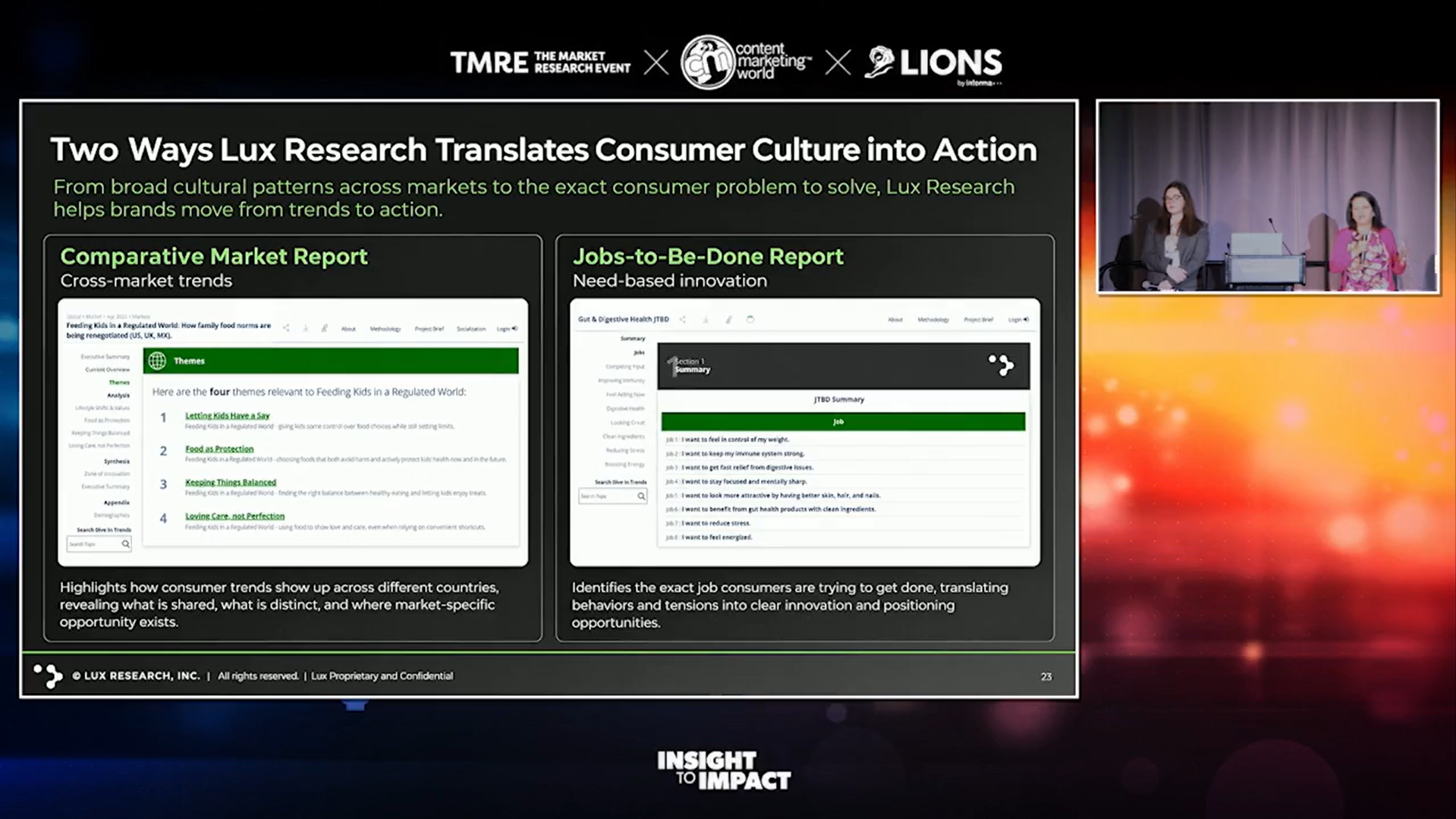
Shilpa Khanna: I forced Cheryl to put this slide in because I want to reinforce that what we talked about today was really simple, but Lux gives you real depth of information, so you can go deep and dig in different directions. I wanted to illustrate that, and then talk a little about the way we use Lux at Clorox.
We start with an area of interest and look at trends. What I really love about Lux trends is that you don’t just get the gist of the trend; you get the language consumers are using and the sentiment around that language. Most importantly, you get a maturity curve. The maturity curve tells you where you are. Are you too late to the game? Or are you really early, so you can grow it if you choose that as your strategy? Knowing where you stand with a trend helps answer a lot of questions I’ve heard today, like whether a trend is temporary or long-term. You can’t always prove that out, but it gives you a very strong starting point and helps inform the choices you make.
Once we pick a trend and have our hypotheses, we do tension exploration, workshopping and quantitative testing. Then we converge further and figure out which trend we’re going to work on, and for that we get jobs. The jobs really drive clarity on the specific aspect of an occasion that we’re going to solve for the consumer. Then we either ideate for different jobs, or go another direction, picking the job we have the strongest gut feel or sizing for and going strong on developing solutions for that single job.
The one thing I love with Lux, and I do this with all the partners I work with: I don’t work with vendors; I only work with partners. It’s not just the technology you’re bringing me. Anybody could give me technology. I really believe in the shared human mind and the power that comes from having a joint conversation. Aaron, who’s here with us from Clorox, and I were in an ideation session where Lux came in. They gave us some hypotheses, and we had a great time springboarding off each other to get to some really strong ideas. With a combination of human and AI, we got to over 350 ideas, but the starting point was that human interaction in the workshop. So my favorite thing is to bring in Cheryl and her team of anthropologists to have those deep conversations with us that point us in the right direction.
OK, so I guess we’ll stop and take questions. That’s what we wanted to share with you today, but there’s lots of fun stuff you can do. We’ve been using Lux for many years across a lot of different categories, all the way from the toilet to the food on your table. True story.
Cheryl (Lux Research) 26:04
I think we have just a few minutes left. If anyone has any questions for us, we’d be more than happy to take a few. But as we said at the start, we also know this is the time of day when it starts to get hard, and cocktail hour is coming up.
Shilpa Khanna: Cool. So we’ll wrap up, and as promised, in 30 seconds I’ll give you my takeaways. [Brief inaudible exchange.] OK, you can ask us later.
One: please, please start with diverging and strong hypotheses. Walk into everything with a hypothesis. Social listening makes that possible for us, so definitely do that.
Two: go back and forth between exploring and quantifying, because that will set you in the right direction toward scalable things to work on.
Three: always, always keep tensions front and center, all the way from early white space articulation through launch. Even when I’m three months away from launch, I go back, pull up that slide and ask, “After all the changes we made, does the product we’re launching still meet that tension?” That is your compass, so keep it at the center.