Key takeaways
- The Lux Tech Hubs are Lux Research’s most complete and quantifiable view of innovation in a novel technology.
- The Lux Tech Hubs provide a quantifiable view of innovation momentum, scalability, and the ecosystem developing solutions.
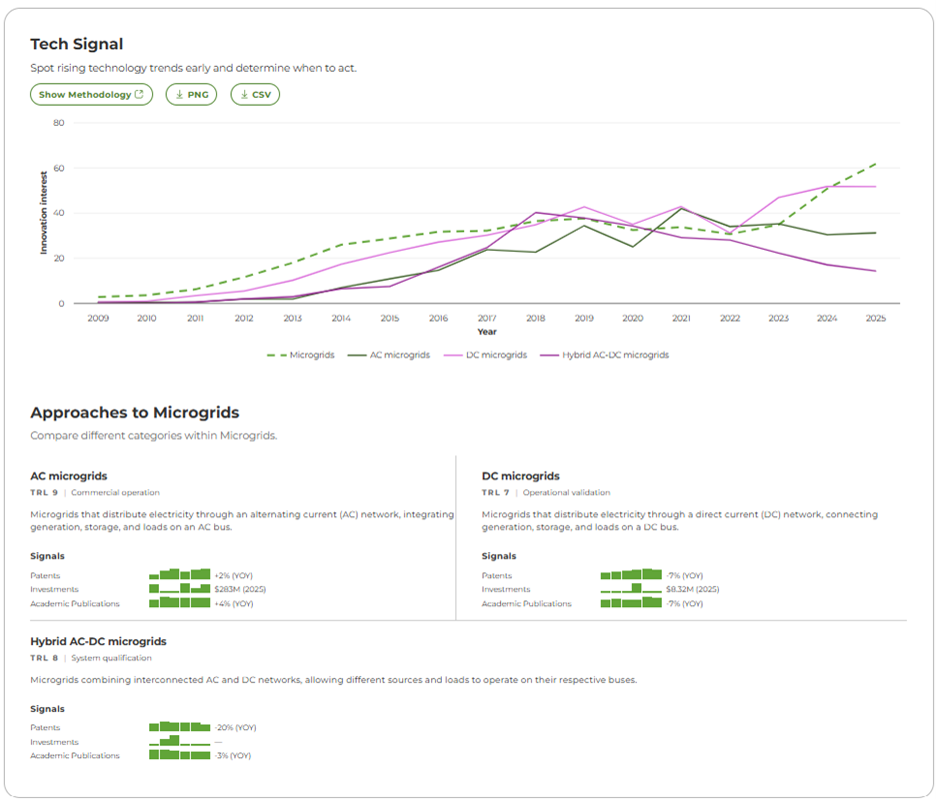
- The Lux Tech Signal quantifies innovation momentum and is derived from patent, publication, and investment data.
- The Lux Market Signal quantifies how significant the barriers to market scale are and identifies the challenges that stand between technical de-risking and adoption at scale.
The search for the next investment
Innovation teams are being asked for a return on innovation in one of the most uncertain environments in decades. Spotting an emerging technology is no longer enough; teams have to pick the ones that will scale. This guide explains what the Lux Tech Hubs are, how they measure momentum and scalability, and how Lux helps you act with confidence.
Why is choosing the right technology harder now?
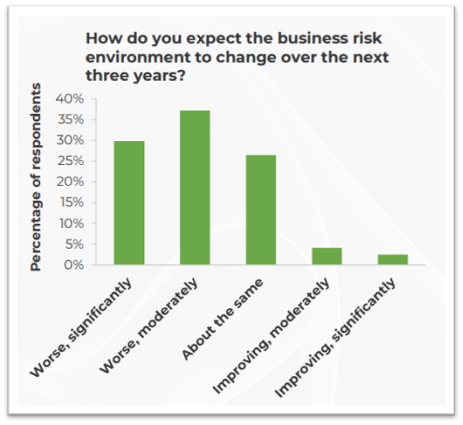
Rising volatility and uncertainty are pushing companies to be more risk averse, and innovators expect it to get worse. In the 2026 Lux Innovation Survey of 160 senior innovation professionals, 84% said current conditions negatively affect their innovation work. Two-thirds expect the business risk environment to worsen over the next three years, while just 7% expect improvement.
Why do innovation teams need the Lux Tech Hubs?
Promising technologies often fail not because they don’t work, but because they never scale. Many get stuck in the “valley of death,” where solutions have been technically de-risked but fail to make a meaningful commercial impact or connect with customers.
The innovation environment can make this worse. Excitement about the next big thing – specifically AI – can funnel outsized investment into earlier and less impactful decisions, while risk aversion can push money into scaling existing, proven technologies. This is the valley of death. Innovation teams need a way to see which emerging technologies are gaining relevance and crucially understand the barriers to adoption at scale.
What is a Lux Tech Hub?
A Lux Tech Hub is an easy-to-digest synopsis of an emerging technology, backed by proprietary research. The Lux Innovation Radar flags technologies to watch before they enter a hype cycle, and the Tech Hub explains why each one is there, and, crucially, its likelihood of escaping the valley of death.
Each Tech Hub helps you understand four things:
- Innovation scalability: Understand how challenging it will be to scale a technology relative to other technologies, and which factors need to be addressed.
- Innovation momentum: Track momentum measured by the Lux Tech Signal, based on patent, paper publication, and investment data.
- Current status and barriers: Identify the technology and market challenges most developers are encountering.
- Key players: Identify which companies are leading the pack and which are promising partners to work with.
The Tech Signal and its underlying data, including patents, papers, and investments, can be broken down by category, so you can compare competing approaches within the same technology.
The result is a structured way to get up to speed on a new space. Teams get quick access to the underlying innovation data, can self-serve to stay current with the latest Lux Take, and can follow links to deeper Lux research when they need more context.
How does the Lux Market Signal measure scalability?
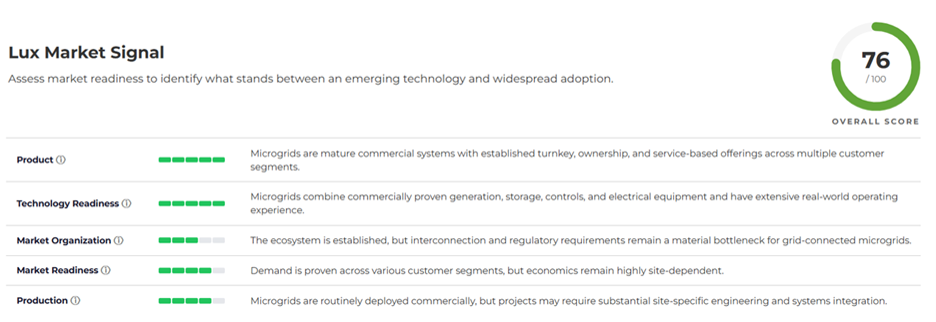
The Lux Market Signal is a 0-100 score that reflects how ready a technology is to scale by identifying the barriers that could limit its growth. It complements the Tech Signal, which tracks innovation interest.
“Novel technologies can’t succeed on technical merit alone,” says Lux Research’s Christopher Robinson. Lux has spent years analyzing which technologies and companies are likely to remain stuck in the valley of death.
Analysts score five factors from 1 to 5 and explain each score:
- Product definition: Measures how clearly the product, its value proposition, and its commercial offering, including its business model and pricing, are defined.
- Technology readiness: Assesses how technically mature the landscape of innovators building new solutions is.
- Market organization: Evaluates to what extent the regulatory frameworks, supply chains, infrastructure, and broader market ecosystem are established enough to support commercial scaling.
- Market readiness: Measures the extent to which customer demand is established, including evidence of willingness to purchase and the size of the potential market.
- Production: Assesses the ability to reliably manufacture, deploy, and operate the technology at commercial scale with consistent quality and repeatable processes.
Our analysis uses a structured rubric with specific questions to inform scoring on each factor. We then combine these scores into a single score ranging from 0 to 100 using an algorithm that penalizes weakness in any one area. This reflects the fact that a single low score can be enough to prevent scaling. The approach also rewards technologies that score well across all categories rather than standing out in one or two.
How does Lux help your team make confident decisions?
Innovation teams don’t lack information; they lack a trusted way to separate signal from noise. That’s the role of the Lux Take, Lux’s proprietary evaluation of a technology’s or startup’s prospects for success. Here, our analysts distinguish between hype and real opportunity in the technologies and markets they cover.
In addition to these sophisticated tools, clients get direct access to experts with advanced degrees in fields from chemistry to engineering, not just reports or algorithms. Lux AI, Lux’s AI research assistant, answers questions using only vetted primary research.
What we can learn from the Lux innovator assessment is much deeper than other sites or databases. The depth of the analysis is what we value.
– Nobuyoshi Takiguchi, vice president of strategy and innovation, Kurita Water
Frequently asked questions
What is a Lux Tech Hub?
A Lux Tech Hub is Lux Research’s most complete view of innovation in an emerging technology. It includes the analyst’s Lux Take, innovation interest through the Lux Tech Signal, maturity and scalability, current barriers, category data, and leading players, with access to the underlying patent, paper, and funding data. All the data and insights you need to decide whether a technology is worth a deeper dive.
How is the Lux Market Signal score calculated?
Lux Research analysts score a technology from 1 to 5 on product definition, technology readiness, market organization, market readiness, and production, explaining each score. A proprietary algorithm developed by Lux then combines these scores into a 0-100 Market Signal. This is designed to ensure a single weak factor pulls the score down instead of being hidden by stronger ones.
What’s the difference between the Lux Tech Signal and the Market Signal?
The Lux Tech Signal measures innovation interest in a technology using signals such as patents, papers, and investments. The Lux Market Signal measures how ready that technology is to scale commercially. Read together in a Lux Tech Hub, they show whether momentum is likely to turn into adoption or stall in the valley of death.
Find the technologies rising next
Find out which technologies Lux Research sees gaining momentum, and the innovation signals and strategic trends executives should weigh as they plan their next moves in Rising Technologies Shaping Innovation in 2026.