
Key takeaways
- Innovation teams are being asked to scout more technologies with fewer resources, tighter budgets, and shorter timelines.
- Digital tech scouting has expanded access to startups but made it harder to identify credible innovation providers.
- Comprehensive ecosystem mapping is essential to understand technology landscapes and avoid blind spots.
- Lux Lists help innovation teams build a complete view of innovation ecosystems, including startups, incumbents, and emerging competitors.
- Lux Innovator Assessments provide a structured framework for evaluating startup quality, commercial potential, and long-term viability.
Innovation teams are being asked to do more with less
Innovation leaders face a difficult reality in 2026.
Across industries, organizations are dealing with budget constraints, profitability pressures, head count reductions, changing government incentives, and a more cautious funding environment. Yet despite these challenges, innovation teams are still expected to identify new growth opportunities and emerging technologies faster than ever.
The result is a paradox. Teams have fewer resources available for technology scouting but are expected to cover more technology areas, evaluate more startups, and make decisions with greater confidence.
Finding the right innovation providers has never been more important or more difficult.
Digitalization makes innovators easier to access, but harder to prioritize
Technology scouting has changed dramatically over the past several years.
Historically, many innovation partnerships began at conferences, industry events, and in-person meetings. Today, much of that activity happens digitally. Startup pitches, technical evaluations, and discovery sessions are increasingly conducted over video calls and through online research.
This shift has made innovation ecosystems more accessible. Teams can evaluate startups from around the world without leaving their offices.
However, digital access has created a new challenge: an overwhelming amount of information.
Innovation teams no longer struggle to find startups. They struggle to determine which startups are credible and which deserve further attention.
Three challenges every innovation team now faces
1. Covering more technology areas with limited resources
Innovation teams are often responsible for monitoring multiple technology sectors simultaneously.
Whether exploring AI, energy transition, advanced materials, biotechnology, or manufacturing technologies, teams must stay informed across an expanding range of innovation domains despite having limited bandwidth.
2. Building confidence in technology landscapes
Leadership teams increasingly demand evidence that innovation groups have conducted thorough due diligence.
Missing a critical startup, competitor, or emerging technology can undermine strategic decisions and create uncertainty around investment recommendations.
3. Identifying winners earlier
As competition for breakthrough technologies increases, organizations must engage promising innovators earlier in their development cycles.
The challenge is determining which early stage companies are likely to become successful commercial partners and which may never achieve scale.
Why comprehensive landscape mapping is the difference maker
Many organizations begin scouting by looking at individual startups.
A better approach is to first understand the broader innovation ecosystem.
Before assessing any individual provider, innovation teams should understand:
- Which startups are active in the space
- Which incumbents are investing in the technology
- Where patent activity is increasing
- Which research centers are advancing the field
- How funding patterns are evolving
- What partnership networks already exist
Without this broader perspective, it is easy to miss promising innovators or overestimate the uniqueness of a particular company.
How Lux Lists help teams scout more efficiently
One of the most effective ways to build a comprehensive view of a technology landscape is through structured ecosystem mapping.
Lux Lists were developed specifically to address this challenge.
Each Lux List provides a curated overview of a technology ecosystem, helping innovation teams understand the key players operating within a specific market or technology domain. Rather than focusing exclusively on startups, Lux Lists include established companies, emerging innovators, and competitive players across the entire landscape.
The methodology combines AI-driven screening of more than 4 million companies and data sources with analyst review, patent analysis, publication tracking, investor activity, and expert curation. This approach helps ensure innovation teams are seeing the full picture rather than a limited subset of visible startups.
This type of landscape intelligence can dramatically reduce research time while improving confidence in coverage.

Finding providers is only half the challenge
After identifying potential innovation partners, organizations must determine which providers are worth pursuing.
This is where many technology scouting efforts break down.
A startup may have a compelling story, impressive technical claims, or strong marketing materials, but none of those necessarily indicates long-term success.
Innovation teams need a repeatable process for evaluating companies objectively.
How to assess innovation providers
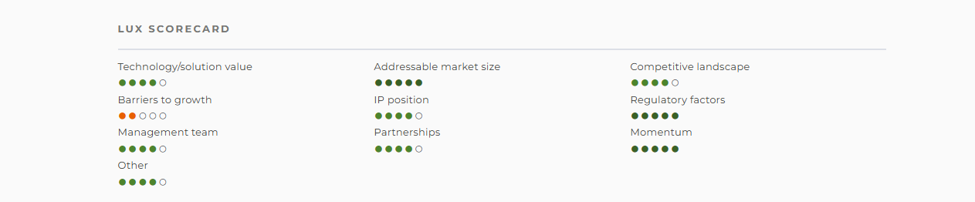
Effective innovation assessments should evaluate companies across multiple dimensions, including:
1. Technology and solution value
Does the technology provide a meaningful advantage over existing alternatives? Teams should assess technical differentiation, scalability, performance, and implementation requirements.
2. Addressable market
A strong technology must be supported by a sufficiently large market opportunity. Understanding customer demand, adoption barriers, and market growth is critical.
3. Competitive landscape
Innovation leaders should evaluate how crowded a market is and whether a company possesses a sustainable competitive advantage.
4. Barriers to growth
Innovation teams should assess potential barriers like manufacturing complexity, supply chain constraints, capital intensity, customer adoption hurdles, regulatory requirements, and dependence on key partnerships
5. IP position
Patents, proprietary expertise, and technical know-how often determine whether a company can maintain differentiation over time.
6. Regulatory factors
Industries like healthcare, agriculture, chemicals, and energy require careful consideration of regulatory risks and approval pathways.
7. Management team
Founders and leadership teams play a significant role in commercialization success. Execution often matters as much as innovation.
8. Partnerships
Strategic partnerships can provide validation that customers, investors, and industry participants believe in a company’s value proposition.
9. Momentum
Funding rounds, hiring activity, customer growth, and commercial milestones often reveal whether a company is successfully translating potential into progress.
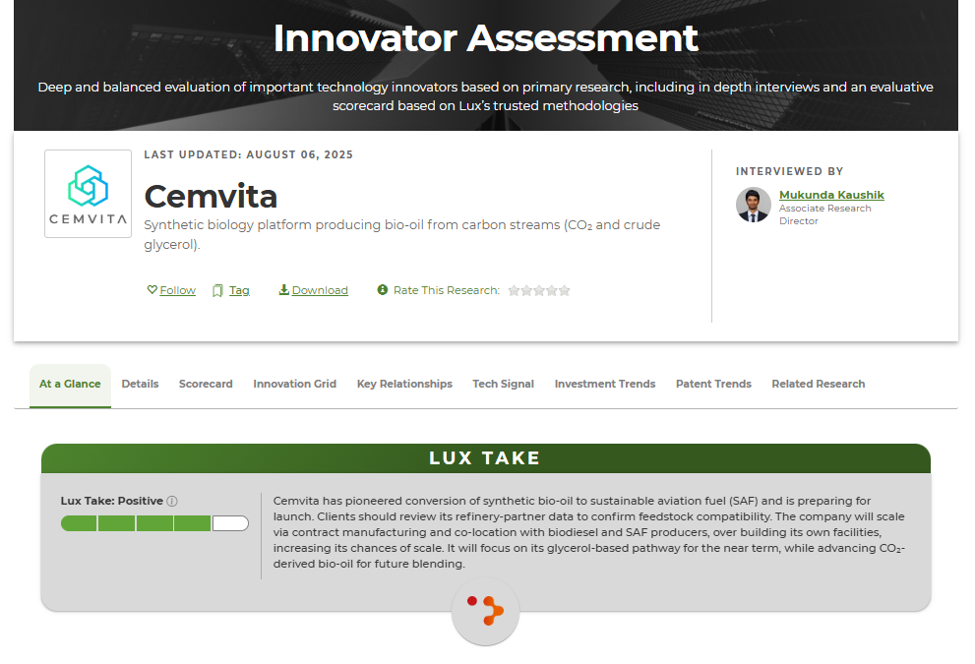
Each innovation provider in a Lux Innovator Assessment is graded on these criteria.
Bringing consistency to startup evaluation with Innovator Assessments
While many organizations evaluate startups, few do so consistently.
Lux Innovator Assessments were designed to create a structured, repeatable framework for assessing innovation providers. The methodology has been refined over more than 15 years and incorporates thousands of executive interviews, analyst assessments, and rigorous fact-checking.
Each company is evaluated against 10 core dimensions listed above. This standardized framework allows organizations to compare innovation providers objectively rather than relying on intuition or anecdotal impressions.
The result is a more defensible approach to partner selection and startup evaluation.
The importance of expert opinion in decision-making
Data alone are rarely enough to make innovation decisions.
Innovation leaders ultimately need guidance on what the information means and how it should influence decision-making.
This is why expert analysis remains a critical component of technology assessment.
The most valuable assessments do not simply summarize facts. They interpret those facts and provide clear recommendations regarding risks, opportunities, and strategic implications.
This combination of quantitative analysis and expert judgment helps organizations make decisions with greater confidence.
Building a more effective innovation scouting process
The most successful innovation teams follow a structured process:
- Map the technology landscape comprehensively.
- Identify the most relevant innovation providers.
- Apply a consistent assessment framework.
- Incorporate expert analysis and market context.
- Prioritize opportunities based on strategic fit and commercial potential.
As innovation teams continue to operate under tighter constraints, disciplined scouting and evaluation processes will become increasingly important.
Organizations that combine comprehensive landscape intelligence through tools like Lux Lists with rigorous startup evaluation methodologies like Innovator Assessments will be better positioned to identify emerging winners, avoid costly mistakes, and accelerate innovation outcomes.
In an environment where teams must do more with less, confidence in innovation decisions may be the most valuable resource of all.
Explore the technologies defining innovation in 2026
Finding the right innovation providers starts with understanding where technology is headed next. Which emerging technologies are gaining momentum? Which innovations are attracting investment, partnerships, and commercial adoption? And which trends are most likely to create competitive advantage in the years ahead?
Download Lux Research’s e-book “Rising Technologies Shaping Innovation in 2026” to explore the technologies and innovation ecosystems poised to have the greatest impact across industries. The report provides strategic insights into the emerging technologies, startups, and market shifts that innovation leaders should be monitoring today to make smarter investment, partnership, and growth decisions tomorrow.
Download the e-book and stay ahead of the technologies shaping the future of innovation.