Key takeaways
- Advanced plastic recycling technologies may be commercially mature, but weak market infrastructure and uncertain project economics continue to make first-of-a-kind (FOAK) projects high-risk investments.
- Recycled-content premiums are the most important driver of project returns, while policy design and mass-balance accounting determine how much value projects can capture.
- Reliable feedstock volume, quality, and composition have a greater impact on project economics than lower feedstock prices.
- Strategic benefits, including feedstock diversification, regulatory positioning, customer retention, and product differentiation, can strengthen marginal investment cases.
- Investors should evaluate advanced recycling projects at the enterprise level rather than relying solely on stand-alone project IRR.
LUX TAKE
Advanced plastic recycling technologies face ecosystem risks: Advanced plastic recycling technologies may be technically mature, but an immature ecosystem keeps most projects high-risk bets.
Advanced plastic recycling is reaching commercial scale
Advanced plastic recycling is becoming an important component of the circular plastics economy as regulatory pressure grows and demand for recycled content increases. Several technologies have reached commercial scale, with more than 1.5 Mtonne/y of installed capacity globally. However, technoeconomic projections often overstate project attractiveness. Many facilities continue to struggle with profitability and execution, and more than 100,000 tonne/y of installed pyrolysis capacity is scheduled to shut down in 2026.
Evaluating what makes advanced recycling projects investable
In a recent report, “Derisking Advanced Plastic Recycling Projects,” Lux set out to determine what makes FOAK advanced plastic recycling projects investable by quantifying the uncertainties that shape expected returns and project risk. The analysis considered five primary factors: technology readiness, market organization, market readiness, production, and product. Lux incorporated uncertainty across these factors into project-level internal rate of return (IRR) models to assess both expected returns and the variability around them. Scenario analysis then identified what must be true for a project to become investable, which assumptions have the greatest effect on project economics, and where derisking efforts can have the most impact.
Three findings stand out.
1. Product premiums are the largest economic lever — and policy determines whether they are achievable
The standalone business case for most advanced plastic recycling technologies is generally weak. High capital and operating costs mean that recycled outputs typically need to sell at a premium over virgin alternatives to generate attractive returns. Without these premiums, projects are at best investable only at high risk and at worst unprofitable. Recycled-content mandates are the most direct way to create demand for these premiums. However, policy design and accounting rules determine how much of the resulting value a project can capture.
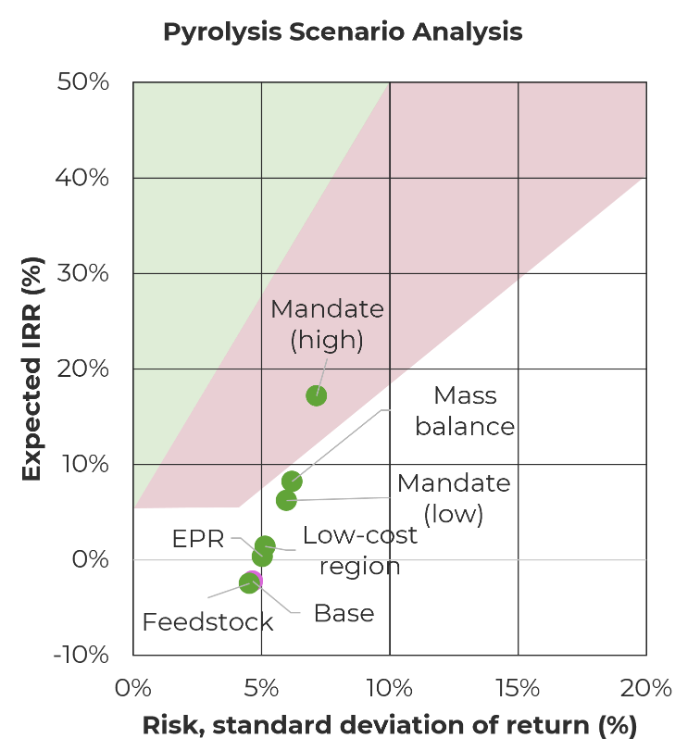
Plastic pyrolysis illustrates this tension. If pyrolysis oil is priced at parity with virgin naphtha, the modeled plant operates at a loss. Recycled-content premiums can improve returns enough to make the project potentially investable, although it remains risky. For example, the region with the strongest recycled-content mandates is also taking the strictest approach to mass-balance accounting. The EU is moving toward a fuel-exempt mass-balance method, which, under Lux’s assumptions, roughly halves the premium that pyrolysis oil can command and pushes expected project IRR below the minimum investor threshold. However, plastic pyrolysis may still be viable within an integrated business model in which the investor can capture more of the value created across the full plastic-to-plastic recycling chain.
2. Feedstock availability matters more than feedstock cost
FOAK advanced plastic recycling projects are capex dominant. As a result, Lux’s analysis found that even a 25% reduction in feedstock cost had little effect on overall project IRR. Plant utilization is more important. If a facility cannot secure enough feedstock to operate near nameplate capacity, its projected returns will not hold. Investors should therefore focus less on waiting for feedstock prices to decline and more on securing reliable supply through collection, sorting, preprocessing, and long-term contracting. The analysis also suggests that a moderate increase in feedstock price would not materially change the investment case. Operators may therefore be justified in paying more for feedstock when doing so guarantees consistent volume, quality, and composition.
3. Strategic benefits can strengthen an otherwise marginal investment case
Advanced plastic recycling projects remain difficult to justify on financial returns alone. However, they can provide strategic benefits that are not fully captured in project-level IRR calculations, including feedstock diversification, regulatory positioning, customer retention, and product differentiation. For example, the ongoing armed conflict in the Middle East and the closure of the Strait of Hormuz have led to petrochemical feedstock shortages in regions such as Thailand. The shortages have forced several chemicals companies to cut production, with some, like Rayong Olefins, shutting down their naphtha crackers entirely. Pyrolysis oil would not have replaced naphtha at the volumes required to prevent these disruptions, but an established supply of circular feedstocks could have provided some additional operating flexibility and reduced dependence on a single feedstock source.
For European chemicals companies, advanced recycling can also support differentiation from low-cost virgin plastics imported from Asia. Traceable recycled content can help producers compete on regulatory compliance and customer sustainability requirements rather than price alone. These benefits are difficult to assign a precise financial value, but they can materially affect the investment case at the enterprise level. Investors should therefore assess advanced recycling projects not only as standalone assets but also according to their contribution to feedstock flexibility, regulatory compliance, customer relationships, and portfolio differentiation.
Explore the advanced recycling outlook for 2026
To learn more about the investment case for advanced plastic recycling technologies, see Derisking Advanced Plastic Recycling Projects.
Advanced recycling markets are entering a critical period as companies confront uncertain economics, evolving policy requirements, and pressure to scale circular plastics solutions. Explore the technologies, market developments, and strategic considerations shaping the sector in Lux Research’s Advanced Recycling in 2026.