
Lux Research’s mid-year technology analysis identifies six areas gaining innovation momentum in 2026, from thermal energy storage and grid orchestration to critical minerals and health wearables. The findings show why innovation leaders must look beyond visibility and evaluate the source, maturity, and commercial relevance of each technology signal.
Key takeaways
- Thermal energy storage and DERMS are gaining attention as companies respond to energy costs, grid congestion, and resilience requirements.
- Novel electronic materials are moving from materials discovery toward device integration and manufacturability.
- Critical minerals innovation is expanding beyond extraction to refining, recycling, and supply chain resilience.
- Food additive investment is concentrating on scalable, regulation-ready ingredients that deliver functional performance.
- Consumer health wearables are evolving from monitoring devices into closed-loop platforms that connect diagnostics and treatment.
- Technology momentum should inform innovation strategy, but market readiness and ecosystem maturity determine when companies should act.
Innovation activity is changing direction in 2026
Over the past several years, many organizations built technology portfolios around decarbonization, digitalization, and emerging scientific breakthroughs. Those priorities have not disappeared, but economic constraints, energy security, AI infrastructure growth, regulation, and supply chain disruption are changing where companies focus their resources.
Lux Research’s Mid-Year Tech Check 2026 identified six technologies showing notable innovation momentum across oil and gas, utilities, chemicals, industrials, agrifood, and medical devices.
The findings suggest that resilience, affordability, performance, and near-term deployability are becoming more influential than novelty alone.
How does Lux Research identify rising technologies?
The Lux Tech Signal is a normalized indicator that measures innovation activity across multiple data sources, including:
- Patents
- Academic publications
- Venture capital
- Early-stage government funding
- Lux Research proprietary data
The signal evaluates both overall innovation interest and year-over-year change.
Innovation interest indicates the scale of activity surrounding a technology. Year-over-year change helps reveal whether that activity is accelerating or declining. Together, the measurements help innovation leaders distinguish established areas of technical activity from technologies experiencing a new surge in momentum.
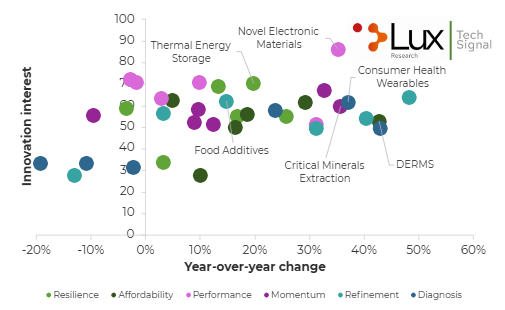
6 emerging technology trends gaining momentum in 2026
1. Thermal energy storage supports industrial resilience
Thermal energy storage is gaining momentum as industrial companies seek reliable and affordable sources of heat.
The next innovation wave is shifting toward high-temperature systems that can support industrial processes. These technologies allow facilities to purchase electricity when it is less expensive, store that energy as heat, and use it later.
This flexibility can reduce exposure to fuel price volatility and support industrial electrification. However, deploying thermal storage is more complex than installing a standard renewable energy and battery system. Each project must be designed around process temperatures, steam requirements, site conditions, and operational needs.
Companies should consider lower-temperature applications available today while monitoring high-temperature systems, government incentives, and changing energy prices. Competitive advantage will increasingly depend on materials science, engineering, and systems integration.
2. DERMS is becoming a strategic grid platform
Distributed energy resource management systems, or DERMS, help utilities coordinate assets such as batteries, electric vehicles, solar systems, microgrids, and flexible loads.
These platforms are becoming more important as grid congestion increases and electricity demand grows. Instead of relying only on new generation and transmission projects, utilities can use DERMS to make better use of existing infrastructure.
The market is also changing. Early platforms focused primarily on asset visibility and control. Newer systems are becoming orchestration layers that coordinate resources, manage demand, support market participation, and provide flexibility services.
Utilities should prioritize interoperable platforms capable of managing multiple asset types. Artificial intelligence can improve forecasting and optimization, but long-term platform performance will depend on reliable data and strong system integration.
3. Electronic materials must deliver manufacturable performance
Novel electronic materials have one of the highest innovation-interest scores in the analysis.
However, the definition of performance is becoming more demanding. Discovering a material with improved electrical, optical, mechanical, or quantum properties is no longer enough. Companies must also demonstrate that the material can be integrated into manufacturable devices.
Innovation is moving toward:
- Semiconductor compatibility
- Process integration
- Repeatable production
- Device-level performance
- Codevelopment with manufacturers
Chemicals and materials companies should look for opportunities where material properties can be connected to a specific device or application. Near-term value is more likely to come from application-ready integration than from broad investments in material novelty.
4. Critical minerals require an integrated supply chain strategy
Critical minerals remain essential to batteries, electronics, defense, energy systems, and advanced manufacturing.
The challenge is no longer limited to finding new mineral resources. Companies and governments must build supply chains that connect extraction with processing, refining, recycling, and end markets.
Direct lithium extraction and hydrometallurgical technologies offer strong near-term potential. These approaches may improve recovery, reduce resource use, and create opportunities to recover minerals from brines or existing operations.
Biomining remains promising but generally represents a longer-term opportunity.
Industrial companies should evaluate the entire value chain. Investment in extraction without sufficient refining or recycling capacity may simply shift the supply chain bottleneck rather than resolve it.
5. Food additive innovation is moving toward execution
Innovation in food colors, flavors, preservatives, and texturizers is shifting from scientific exploration toward commercial implementation.
Investment is concentrating on ingredients that can meet several requirements at once:
- Functional performance
- Product safety
- Regulatory acceptance
- Scalability
- Cost competitiveness
- Consumer expectations
Texturizers and preservatives appear particularly well positioned because they address essential product functions. Colors and flavors may face greater challenges related to scale and cost.
Agrifood companies should prioritize regulation-ready platforms with a clear path to commercial production. The strongest technologies will not simply offer a novel ingredient. They will solve a functional problem while fitting within manufacturing, pricing, and regulatory constraints.
6. Wearables are moving from monitoring to intervention
Consumer health wearables are evolving beyond standalone monitoring.
The emerging model is a closed-loop platform that can detect a physiological signal, analyze the information, recommend or deliver a response, and continue monitoring the outcome.
These systems may combine:
- Multimodal sensing
- AI-enabled analytics
- Clinical diagnostics
- Therapeutic intervention
The opportunity is significant, but medical device development remains challenging. Clinical validation, regulatory requirements, and long commercialization timelines can limit investment readiness.
Companies should prioritize platforms with strong clinical evidence and clear integration pathways. Technologies with unresolved accuracy or validation challenges should remain within exploratory portfolios.
How should innovation leaders act on technology momentum?
Technology signals should guide investigation, not automatically trigger investment.
Innovation leaders should first identify where momentum is coming from. A technology driven primarily by academic publications requires a different engagement strategy than one supported by patents, startup funding, corporate activity, and commercial projects.
Leaders should also compare technology momentum with market readiness. Product definitions, infrastructure, customers, manufacturing capacity, regulations, and supply chains must develop alongside the technology.
Finally, organizations should protect their ability to experiment. Selective engagement with earlier-stage technologies helps companies learn before the commercial opportunity becomes obvious. Lux Research recommends isolating the source of momentum, defending the ability to “dabble,” and monitoring technology and market signals in parallel.
Frequently asked questions
What technologies are gaining momentum in 2026?
Thermal energy storage, DERMS, novel electronic materials, critical minerals extraction, food additives, and consumer health wearables are showing notable innovation activity.
What is innovation interest?
Innovation interest measures the scale and trajectory of activity surrounding a technology using data such as patents, publications, funding, and proprietary research.
Does high innovation interest mean a technology is ready to invest in?
No. High interest may reflect scientific research, funding, corporate R&D, or commercialization. Companies must also evaluate technical maturity and market readiness.
Which technologies offer the clearest near-term opportunities?
Opportunities highlighted in the analysis include lower-temperature thermal storage, interoperable DERMS platforms, application-ready electronic materials, direct lithium extraction, hydrometallurgy, and scalable food additives.
How should companies use technology signals?
Technology signals can help companies decide where to monitor, conduct research, establish partnerships, run pilots, or make investments. The appropriate action depends on the source of momentum and the organization’s strategy.
Explore the technologies shaping innovation in 2026
See the complete analysis, supporting data, technology comparisons, and strategic recommendations in the Lux Research webinar.
Watch the Mid-Year Tech Check 2026 webinar to learn which technologies are rising, which are falling, and how your organization should respond.