Every decade has had its defining technology: wind and solar in the 2000s, EVs in the 2010s. The 2020s looked like the decade for heavy industry, but four years from 2030, many of the technologies bet on for it, such as direct air capture, water electrolysis, low-carbon methanol, SAF and low-carbon steel, are at an inflection point. In our webinar From Signals to Strategy: What’s the Next Wave of Energy and Chemical Innovation?, Lux Director of Energy Mukunda Kaushik and Analyst Matilde della Fontana used the Lux Tech Signal to explore how Europe can navigate this era of uncertainty.
Key takeaways
- External risks and threats should be part of decision-making. The energy system is experiencing shocks at an increasing frequency.
- Uncertainty breeds change. Watch for current uncertainty to translate into systemic changes that factor in hydrocarbon supply risk.
- Be selective about rebound and collapse. The EU cannot do it all, especially in increased competition with the U.S. and China.
EU policy is adapting to uncertainty
The EU’s early-2020s policies, such as the European Green Deal and Fit for 55, were measured by net greenhouse gas reductions. Newer policies, including the Critical Raw Materials Act, the Net Zero Industry Act and the Industrial Accelerator Act, add sovereignty and industry to the picture. Decarbonization is still a focus, but it’s no longer the only driver.
Forecasting innovation with the Lux Tech Signal
The Lux Tech Signal is a unitless metric that tracks how innovation ecosystems develop, combining patents, academic publications, venture funding, early-stage government funding and Lux proprietary analysis. Zero is the median across all the technologies Lux tracks, so a negative value doesn’t mean a technology is failing; what matters is the direction of the curve.
The new Tech Signal goes a step further, from tracking historical activity to forecasting it. A predictive model based on Kalman filtering sets an expectation from historical innovation patterns, then updates it as new data comes in, producing a central forecast surrounded by a range of possible outcomes. Wind and solar show why this matters: their signals rose around 2009–2010 and flattened around 2012, an early warning that they were ready to scale.
After analyzing key EU guiding documents, including the Draghi Report, the Net Zero Industry Act and the Competitiveness Compass, Lux found three scenarios for Europe’s future.
Scenario 1: A deglobalized transition
Decisions and technology adoption are increasingly driven by geopolitics and changing trade structures. Heavier industries such as coke and petroleum, chemicals and metals have reduced their import intensity. In this scenario, resource independence, industrial sovereignty, paying the security premium and creating regional demand all matter.
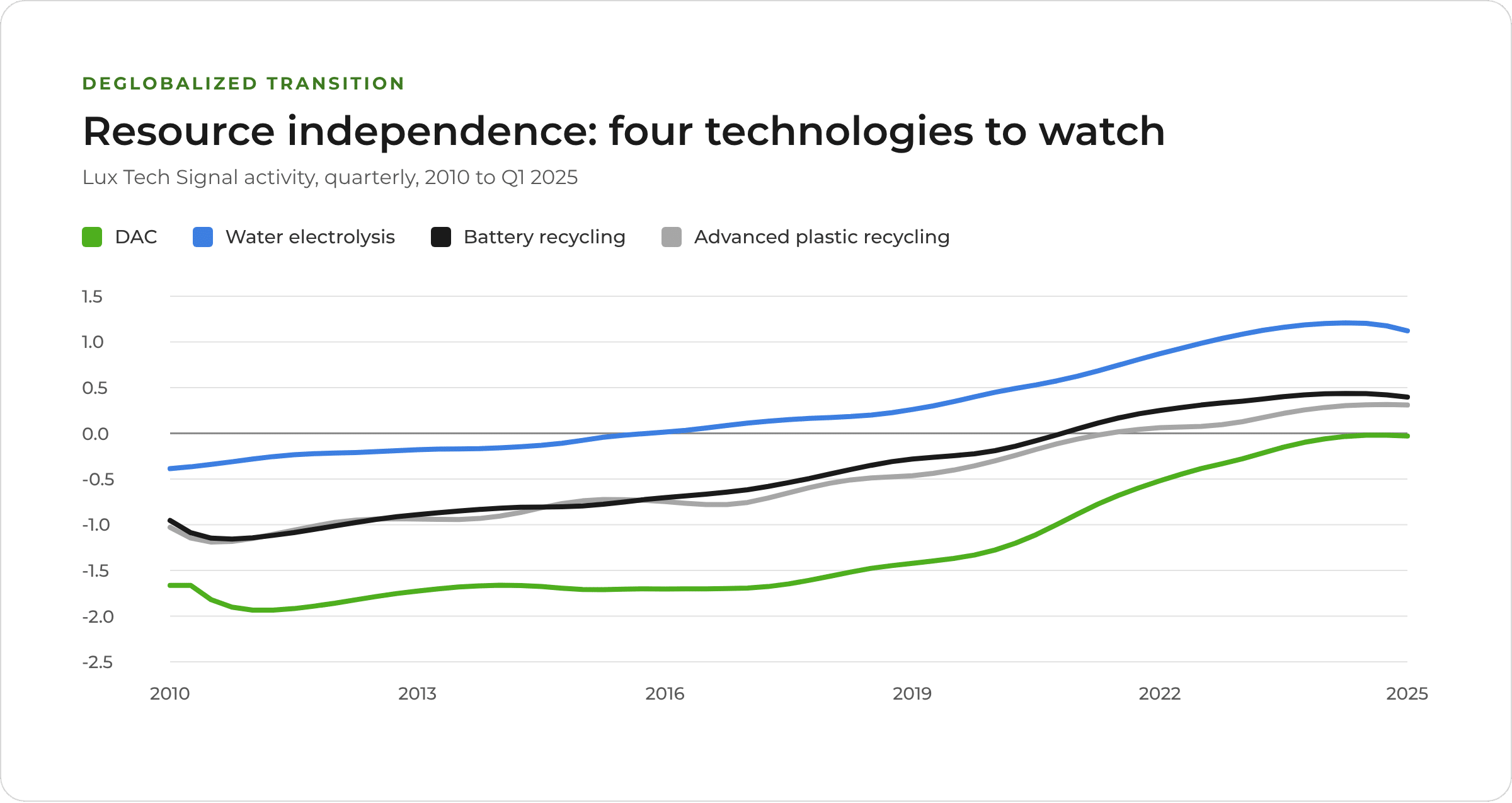
For resource independence, direct air capture (DAC) and water electrolysis can unlock domestic production of strategic molecules from renewable hydrogen and captured carbon. Both have increased innovation activity over the past decade, though DAC’s activity is starting to plateau. Battery recycling and advanced plastic recycling can turn Europe’s existing material stocks into a secondary resource base for critical minerals and chemical feedstocks.
Industrial sovereignty doesn’t mean Europe needs to own every technology end to end. It means controlling critical capabilities that would be difficult or dangerous to lose. In quantum, for example, Europe can capture value from enabling technologies like photonics, specialized chips and cryogenics before computing reaches commercial maturity; Pasqal launched a €50 million pilot line initiative to industrialize components such as integrated lasers and atom chips.
Advanced plastic recycling shows the gap between strategic need and innovation momentum. After years of growth, its activity is plateauing, and the central forecast suggests a decline through 2027, though the uncertainty range still leaves room for a rebound.
LUX TAKE
Europe’s push for resource independence could revive innovation, provided domestic plastic waste can be turned into cost-competitive recycled feedstocks.
Scenario 2: An electricity-constrained transition
Access to electricity is constrained, raising the costs and timelines to electrify processes: 120 GW of planned EU renewable capacity is at risk due to grid shortfalls. As Mukunda put it, the last decade was about how to make and store electrons; the next will be about getting more out of the existing grid.
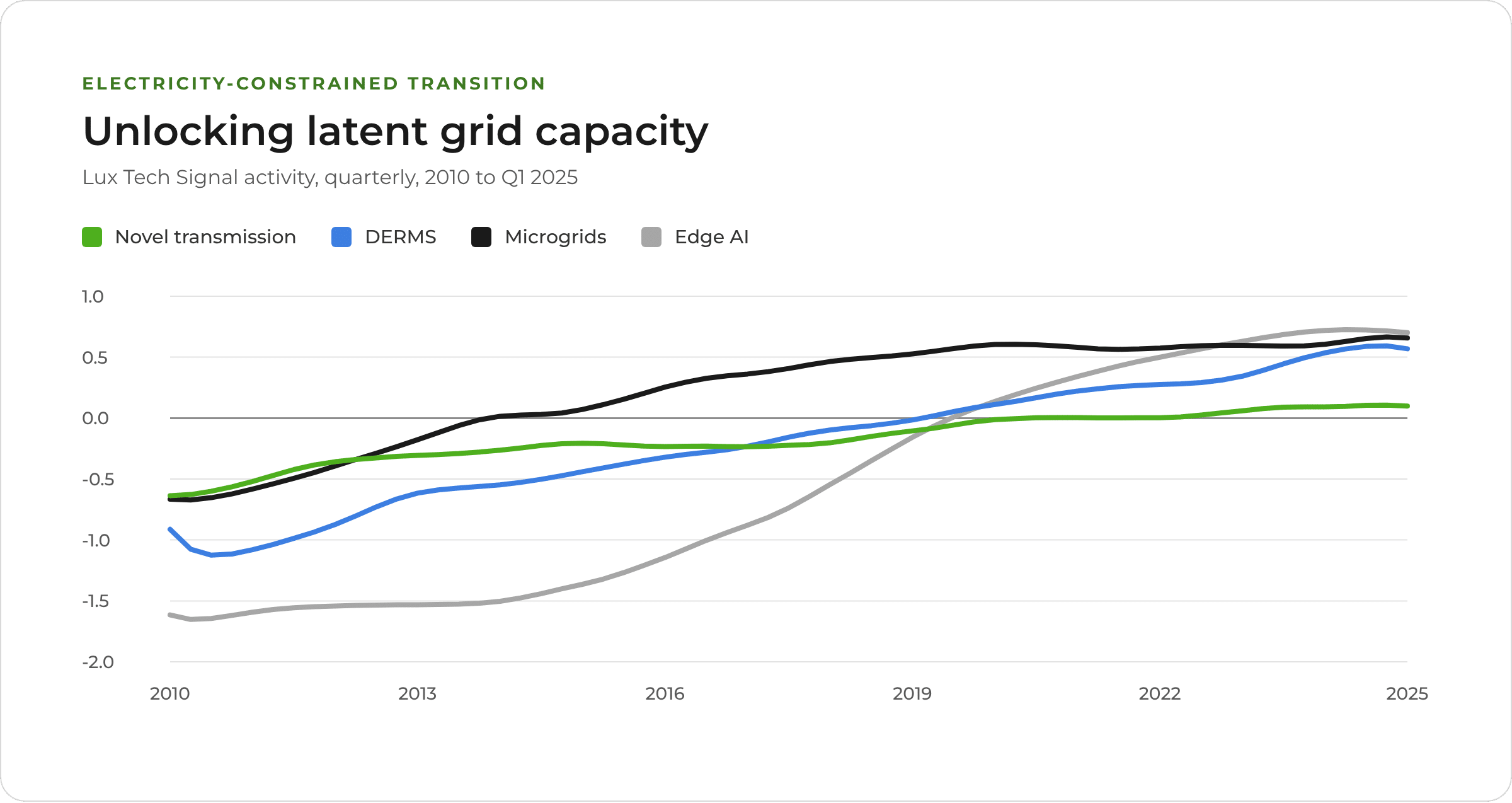
Two ways to do more with less stand out. Unlocking latent grid capacity through DERMS, microgrids and edge AI lets new loads tap into the grid when there’s excess capacity, with data centers the biggest drivers. Novel transmission gets more out of existing rights of way. Dense power generation also matters: geothermal accounted for only about 0.5% of renewable electricity generated in the EU in 2024, but France and Germany have added it to their roadmaps, and pairing carbon capture with natural gas can keep existing thermal generation relevant.
LUX TAKE
Data centers will pioneer opportunities to manage large loads; residential batteries and EVs are the best assets for distributed flexibility.
Scenario 3: Redefining competitive advantage
Europe can’t compete with manufacturing powerhouses on cost and scale alone: by 2021, China accounted for 31% of global manufacturing value added, compared with 16% for the EU. Instead, Europe can derisk industrial scale-up, optimize resource intensity, build a next-generation portfolio and pursue lateral cross-industry strategies.
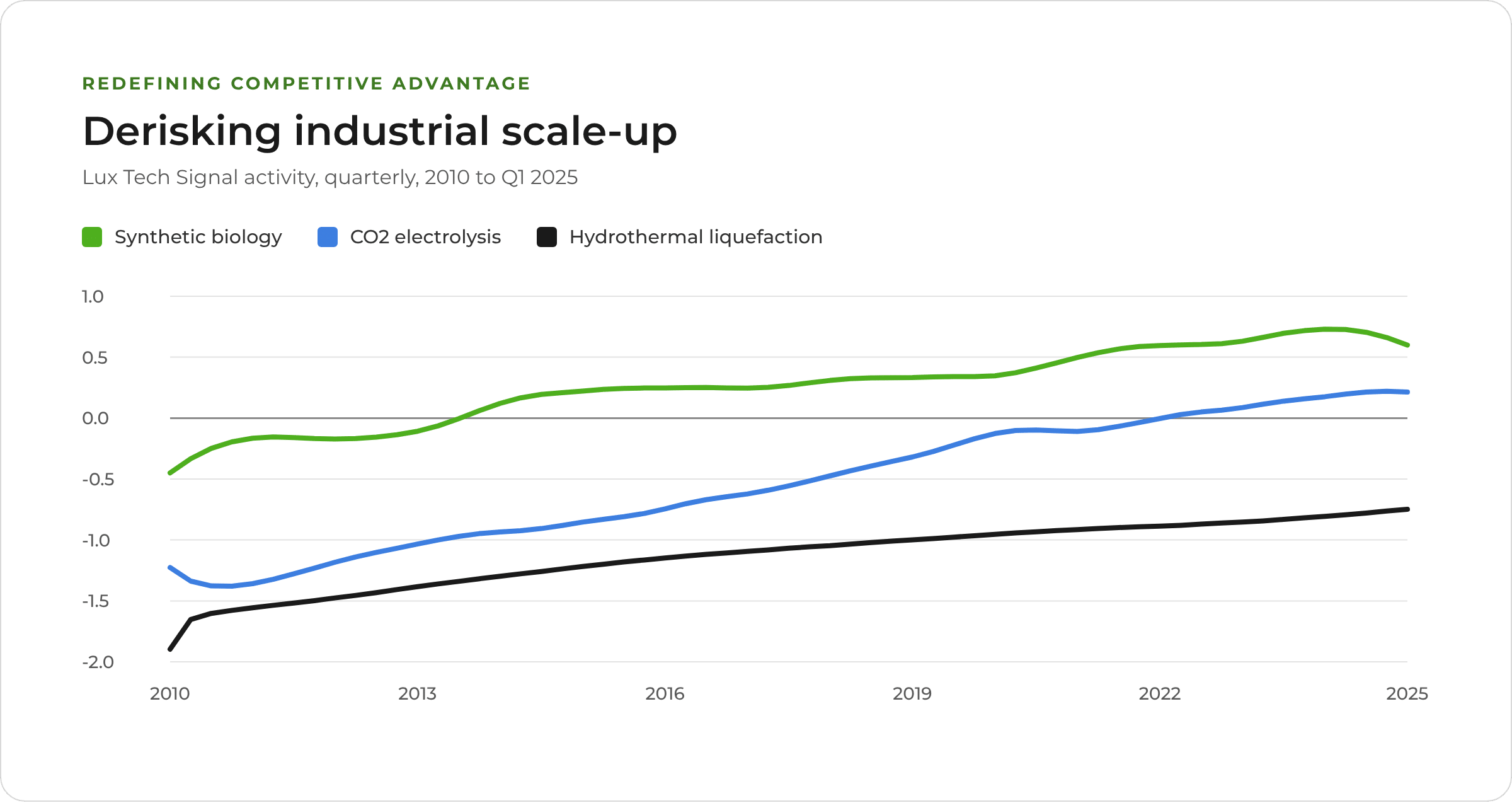
Synthetic biology, CO2 electrolysis and hydrothermal liquefaction can help Europe compete through process simplicity rather than plant size, and design processes around its available feedstocks. For the next-generation portfolio, chemical companies like BASF, Covestro and Evonik are shifting from commodities toward specialties. In emerging frontiers like deep sea mining, space solar and orbital data centers, Europe can build positions through critical enabling capabilities rather than waiting for markets to mature.
LUX TAKE
The EU should prioritize critical enabling technologies where it can capture IP, build industrial capabilities, and secure a position in future value chains.
All three scenarios are happening at once
In reality, companies aren’t choosing one scenario; they’re preparing for all three simultaneously. Because the Tech Signal is a technology signal, Lux also developed the Lux Market Signal to account for market conditions. It looks at five factors: product, technology readiness, market organization, market readiness and production. Methane pyrolysis, for example, has a well-defined product in low-carbon hydrogen, but its economics depend on selling solid carbon that isn’t yet produced consistently to the specifications big demand centers like batteries need.
Q&A
Do the declining forecasts mean innovation is slowing everywhere?
Q: Many of the Tech Signal forecasts show declining innovation over the next few years. Is this happening across the broader technology landscape, and how confident can we be in the forecasts?
A (Matilde della Fontana): We’re not suggesting innovation activity is declining across the board. These technologies were selected because they address Europe’s strategic challenges, and a technology’s strategic importance and its innovation activity don’t always move in the same direction. A decline can reflect a maturing ecosystem where the focus shifts from early-stage research toward efficiency, integration or deployment. A declining signal isn’t a signal to abandon a technology, but a signal to investigate what is changing and why.
How do these scenarios apply outside Europe, and what do the U.S. midterms mean for climate tech?
Q: How do these scenarios and technologies translate to other regions, and what is the impact of the recent U.S. midterm election on the global technology innovation landscape?
A (Mukunda Kaushik): If Europe is going to have a deglobalized transition, other regions might too, and the same technologies apply. The midterms are likely a significant win for climate tech, but not quite enough, because the challenge has been policy flip-flopping. Companies can’t build a corporate strategy without certainty that a policy will hold for 10 to 15 years. That’s why our message to clients has been to hibernate technologies, not exit.
Watch the full webinar
Watch From Signals to Strategy: What’s the Next Wave of Energy and Chemical Innovation? on demand to see every Tech Signal forecast and the Lux Market Signal in action.