
Key Takeaways
- Innovation should accelerate during uncertainty — not slow down. Companies that pause innovation during volatile periods risk falling behind competitors.
- Not every risk can be quantified, but many can be forecasted. Innovation teams can anticipate supply chain, regulatory, and societal risks before they become business disruptions.
- Forecasting risk creates competitive advantage. Organizations that identify future bottlenecks, regulatory shifts, and consumer backlash early can turn uncertainty into opportunity.
- Innovation processes must evolve. Traditional product-launch models should incorporate resilience, optionality, and risk management alongside growth objectives.
Innovating for Uncertainty: How Innovation Leaders Can Turn Risk into Opportunity
Economic volatility, geopolitical instability, shifting regulations, and changing consumer expectations are reshaping how companies approach innovation. During Lux Research’s recent webinar, “Innovating for Uncertainty: How Innovation Teams Can Retool Their Approaches to Help Their Corporations Manage Volatility,” Anthony Schiavo, Senior Director and Principal Analyst, explained why uncertainty shouldn’t delay innovation — it should change how organizations innovate.
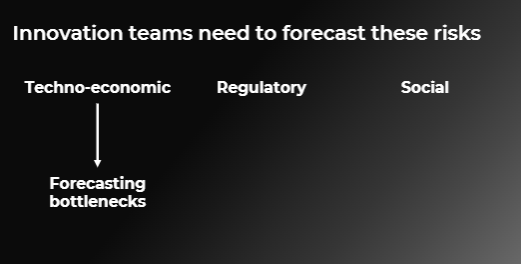
The session highlighted a new framework for forecasting risks beyond traditional financial and technology metrics. Rather than relying solely on quantitative models, organizations should assess three emerging risk categories:
- Techno-economic risks such as supply chain bottlenecks and critical material shortages
- Regulatory risks by monitoring technology maturity and innovation ecosystem activity
- Social risks including consumer sentiment, reputation, and public backlash
One example presented was Lux Research’s Raw Materials Criticality Framework, which helps companies evaluate both supply risk and material criticality when selecting technologies. Rather than avoiding uncertainty altogether, businesses can prioritize innovations that diversify sourcing, leverage waste streams, or reduce dependence on vulnerable supply chains.
Three Big Ideas from the Webinar
1. Forecast supply chain bottlenecks before they become crises
Critical materials, geopolitical concentration, and raw material availability should influence technology selection just as much as cost or performance.
2. Technology often drives regulation—not the other way around
As innovation ecosystems mature, supportive regulation frequently follows. Tracking technology maturity can provide an early signal for future policy changes, helping organizations invest ahead of the market.
3. Consumer backlash is becoming a strategic innovation risk
Topics like PFAS demonstrate how public opinion evolves across industries over time. Companies that monitor consumer consensus can identify emerging innovation opportunities before markets shift.
Webinar Q&A Highlights
Q: Does every new technology lead to favorable regulation?
A: No. Successful regulatory support typically emerges when a technology aligns with government priorities and has strong industry backing. Mature innovation ecosystems increase the likelihood of supportive policy.
Q: How can companies prepare when they don’t know exactly when an opportunity will emerge?
A: Organizations should build flexibility into their innovation strategy by partnering with startups, investing in modular technologies, and treating innovation investments like a portfolio of options rather than fixed bets.
Q: Should innovation investments be viewed as insurance or options?
A: The speakers concluded that individual innovation projects are best viewed as options. A diversified portfolio of innovation investments helps organizations manage uncertainty while preserving future growth opportunities.
Watch the Webinar On Demand
Want to learn how your organization can forecast uncertainty instead of reacting to it?
Watch the on-demand webinar, “Innovating for Uncertainty: How Innovation Teams Can Retool Their Approaches to Help Their Corporations Manage Volatility,” to explore practical frameworks for forecasting risk, evaluating emerging technologies, and building a more resilient innovation strategy.