Key takeaways:
- Companies have pursued regenerative initiatives to reduce emissions and improve climate resilience and on-farm livelihood.
- Program design often focuses on tracking emissions with digital platforms as opposed to in-field interventions.
- Despite evidence of benefits of regenerative agriculture, initiatives to scale beyond pilots have failed due to complexity and misalignment with production outcomes.
- Companies should prioritize technologies that strengthen both production and market resilience and evaluate opportunities to integrate technologies across data, management, and inputs to deliver resilience.
Where regenerative fails to scale
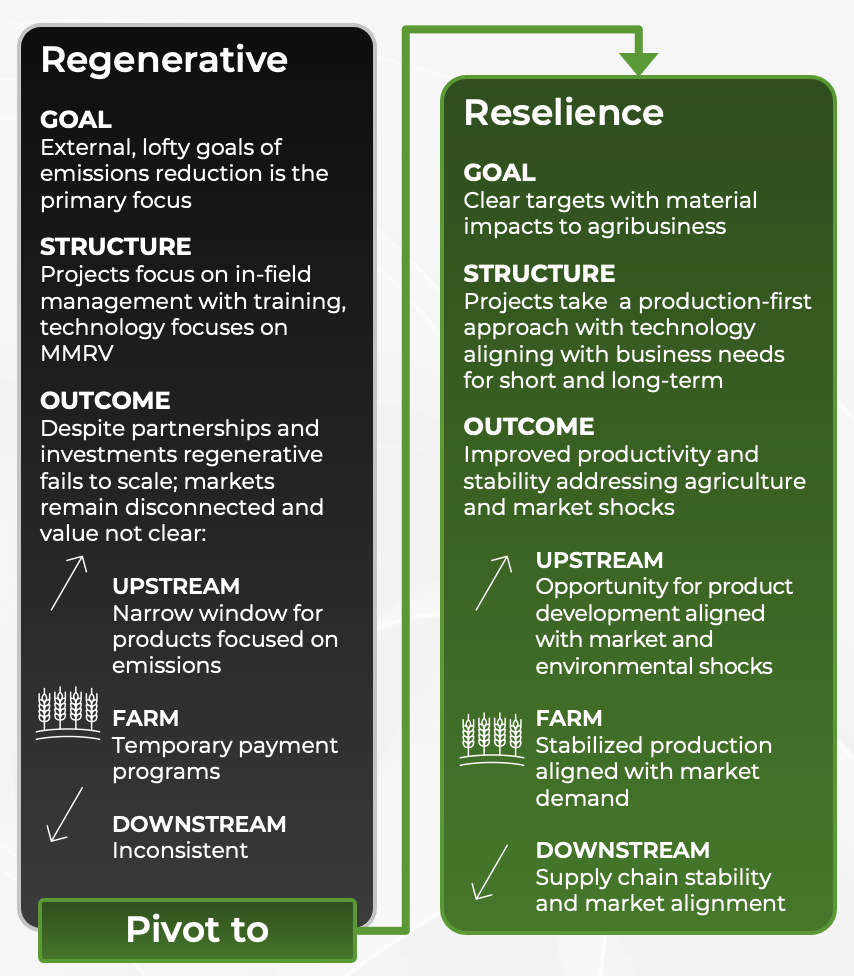
Regenerative agriculture has become a central pillar of corporate sustainability strategies, with input providers, food companies, and retailers investing in programs to reduce greenhouse gas emissions, improve soil health, and support producer income. However, many initiatives remain at the pilot stage and have struggled to scale. Lux Research evaluated more than 100 projects across 30 global companies and found that nearly 72% primarily targeted greenhouse gas emissions reduction, representing approximately USD 2 billion in investment.
This focus has driven heavy reliance on measurement, monitoring, reporting, and verification technologies. Digital platforms, farm management software, remote sensing, and carbon accounting tools account for approximately 76% of the technologies used, while fewer projects directly address production through crop genetics, precision input application, or livestock management, creating a fundamental mismatch, as monitoring improves visibility into environmental outcomes but does not directly reduce risks such as pests, disease, weather variability, or input cost volatility.
Where core needs lie: Internal and external resilience
Lux Research developed a resilience framework across two complementary dimensions. Internal resilience refers to the physical production system: Resistance is the ability to maintain productivity and quality under biotic and abiotic stress, while recovery is the ability to restore or prepare production for subsequent growing cycles. External resilience refers to market, policy, and trade conditions: Resistance is the ability to limit near-term financial impacts, while recovery is the ability to anticipate and prepare for future disruptions.
Internal system pressures threaten productivity and quality
Disease, weed, and pest pressures reduce yields by 20%–40% annually, while abiotic stressors, including drought, have intensified over the past decade. Climate change could reduce global crop yields by 8%. Upstream input providers (e.g., Nutrien, Bayer) and OEMs identify losses from biotic and abiotic stressors as a core business risk. They also position these threats as opportunities to develop crop protection solutions that build resistance. Downstream processors, CPG companies, and retailers face supply disruptions from declines in yield and crop quality, which destabilize supply and increase raw materials costs. Across the agricultural value chain, companies consistently cite climate-driven production losses as a key risk.
External market pressures create shocks that challenge and constrain agrifood systems
Rising input costs, commodity price volatility, and biotic and abiotic stressors reduce farm income and disrupt predictable sourcing. Fertilizer prices have fluctuated by more than 60% over the past five years, while trade and geopolitical shocks in 2026 continue to disrupt global fertilizer supply chains. Managing these risks requires the agricultural value chain to look beyond regenerative agriculture and adopt metrics that capture the ability of production systems to withstand shocks and recover over time.
Current potential of innovation to meet resilience
Technologies to improve agricultural resilience are advancing rapidly, but Lux Research’s assessment of 23 categories found that few address both production and market risks across near- and long-term horizons. The strongest opportunities converge around input efficiency, livestock health and reduced antibiotic use, systems-level productivity, and value-added production. Remote sensing enables early stress detection but requires targeted field intervention. Computer vision and acoustic monitoring improve livestock surveillance but remain limited in disease-specific diagnosis. Crop phenotyping strengthens genotype-by-environment decision-making. Manure treatment creates new revenue and compliance pathways but remains cost sensitive. Future value will come from integrating complementary technologies into production systems that improve resistance and recovery across both field and market pressures.
How should agrifood players strategize for this regenerative to resilience shift?
Companies across the agricultural value chain have piloted regenerative initiatives to reduce emissions, improve farm livelihoods, and strengthen climate resilience. However, most remain at pilot scale, deliver inconsistent Scope 3 reductions, and have yet to demonstrate measurable resilience impacts. Although regenerative agriculture originated as a system for creating net-positive on-farm outcomes, its complexity has made it difficult to scale across supply chains. Stakeholders will need to link on-farm practices with market signals and demonstrate measurable improvements in supply stability, emissions, and farmer outcomes to build resilience at scale.
Build resilience into your agrifood innovation strategy
Regenerative agriculture is only part of the equation. Discover the technologies, strategies, and emerging opportunities shaping more resilient agrifood systems in Lux Research’s report, The Next Era of Agrifood and Health Innovation. Explore where innovation can strengthen productivity, manage market volatility, and create long-term value across the agricultural value chain.