
Key takeaways
- Human-centric innovation starts with unmet human needs, not with a technology searching for a market.
- The Lux Human-Centric Innovation Model organizes innovation into three connected phases: Inspire, Illuminate, and Ignite.
- Successful innovation requires teams to validate human desirability, technical feasibility, commercial viability, and organizational readiness together.
- Consumer and buyer insights should remain part of the innovation process from discovery through commercialization and optimization.
- Continuous feedback helps organizations improve launches and identify the next innovation opportunity.
Many innovation programs fail for reasons that have little to do with technical performance. A product can work exactly as intended and still struggle because customers do not understand it, value it, or see how it fits into their lives.
Human-centric innovation helps companies reduce this risk by putting human needs at the center of the innovation process.
In Lux Research’s webinar, “Applying a Human-Centric Framework to Accelerate Innovation,” Derek Gingrich and Matthew Watton explain how companies can connect human insight with technology strategy, organizational alignment, and commercialization. The goal is not simply to build better technology. It is to develop innovations that people are ready to adopt and organizations are prepared to support.
What is human-centric innovation?
Human-centric innovation is an approach to developing products, services, and business models around real human needs, behaviors, values, and expectations.
Instead of starting with “What can our technology do?” teams begin with questions such as:
- What problem are people trying to solve?
- What needs remain unmet?
- What will customers or buyers actually value?
- What will stakeholders support and fund?
This applies to both B2C and B2B innovation. Business markets still involve people, including procurement teams, technical buyers, executives, partners, and end users. Each evaluates risk, value, credibility, and relevance differently.
A human-centric framework helps organizations maintain that perspective as an idea moves through increasingly complex technical and commercial processes.
Why innovation processes lose sight of the customer
Innovation can break down when different functions operate in isolation.
R&D teams may develop technically impressive solutions that customers do not want. Insights teams may identify meaningful needs without a feasible technical pathway. Promising concepts may stall because leadership does not understand the opportunity or see a strong enough business case.
Human-centric innovation connects these activities rather than treating them as sequential handoffs.
Teams should assess market demand, technical feasibility, business potential, regulatory constraints, and organizational readiness in parallel. Doing so can identify critical conflicts earlier and reduce the likelihood of expensive late-stage surprises.
The Lux Human-Centric Innovation Model
The Lux Human-Centric Innovation Model organizes innovation into three connected phases: Inspire, Illuminate, and Ignite.
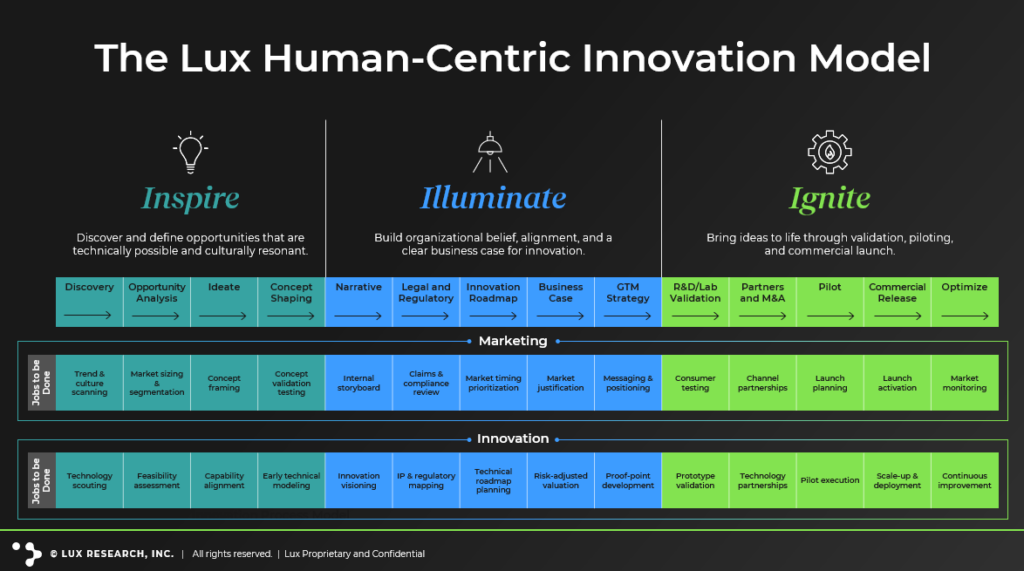
The framework is not intended to function as a rigid stage-gate process. Instead, it creates a continuous learning system. Findings from validation, pilots, launches, and market monitoring can reshape the original opportunity and inform future innovation.
Inspire: Start with the human problem
The Inspire phase focuses on discovering and defining opportunities that are technically possible and culturally resonant.
Activities include discovery, opportunity analysis, ideation, and concept shaping.
Teams should look beyond existing product categories and examine the functional and emotional dimensions of demand. What frustrations remain unresolved? How do people describe the problem? What behaviors suggest that current solutions are inadequate?
Netflix provides an example. Its expansion into original programming responded to changing viewer behavior and growing demand for always-available content. Rather than simply adding another technical capability, the company addressed an emerging audience need while creating strategic value beyond licensed programming.
The broader lesson is to define the human opportunity first, then determine which capabilities can address it.
Illuminate: Build organizational belief
Identifying a compelling opportunity is not enough. The organization must understand why it matters and believe the opportunity is worth pursuing.
Illuminate focuses on building that alignment through narrative development, legal and regulatory assessment, innovation roadmapping, business-case development, and go-to-market planning.
A strong innovation narrative should answer three questions:
- Why does this human need matter?
- What should the organization do about it?
- How will success be measured?
Microsoft’s Xbox Adaptive Controller demonstrates this principle. Evaluated only through near-term hardware sales, an accessibility-focused controller could have been difficult to justify. A broader view of value included underserved audience reach, customer loyalty, brand trust, inclusive-design leadership, and learning that could improve future products.
Human-centric business cases do not replace financial discipline. They create a more complete picture of the opportunity.
Ignite: Validate, launch, and learn
Ignite moves an innovation from concept toward execution through R&D validation, partnerships, pilots, commercial launch, and optimization.
Importantly, launch is not the end of the innovation process.
Pilot results, customer feedback, regulatory developments, competitive activity, and changing cultural expectations can all reveal opportunities to improve the product or its positioning.
Domino’s pizza turnaround illustrates how feedback can become a source of innovation. The company responded directly to customer criticism, changed its core product, and communicated openly about what it had learned.
The lesson for innovation teams is simple: Optimization is part of innovation. Market feedback should improve the current offering while informing the next opportunity.
How to apply human-centric innovation
A human-centric innovation framework is most effective when it keeps the original human need visible from discovery through commercialization. Teams can apply the approach in five practical steps:
1. Keep learning after launch. Use customer feedback, market signals, cultural changes, competitive activity, and performance data to optimize the innovation. These insights can improve the current offering while also informing the next cycle of discovery.
2. Start with an unmet human need. Define the opportunity in clear, human language before focusing on a specific product, technology, or solution. The need should remain the foundation for decisions throughout the innovation process.
3. Validate key assumptions in parallel. Evaluate human desirability, technical feasibility, commercial viability, regulatory considerations, and organizational readiness at the same time. This helps teams identify conflicts and risks earlier.
4. Create learning checkpoints. Instead of treating innovation as a rigid sequence of stage gates, regularly review what the team has learned, which assumptions have changed, and whether the opportunity still addresses the original need.
5. Build a shared innovation narrative. Give stakeholders a clear story that connects the human problem to the opportunity, strategic fit, technical approach, business case, risks, and measures of success. A strong narrative helps build the organizational belief needed to move an idea forward.
Put human-centric innovation into practice
Successful innovation requires more than a promising technology or a compelling idea. It requires a framework that connects unmet human needs with organizational alignment, technical validation, and commercial execution.
Explore The Lux Human-Centric Innovation Model to see how Lux Research helps innovation teams move from discovery to market with greater clarity, confidence, and customer relevance.
Frequently asked questions
What is the goal of human-centric innovation?
The goal is to create innovations that are desirable to people, technically feasible, commercially viable, and supported by the organization bringing them to market.
Is human-centric innovation only relevant to consumer products?
No. Human-centric innovation also applies to B2B markets because business decisions are made by people with specific priorities, expectations, concerns, and definitions of value.
How can insights support innovation after launch?
Insights can track changing customer needs, language, behaviors, and cultural expectations. These signals help teams refine products, improve messaging, and identify emerging opportunities.