Key takeaways
- GLP-1 is accelerating existing metabolic health trends rather than creating an entirely new market.
- High-protein, fiber-rich, nutrient-dense foods represent the strongest commercial opportunities today.
- Food companies should segment innovation across pre-, active-, and post-GLP-1 consumers rather than treating all users alike.
- Ingredient suppliers are repositioning existing portfolios instead of launching entirely new GLP-1 product lines.
- The long-term opportunity extends beyond weight loss into metabolic health ecosystems spanning food, nutrition, and digital health.
GLP-1 is accelerating a broader shift in food and nutrition
The rapid adoption of GLP-1 receptor agonists is changing the relationship between consumers and food. People using these medications may consume fewer calories, feel full sooner, and become more selective about what they eat.
For food companies, that creates a simple but important challenge: When consumers eat less, every bite has to do more.
That puts more pressure on products to deliver meaningful nutritional value in smaller portions. Protein quality, fiber, micronutrients, hydration, digestive support, and satiety all become more important as overall intake declines.
At the same time, many of these priorities were already gaining momentum before GLP-1 adoption accelerated. Consumers were already showing greater interest in healthy aging, weight management, functional nutrition, blood sugar management, and metabolic wellness.
GLP-1 is therefore less of a completely new market than a catalyst for trends that were already reshaping food and health.
The opportunity extends beyond active GLP-1 users
One of the most important strategic considerations is that there is no single “GLP-1 consumer.”
Needs change depending on where consumers are in their health and weight-management journey.
Before beginning GLP-1 therapy, consumers may be focused on weight management, lifestyle changes, satiety, and metabolic health. During treatment, their priorities may shift toward preserving muscle, maintaining adequate nutrition, supporting digestion, and staying hydrated. After treatment, preventing weight regain and maintaining healthier eating patterns can become more important.
That creates three broad innovation opportunities:
- Pre-GLP-1: weight management, satiety, and metabolic wellness
- Active GLP-1: nutrient density, protein, hydration, and digestive support
- Post-GLP-1: long-term satiety, healthy habits, and weight maintenance
Importantly, these needs are relevant to many consumers who will never take a GLP-1 medication.
That is why metabolic health may prove to be a more durable innovation platform than products marketed specifically for GLP-1 users.
Protein and fiber are leading near-term opportunities
Some of the most attractive GLP-1-related opportunities are not emerging technologies at all. They are familiar ingredients being repositioned for a new set of consumer needs.
Protein is one of the clearest examples.
As calorie intake decreases, maintaining muscle mass becomes increasingly important. This gives food and ingredient companies an opportunity to move beyond the traditional “high-protein” message and focus more heavily on protein quality, muscle preservation, and nutritional efficiency.
Fiber and prebiotics offer a similarly strong fit. They can support digestive health and satiety while aligning with broader metabolic health positioning.
Together, these technologies have several commercial advantages. They are familiar to consumers, compatible with existing food formats, and already supported by established supply chains.
For many companies, that means the fastest GLP-1 innovation strategy may be to rethink an existing portfolio rather than invent a completely new category.
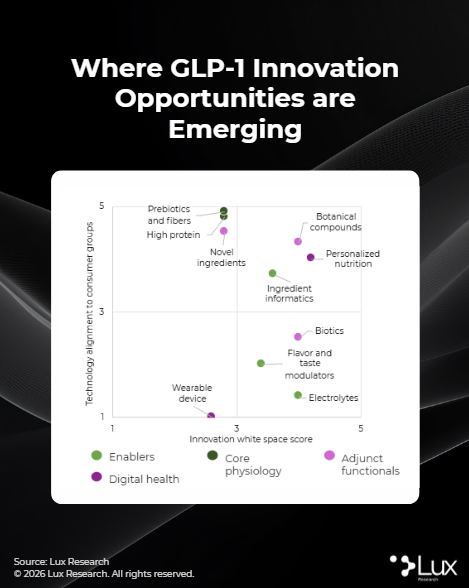
Where GLP-1 innovation opportunities are emerging
Lux’s opportunity framework maps technologies based on their alignment with changing consumer needs and the amount of innovation white space available. The technologies fall into four broad groups:
- Core physiology: protein, fiber, and prebiotics
- Enablers: flavor modulation, ingredient informatics, and electrolytes
- Adjunct functionals: botanicals, biotics, and novel peptides
- Digital health: wearables, continuous glucose monitoring, and personalized nutrition platforms
The strongest near-term opportunity sits in core physiology because these technologies address multiple consumer needs while fitting relatively easily into existing food systems.
Emerging functional ingredients and digital health tools may offer greater differentiation over time, but they also bring more uncertainty around validation, adoption, and commercialization.
The eating experience matters more when consumers eat less
Nutrition alone will not determine which products succeed.
If consumers are eating smaller portions or fewer meals, sensory quality becomes even more important. There are fewer opportunities to make up for a disappointing food experience.
This gives enabling technologies a meaningful role in GLP-1-related innovation.
Flavor modulation can improve the taste of high-protein or high-fiber products. Texture technologies can help maintain indulgence and familiarity even as formulations become more nutrient dense. Electrolytes can support hydration, while ingredient informatics can help formulators identify combinations that improve both nutrition and sensory performance.
These technologies may not always appear on the front of the package, but they can be critical to whether a product earns repeat purchases.
Emerging functionals show promise, but evidence matters
Botanicals, bioactive peptides, biotics, and other functional ingredients are attracting attention because of their potential connection to appetite regulation and metabolic pathways.
However, these technologies are at very different stages of maturity.
The scientific mechanism behind an ingredient may be compelling without being strong enough to support a commercial health claim. Regulatory requirements can also vary significantly by market.
That makes claims such as “natural GLP-1,” “GLP-1 booster,” or comparisons to pharmaceutical products particularly risky.
The more credible approach is to evaluate emerging ingredients based on several factors: quality of evidence, regulatory readiness, scalability, formulation compatibility, and the consumer benefit they can realistically support.
In other words, companies should distinguish between an interesting biological mechanism and a commercially defensible product proposition.
Digital health could extend the opportunity beyond food products
The longer-term opportunity may not stop at reformulating food.
Wearables, continuous glucose monitoring, personalized nutrition platforms, and other digital health technologies are beginning to connect food choices with individual metabolic responses.
That could eventually enable a much more personalized model of nutrition.
Consumers might use metabolic data to understand which foods work best for them, while food companies could use digital platforms to provide more targeted recommendations, services, or product ecosystems.
However, digital health still faces a central challenge: engagement. Data alone is not enough. Consumers need clear, actionable value if they are going to continue using a platform over time.
For that reason, digital health may ultimately be most effective when paired with food, nutrition, or wellness offerings rather than positioned as a standalone solution.
A phased strategy can help companies respond to GLP-1
Food and ingredient companies do not need to transform their innovation pipelines overnight.
A phased strategy can help companies capture immediate opportunities while building toward more differentiated offerings.
In the short term, brands can reconsider how existing products are positioned. Nutrient density, protein quality, fiber, satiety, and metabolic wellness may already be present in a portfolio but underemphasized in product messaging.
In the medium term, companies can reformulate products to improve nutritional profiles, incorporate complementary functional ingredients, and address sensory challenges.
Over the longer term, food, functional ingredients, personalized nutrition, and digital health may come together in broader metabolic health ecosystems.
The key is to avoid defining the strategy too narrowly around the medication itself. GLP-1 adoption may change over time, but the underlying demand for better metabolic health is likely to remain strategically important.
What GLP-1 means for the future of agrifood innovation
GLP-1 is one part of a much larger transformation underway in agrifood and health.
Food companies are increasingly operating at the intersection of nutrition, healthcare, biotechnology, consumer behavior, and digital technology. As those boundaries continue to blur, innovation strategies will need to account for more than traditional food trends.
The most durable opportunities are likely to emerge where four factors intersect:
- Consumer need
- Scientific credibility
- Technical feasibility
- Commercial scalability
In the near term, that points toward familiar technologies such as protein, fiber, and nutrient-dense formulations. Over time, it could expand into novel bioactives, personalized nutrition, and integrated metabolic-health platforms.
The companies that succeed will be those that understand GLP-1 not simply as a pharmaceutical disruption, but as a signal of how quickly the relationship between food and health is evolving.
Frequently Asked Questions
How is GLP-1 changing the food industry?
GLP-1 therapies are driving demand for smaller portions, nutrient-dense foods, high-quality protein, fiber, hydration, and products that support metabolic health.
Should food brands create products specifically for GLP-1 users?
Not necessarily. Designing around broader outcomes such as satiety, muscle preservation, nutrient density, and metabolic health can address the needs of GLP-1 users while also reaching a much larger consumer population.
Why are protein and fiber important for GLP-1 consumers?
Reduced food intake can increase the importance of getting sufficient nutrition from fewer calories. Protein can help support muscle maintenance, while fiber can contribute to satiety and digestive health.
Explore the next era of agrifood and health innovation
GLP-1 is only one of the forces redefining where agrifood companies should place their next innovation bets. Lux Research’s The Next Era of Agrifood and Health Innovation examines the broader priorities emerging across agriculture, ingredients, food, and health, drawing on industry analysis and more than 2,500 executive questions. The report explores how leaders are responding to regulatory pressure, supply volatility, bioeconomy opportunities, and the shift toward performance- and health-driven product strategies.
Download The Next Era of Agrifood and Health Innovation to identify the technologies, markets, and strategic priorities likely to shape the next phase of agrifood growth.