
Key Takeaways
- AI delivers the greatest impact when applied to the most significant bottlenecks in the materials development workflow, not simply where the technology is most impressive.
- Discovery is only one piece of the puzzle. Commercial success depends on integrating AI with synthesis, testing, scale-up, and manufacturing.
- Companies should prioritize a single high-value AI use case, supported by high-quality experimental data and closed learning loops, before expanding AI across R&D.
- Organizations that combine AI with proprietary data, experimentation, and scientific expertise will build the strongest long-term competitive advantage.
AI in Materials Discovery: Where Does It Actually Create Value?
Artificial intelligence has become one of the hottest topics in materials R&D, with more than $600 million invested in materials informatics startups during 2025 alone. Yet despite the excitement surrounding generative AI, materials design platforms, and self-driving laboratories, many organizations still struggle to answer a fundamental question:
Where does AI actually create measurable business value?
Rather than treating AI as a universal solution, Lux Research recommends evaluating AI opportunities through a practical framework that balances AI capability against real-world development bottlenecks.
A Framework for Prioritizing AI Investments
Instead of selecting AI tools based on hype, organizations should follow a three-step process:
- Evaluate the value AI can provide through automation and knowledge generation.
- Identify the biggest bottlenecks across the materials development workflow.
- Invest where those two factors overlap.
This approach recognizes that every material has different constraints. While AI may dramatically improve molecule screening or literature review, the true limiting factor may actually be manufacturing integration, testing, or scale-up.
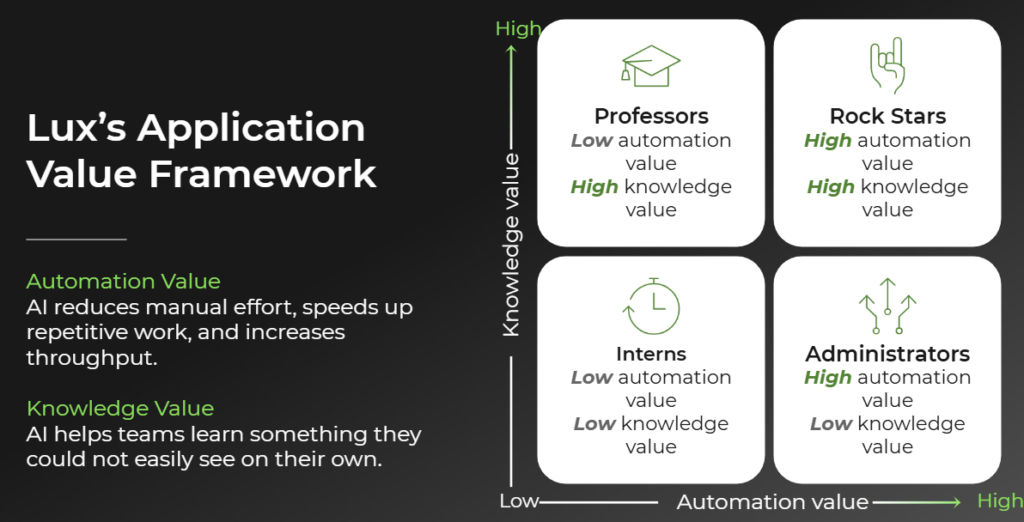
Lux’s Application Value Framework
This framework categorizes AI applications based on two dimensions:
- Automation Value: How much manual effort AI eliminates.
- Knowledge Value: How much new insight AI generates.
High-value “Rock Star” applications score highly on both dimensions and represent the strongest opportunities for investment.
Why Discovery Alone Isn’t Enough
Using examples from battery electrodes, electrocatalysts, and metal-organic frameworks (MOFs), the webinar demonstrated that AI can significantly accelerate early-stage discovery, but commercialization often fails because downstream bottlenecks remain unresolved.
For example:
- Battery materials frequently stall during manufacturing scale-up.
- Electrocatalyst development depends on proprietary experimental validation, not just predictive models.
- MOFs often encounter manufacturability and stability challenges long after promising computational results.
The common lesson: successful organizations connect AI with experimentation, validation, and manufacturing in continuous learning loops rather than treating AI as a standalone discovery tool.
Questions & Answers
Q: How should companies evaluate AI vendors?
Look beyond polished interfaces. Evaluate whether a platform addresses your specific materials workflow, supports your data strategy, and produces measurable improvements such as fewer experiments, faster development cycles, or better decision-making.
Q: What if R&D data is fragmented across different teams?
Rather than attempting a company-wide digital transformation, begin with one high-value use case. Standardize the data needed for that workflow, demonstrate measurable success, and expand from there.
Q: Should organizations build AI internally or partner with vendors?
Lux recommends a hybrid approach. Companies should retain ownership of their proprietary data, experimental feedback loops, and scientific expertise while leveraging external vendors for specialized AI platforms and workflow tools.
The Bottom Line
The biggest opportunity in AI for materials R&D isn’t simply discovering new materials faster. It’s creating an integrated system where AI continuously learns from experiments, testing, manufacturing, and scientific expertise.
Organizations that diagnose their true bottlenecks first, build strong data foundations, and connect AI to real-world validation will realize far greater value than those deploying AI solely for discovery.
Watch the Full Webinar On Demand
Want to learn how to prioritize AI investments across your materials development workflow?
Watch the full Understanding Where AI Adds Value in R&D: Accelerating Materials Discovery webinar on demand to explore Lux Research’s complete evaluation framework, detailed materials case studies, and practical recommendations for building an AI-enabled R&D strategy.