
Key takeaways
- Context-aware large language models (LLMs) improve innovation analysis by combining AI capabilities with expert-curated research and domain-specific context.
- Traditional LLMs often struggle with positivity bias and incomplete information, limiting their effectiveness for strategic decision-making.
- Innovation teams can achieve more accurate technology scouting, funding analysis, and market intelligence by grounding AI outputs in trusted data sets.
- Context is becoming a critical differentiator for enterprise AI applications as organizations move beyond basic search and content generation.
- Combining human expertise with AI enables more consistent, actionable insights than relying on public web data alone.
Why LLMs are becoming essential for innovation teams
The spread of LLMs in the past three years has exceeded expectation, and innovation teams have not been exempt. Teams engage LLMs as a replacement for Google in searching the internet, use LLMs to manage large amounts of internal company data, and are building novel tools that use LLMs’ core capabilities and analyze large amounts of information to tackle innovation-specific data, like government funding databases, news sources, or VC flows. LLMs are becoming more integrated with innovation than ever. But as these tasks get more complicated, pressure builds on the LLMs to accurately analyze information. And as we know from the human task of analyzing information, context is critical. Using a contextless LLM is likely to result in poor analysis and even long-term problems in new data pipelines.
Take a basic workflow. The innovation team sets up a pipeline that pulls in data on government grants. After some minor cleaning, these government grants are sent to an LLM for analysis. The LLM looks at the grants, looks at the recipients, looks at the funding amounts, and rates them in terms of impact criteria. Then it returns a ranked list of those funded projects and highlights any important ones for the innovation team to follow. It sounds great, but there’s one problem: How is the LLM actually conducting that analysis?
Why LLMs struggle with bias and incomplete information
LLMs don’t think, and they don’t analyze. What they do is produce probabilistic predictions — the likely results of textual patterns. That likely result is based on both the large corpus of text that the LLM was trained on and the specifics of the text that it is given — either from the grant or from other sources.
The positivity bias problem in AI analysis
LLMs have a well-known positivity bias because text on the internet — the core training corpus — skews positive. In our example, LLMs will likely supplement any information they receive from discovery on the data pipeline with searches on the internet, primarily the homepages of funding recipients. This is not unbiased information. This is heavily skewed information, which overwhelmingly runs positive. It’s also not complete information — critical context generally isn’t in public sources. These two basic issues, positivity and context, mean that this kind of analysis by LLMs, with all their speed and power, will struggle to match the quality of even a cursory human reading.
How context-aware LLMs improve innovation intelligence
Context-aware LLMs are the solution to both of these challenges. Context-aware LLMs have context provided for them by an unbiased, or at least differently biased, third-party database that complements the web searches and existing capabilities within the LLM. What’s critical is that this context is not merely numbers in spreadsheets. You can score and rank, for example, different knowledge areas or different types of projects, but what LLMs require is prose, actual text, because LLMs are likely-text generators. Giving them prose to build off makes them much more powerful and much likelier to be accurate. They also need context in the form of information. The inductive capabilities of LLMs can produce a fairly reasonable output by bouncing text back and forth, but it needs to start in a place of correct assumptions to achieve consistent success. In addition, context-aware LLMs have access to a much broader scope of information, including information that may not be in public sources. This awareness is critical in tackling the dual issue of positivity in context and makes LLMs much more powerful.
Building more reliable AI-powered innovation workflows
Coming back to our funding pipeline, our context-aware LLM performs the same function of analyzing the data, but it does so in a much more powerful way. It has access to human-written analysis of the companies in those government databases. It also has examples of more critical human-written text to build its output responses from it. This type of context-aware analysis is more powerful not only because there’s more information available but also because there’s an established tone, style, and approach to actually conducting the analysis within that LLM’s data. That’s why Lux has built Lux AI for Copilot, a context-aware LLM plug-in for the Microsoft Copilot ecosystem. As our clients are increasingly building LLM applications, Lux’s unique database of human analysts and written research on companies, which has a consistent methodology approach spanning over 15 years, is critical to providing LLMs the context to conduct successful analysis. This is just the beginning — we’re rolling out this approach to other leading LLMs including Claude and ChatGPT and building our own analysis and applications on top of these context-aware LLMs.
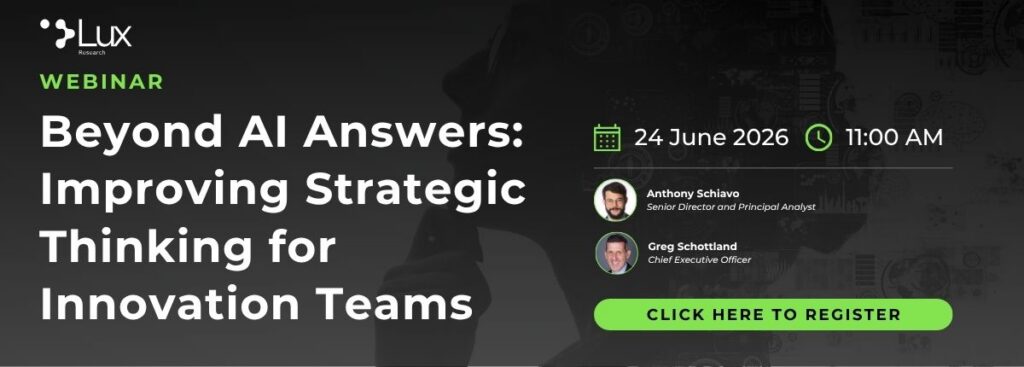
Beyond AI answers: Improving strategic thinking for innovation teams
AI can generate answers in seconds, but innovation leaders need more than speed. They need context, judgment, and strategic insight.
Join Lux Research’s upcoming webinar “Beyond AI Answers: Improving Strategic Thinking for Innovation Teams“ to learn how leading organizations are moving beyond generic AI outputs and building workflows that combine expert knowledge, contextual intelligence, and human decision-making.
You’ll learn:
- How innovation teams can improve the quality of AI-generated insights
- Why context-aware AI delivers stronger strategic outcomes
- Practical approaches for integrating AI into technology scouting, market intelligence, and innovation planning
Register today and discover how to transform AI from an answer engine into a strategic advantage for your innovation team.