
Key Takeaways
- The chemicals industry is facing an innovation paradox — companies are becoming more selective with investment just as long-term competitiveness requires continued attention to emerging opportunities.
- Future materials are reemerging as a core innovation priority as companies sharpen focus on materials-led differentiation.
- Defossilization and decarbonization remain important, but companies are right-sizing expectations around timelines and economics and shifting the sustainability narrative to one anchored on resilience.
- Innovation success increasingly depends on ecosystem readiness — including value chain maturation, market readiness, manufacturability, and partnerships.
- Companies that maintain disciplined innovation pipelines rather than abandoning innovation entirely for near-term performance pressure will be best positioned for the next cycle.
The Lux Take: Innovation discipline is replacing broad technology bets
The chemicals industry is entering an innovation paradox. After several years of revenue pressure and only marginal stabilization, many companies are tightening budgets, restructuring operations, and shifting resources toward near-term objectives. This discipline is necessary, but pulling back too far from long-term innovation will weaken the pipelines companies require to compete in the next market cycle.
The next era of chemicals innovation won’t reward broad ambition, speculative technology bets, or pure near-term operational defensiveness. It will favor companies that remain prepared, sharpening focus on core materials innovations, right-sizing expectations for decarbonization and defossilization, and evaluating opportunities across the full innovation ecosystem rather than through technology momentum alone.
Why chemicals innovation is becoming more selective
The chemicals industry is at an inflection point converging on weaker demand, pricing pressures from low-cost regions, geopolitical uncertainty, and regulatory complexity that have forced companies to become more selective about where they invest. At the same time, the last cycle’s overextension into sustainability efforts — often decoupled from tangible business outcomes — has raised the bar for innovation teams to demonstrate measurable value. In the report The Next Era of Chemicals Innovation , Lux examines how chemicals innovation priorities are shifting amid this backdrop and uncovers which innovation bets are at the forefront of the industry.
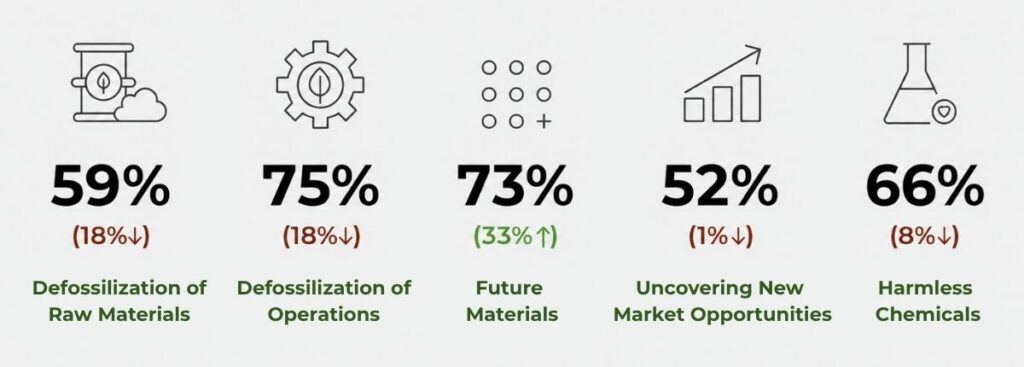
Figure 1. The percentage of chemicals companies analyzed in the report that identified each of the five strategic innovation priorities (black) and the change in focus from the previous year (red and green).
Defossilization and supply chain resilience are now closely linked
Defossilization of raw materials remains crucial for enhancing overall supply chain resilience; a theme exacerbated by the ongoing Iran crisis. Alternative carbon sources benefit from the foundation of several decades of R&D and learnings from previous commercialization efforts. Even so, a full transition at the scale required by the chemicals industry has little chance to be economically feasible. Instead, chemicals innovation leaders should focus on using these emerging technologies to build more localized and resilient supply chains that complement, rather than replace, fossil-based raw materials. Some commercially proven technologies already enable production of alternative carbon sources, offering near-term deployment opportunities. However, realizing commercial success depends on strong market readiness — one that has been triggered by the domino effect of the ongoing Iran crisis — which now tips the narrative of the risks of fossil fuels.
Decarbonization strategies must align with asset life cycles
Decarbonization should be viewed as a strategy to future-proof the capital-intensive assets underpinning the chemicals industry.The right decarbonization pathway depends heavily on asset age, condition, remaining life, and retrofit potential. For newer or strategically critical assets, decarbonization investments can help reduce exposure to regulatory risk and energy price volatility. For older or less advantaged assets, the priority may be lower-cost operational improvements or a more limited role within the broader production network rather than full-scale transformation. Chemicals innovation leaders should therefore approach decarbonization with an eye to protect asset value, strengthen resilience, and extend economic and strategic relevance.
Future materials are reemerging as a core growth engine
Future materials development is at the heart of the chemicals industry’s innovation engine and is now regaining sharper focus.The current macroeconomic environment is pressuring innovation teams to deliver measurable results. Meanwhile, many breakthroughs in materials science, though technically transformative, have struggled commercially. Yet, the cost of missing the next game-changing material may be even greater. To improve the odds of success, chemicals innovation leaders must adopt a two-pronged strategy built around smart bets — accelerating materials discovery, design, and development at the front end — while actively scouting for market opportunities shaped by materials limitations, performance gaps, and evolving consumer needs on the back end.
Chemicals companies must identify real growth markets faster
Chemicals companies need to continuously scan emerging opportunities and discern between real growth prospects and speculative outlooks. As growth in conventional sectors will remain closely tied to global economic development, many chemicals companies are looking to new markets expected to outpace global GDP growth, including those that can be served with existing products as well as those that will require new platforms. Given the uncertainty of these opportunities, chemicals innovation leaders need dynamic and agile product strategy roadmaps, informed by a clear understanding of the technological advances and signals to quickly enter new markets. Not every opportunity will prove viable, and success will be determined by the ability pivot and scale when opportunities solidify.
Harmless chemicals are becoming a competitive differentiator
Harmless chemicals go beyond compliance — they help companies hedge long-term risks, preserve their social license to operate, and unlock opportunities to offer differentiated products. Regulatory affairs teams manage product portfolios to address legal bans and restrictions, but innovation leaders are responsible for advancing harmless chemicals. They must track emerging safer chemistries and anticipate phaseouts based on new scientific insights and evolving consumer sentiment, in a social media environment in which any given viral moment can trigger product backlash — accurate or not. Chemicals innovation leaders must distinguish between short-lived sensationalism and durable consensus, building a portfolio of harmless chemicals capable of capturing near-term differentiation and adapt to long-term shifts to mitigate both financial and reputational risk.
The risk of a sparser innovation funnel and how the next era will favor the consistent
The next era of chemicals innovation will not simply reward the companies that chase every emerging technology, nor will it favor those that focus only on near-term operational defensiveness. The most important strategic risk is no longer choosing the wrong technology — it is allowing the short-term pressures to drain the innovation pipeline. This is critical as innovation pipelines take time to build. Prepared companies will keep filling the front end even while managing near-term KPIs. This doesn’t mean returning to broad, innovation activities reminiscent of the heydays, but maintaining consistent, innovation continuity by building front-end visibility, investing in future materials, and right-sizing decarbonization pathways. This discipline matters as chemicals innovation leaders can no longer innovate across their entire portfolio; instead, they’re prioritizing products and platforms where they can deliver concrete impact and differentiation to give their companies more strategic options as market conditions evolve.
The next era of chemicals innovation
To understand which innovation priorities are gaining momentum, where chemicals companies are recalibrating investment strategies, and how leaders are balancing resilience with growth, explore Lux Research’s report The Next Era of Chemicals Innovation . The report examines the technologies, market signals, and strategic shifts shaping the future of the chemicals industry and pinpoints where innovation leaders should focus to remain competitive in the next market cycle.