
Key takeaways
- Neuromorphic and quantum materials startups account for nearly 95% of tracked funding and will remain the primary focus of investment over the next five years.
- Neuromorphic materials are positioned to deliver the earliest commercial returns due to their potential applications in AI hardware, low-power memory, and compute-in-memory systems.
- Electromechanical, spintronic, and topological materials remain niche opportunities with longer commercialization timelines and limited venture funding.
- Semiconductor materials suppliers and computing companies should pursue codevelopment, licensing, and strategic partnerships rather than relying solely on equity investment.
- Regional innovation strategies differ, with venture funding dominating parts of the Americas, public-private investment supporting EMEA, and corporate R&D playing a larger role in APAC.
The Lux Take: Neuromorphic and quantum materials dominate the outlook
Investment will continue flowing to neuromorphic and quantum materials startups over the next five years, but neuromorphic materials will deliver the earliest commercial returns while quantum materials ride continued market momentum. Electromechanical, spintronic, and topological materials will remain niche investment opportunities. Semiconductor materials suppliers and high-throughput computing companies should prioritize development partnerships over equity investments, using in-house expertise to help sensing and processor startups overcome engineering bottlenecks.
Where investment in novel electronic materials is gaining momentum
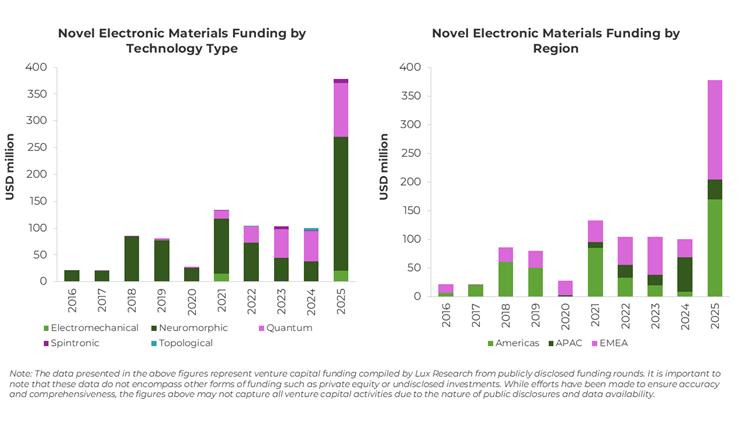
Novel electronic materials are at the forefront of next-gen technologies in AI hardware, memory, and ultra-low power devices. Over the past decade, novel electronic materials startups raised approximately USD 1.1 billion, but funding remained unevenly distributed. Prior to 2021, a few startups dominated the investment landscape with multiple rounds of funding. After 2021, investments stabilized with an average of USD 100 million/y, with a surge in 2025 of USD 378 million. Neuromorphic and quantum materials startups dominate the past decade, accounting for nearly 95% of the total funding, and recent investment signals point toward supporting more established startups moving from device demonstrations toward qualified semiconductor products, chiplets, or customer-specific systems on chips, rather than seed and early-stage investments for emerging startups.
In this piece, we analyze novel electronic materials investments across five main categories — electromechanical, neuromorphic, quantum, spintronic, and topological.
How novel electronic materials investment differs by region
In this section, we analyze the investment trends for each world region individually and discuss how these trends may impact future innovation opportunities in this space.
Investment trends in the Americas
The Americas have an uneven funding distribution across 11 startups. The region raised USD 642 million, but funding remains concentrated among a small number of companies. This pattern suggests that investors favor startups that have demonstrated sustained technical progress, clearer commercialization pathways, and the ability to attract follow-on capital. Given the fragmented investment landscape, emerging companies may find greater value through corporate codevelopment and partnerships that provide access to software tooling, reference hardware, manufacturing expertise, and design-in pathways.
Public-private investment drives electronic materials innovation in EMEA
EMEA raised roughly USD 497 million and has the broadest startup landscape, with 21 startups accounting for 56% of all tracked startups worldwide. Although a small number of companies received a significant share of regional funding, many startups also benefited from government support. This funding profile highlights EMEA’s public-private approach to semiconductor and advanced electronics development, where public investment often supports earlys-stage research and technology translation. The region’s diverse startup base, stronger government involvement, and more regulated growth environment make EMEA an important market for electronics companies seeking partnerships, licensing opportunities, and access to emerging technologies.
Corporate R&D shapes electronic materials development in APAC
APAC raised USD 162 million, with funding concentrated in a limited number of markets and technology areas. Australia accounts for a significant share of disclosed regional funding, highlighting its role as a key hub for quantum and advanced electronics innovation. APAC also has the largest representation of established corporations developing novel electronic materials, indicating that venture funding alone does not fully capture regional innovation activity. As a result, technology development in APAC is more likely to occur through corporate R&D, strategic partnerships, joint development programs, and government-backed initiatives than through standalone venture-funded startups. Companies assessing APAC should evaluate collaboration activity and corporate technology programs alongside disclosed equity funding.
Comparing investment opportunities across five electronic materials categories
In this section, we analyze the investment trends for each of the categories individually and discuss how these trends may impact future innovation opportunities in this space.
Electromechanical materials offer targeted partnership opportunities
Electromechanical materials are underfunded relative to other categories, making them attractive for partnership and component-level investment. Tracked funding totals approximately USD 37 million, 98% of which was received by xMEMS Labs. Use-cases for electromechanical materials lie in thermal management and sensors, and the funding provided to xMEMS shows that investors are willing to move forward with these technologies. Once startups demonstrate usability, reliability, and performance that exceed conventional technologies, device companies should pursue supplier partnerships, design-in evaluations, and licensing opportunities in microelectromechanical systems audio, solid-state cooling, and specialty piezoelectric films. Direct investment is attractive only for startups that can demonstrate OEM demand, manufacturing yield, and a clear path to high-volume component revenue.
Neuromorphic materials lead funding and near-term commercial potential
Funding for neuromorphic materials startups suggests selective interest despite large volume. Neuromorphic startups have raised USD 784 million with Mythic, Ferroelectric Memory Company (FMC), Prophesee, and Vertical Compute representing 74% of that funding. Selective capital deployment reflects a focus on specific commercialization pathways in compute-in-memory integration and nonvolatile, low-power memory storage. Mythic’s USD 130 million funding round in 2025 shows continued interest in analog AI inference with broad use-cases in defense, robotics, and data centers. Recent rounds in FMC and Vertical Compute also highlight a shift within neuromorphic materials toward energy efficiency and longevity of flash memory devices. The strongest investment opportunities within neuromorphic materials are with companies that produce AI processor architectures and workflows that integrate efficiently with current chip manufacturing processes while providing a direct solution to current technological bottlenecks.
Quantum materials attract investment despite manufacturing challenges
Investors most favor quantum startups focused on hardware approaches to increasing computational efficiency.Approximately 24% of total funding went to quantum materials startups. Australia’s Quantum Brilliance and Diraq each raised nearly USD 80 million, reflecting investor interest in room-temperature quantum systems. However, no single methodology or development approach has yet emerged as the dominant model. The most successful startups will demonstrate repeatable device fabrication, noise tolerance, and compatibility with complementary metal-oxide-semiconductor (CMOS) manufacturing workflows. Technology companies should pursue partnerships or joint development opportunities with startups aligned with their application requirements, while investors should prioritize noise-tolerant, CMOS-compatible systems with broad long-term market potential.
Spintronic materials remain a long-term commercialization opportunity
Spintronic materials have drawn limited VC as startups have yet to convert device physics into scalable commercialization models.Startups in this category secured approximately USD 15 million, of which Neuranics raised USD 11.3 million. Other startups in this space claim to focus on memory and AI applications, like NETSOL and Spin-Ion, though they maintain activity in design as a service. The lack of a concrete product offering for many startups highlights spintronics’ limited opportunity, making long-term investment and technology development the best path forward for investors and electronics companies. Semiconductor materials companies should wait and see which startups are able to center their business model around integrated spintronics memory devices in the next five years.
Topological materials face the longest path to commercial adoption
Topological materials remain the weakest-funded category as startups continue exploring commercialization pathways. Tracked funding totals roughly USD 10 million, centered on TopoLogic’s thermal sensor and topological logic random-access memory products. Although demand for topological materials remains strong in research, manufacturing constraints and limited near-term market demand have kept investments low. Tradeoffs between manufacturing quality and production scale remain a key commercialization bottleneck. Materials suppliers can support research markets, but advances in manufacturing processes are necessary for topological materials to reach broader commercial adoption. Quantum-adjacent companies may continue to attract funding because of their potential role in qubits and quantum materials, but investment will remain limited without demonstrated market fit. Electronics companies should therefore use research procurement and targeted collaborations to evaluate technology readiness and commercial potential over the next decade.
The five-year outlook for novel electronic materials investment
Investment in novel electronic materials will remain centered on neuromorphic and quantum technologies over the next five years. Neuromorphic materials startups should continue attracting investor interest as long as they demonstrate measurable improvements for AI hardware. For quantum electronic materials, manufacturing remains the primary bottleneck, likely requiring additional funding rounds and more than five years to achieve scalable production. Electromechanical and spintronic startups are likely more than eight years from widespread commercialization, as they must still demonstrate competitive device performance and repeatable manufacturing processes. Topological materials represent the longest-term opportunity, with most startups remaining in the research phase and likely more than a decade from large-scale production. Investors and strategic partners should prioritize companies with focused product strategies and clear near- to medium-term commercialization pathways, as startups pursuing longer development timelines have yet to demonstrate performance, manufacturability, or economic advantages over incumbent technologies in metrics such as power consumption, read/write speed, and computational efficiency.
Prepare for the next era of industrial innovation
Novel electronic materials are only one part of a rapidly changing industrial technology landscape. Explore the technologies, market shifts, and strategic priorities that will shape The Next Era of Industrial Innovation.