Key takeaways
- Nuclear capacity is unlikely to scale as quickly as political targets suggest. Planned additions are not sufficient to offset expected reactor closures, and projects will continue to require substantial state support.
- Advanced nuclear economics are driven less by reactor type than by financing, project scale, construction execution, and system integration. Smaller or newer designs do not automatically produce cheaper energy.
- Large reactors are best suited to grid power, while SMRs have a stronger potential fit in cogeneration projects serving industrial clusters with multiple premium offtakers.
- Multi-unit development can improve economics by spreading project costs and accelerating learning, but it does not eliminate fuel supply, licensing, construction, or integration risks.
- Microreactors are most likely to remain niche solutions for defense and remote microgrids where alternatives are limited and customers can tolerate higher costs.
Nuclear momentum is rising, but deployment remains difficult
Nuclear fission is again at the center of global energy discussions. Energy security concerns, geopolitical volatility, electrification, and rapidly growing data center power demand have renewed interest in both existing nuclear plants and advanced reactor designs. At COP28, countries committed to working toward tripling global nuclear capacity by 2050, and additional governments have since joined that effort.
Political momentum, however, does not guarantee that projects will be completed at the anticipated rate. Lux Research estimates that planned reactor additions will not offset expected closures over the next 25 years. The industry also continues to face a negative learning curve: greater deployment has often brought stricter and evolving safety requirements, design changes, limited standardization, longer schedules, and higher costs rather than predictable cost reductions.
This creates a more useful strategic question than whether nuclear will “win” as an energy source: Where can nuclear deliver enough distinctive value to justify its cost and risk?
Why advanced nuclear technology does not guarantee better economics
Small modular reactors (SMRs) aim to replace traditional economies of scale with economies of numbers. Standardized components could be produced in factories, transported to project sites, and assembled through a more repeatable process. Type approvals could also reduce the need to reassess an identical design for every deployment.
The approach is compelling in theory, but the limited project evidence available today does not yet demonstrate consistently shorter timelines or lower costs. Early SMR projects have experienced substantial cost escalation, long construction periods, and operational learning challenges. Moving from a first-of-a-kind reactor to an nth-of-a-kind design can lower costs, but Lux’s analysis shows that those gains may remain insufficient to make SMRs broadly cost-competitive with large reactors.
Financing conditions can matter as much as the technology itself. Nuclear projects are highly capital-intensive, so borrowing costs and risk allocation heavily influence the final cost of energy. Markets with low-cost state-backed financing have a structural advantage over projects exposed to higher commercial financing costs.
Multi-unit nuclear projects can improve the learning curve
Developing several reactor units at one site can improve project economics by reusing infrastructure, concentrating expertise, and creating learning opportunities in faster succession. Across the reactor types modeled by Lux, multi-unit projects produced a lower levelized cost of electricity than comparable single-unit projects.
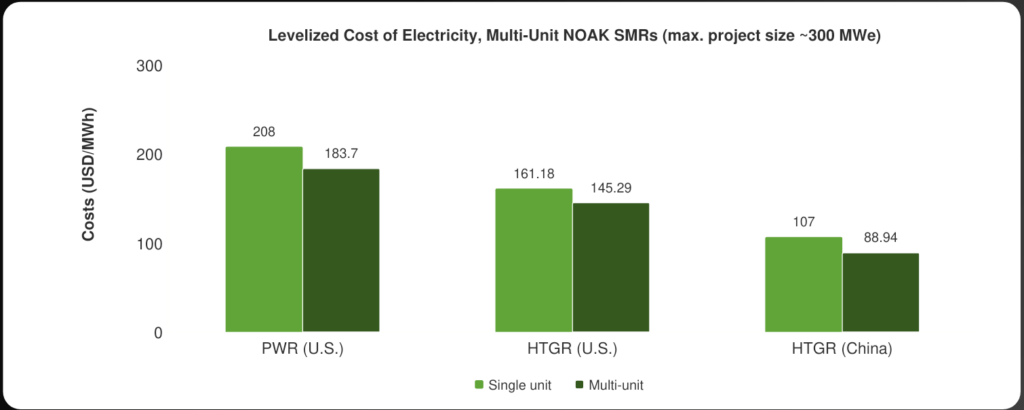
The reduction is meaningful but not transformative. The modeled cost falls from about $208/MWh to $183.70/MWh for a U.S. pressurized water reactor, from $161.18/MWh to $145.29/MWh for a U.S. high-temperature gas-cooled reactor, and from roughly $107/MWh to $88.94/MWh for a Chinese high-temperature gas-cooled reactor. The chart reinforces two conclusions: repeat deployment matters, and regional financing and delivery conditions remain decisive.
The best applications for large nuclear reactors
Large reactors are most compatible with grid-scale power generation. Their output is generally too large for a single industrial user, and their capital requirements favor projects supported by strong government participation, regulated cost recovery, or other mechanisms that can absorb long development timelines and construction risk.
Near-term growth in this segment is likely to come first from reactor restarts and life extensions. New large-scale builds will take longer to contribute because of permitting, financing, supply-chain, and construction requirements. When new projects do advance, multi-unit sites can create a better path to learning and cost reduction than isolated one-off builds.
Where SMRs may create the most value
SMRs are unlikely to succeed simply by offering a smaller version of conventional grid power. Their more differentiated opportunity is cogeneration: producing electricity and usable heat for a group of nearby customers.
Advanced designs such as molten salt reactors, liquid metal reactors, and high-temperature gas-cooled reactors can produce higher-temperature heat than conventional water-cooled designs. In principle, this allows developers to sell both power and heat, creating multiple revenue streams. An industrial cluster could combine customers such as a chemical facility, data center, and desalination plant, each with a different demand profile and willingness to pay.
This model can improve asset utilization and spread project risk across several offtakers. It also reduces dependence on a single customer whose load may be too small for the reactor. Data centers are particularly notable because hyperscalers have shown a willingness to pay a premium for reliable, firm power. Even so, premium power purchase agreements lower financial risk; they do not solve construction, fuel, or integration challenges.
Industrial heat is an integration challenge, not only a cost question
Nuclear heat can appear competitive with fossil-fuel boilers on a levelized-cost basis, especially when fossil fuel prices are high. Yet industrial compatibility depends on the temperature, pressure, timing, and quality of heat required by a specific process.
A reactor’s steam may be hotter or more pressurized than an industrial process can use efficiently. Depressurizing it wastes useful energy. Heat recovered after power generation may be too low-grade and require upgrading. These mismatches can add equipment, complexity, and cost, eroding the apparent advantage shown by a simple levelized-cost comparison.
The implication is that developers should evaluate nuclear heat at the system level. The strongest opportunities will be sites where several users can consume complementary energy products and where reactor output closely matches real operating requirements.
Fuel supply remains a bottleneck for advanced reactors
Many advanced reactor designs require high-assay low-enriched uranium (HALEU) to achieve compact footprints, longer refueling intervals, and higher fuel burnup. Large-scale commercial HALEU production remains geographically concentrated, while Western capacity is still developing. That concentration creates geopolitical and scheduling risk for reactor developers.
Fuel recycling is not a near-term solution to this constraint. Recycling capacity is limited, and recycled fuel has historically been more expensive than newly enriched fuel. The industry therefore faces a circular investment problem: fuel suppliers hesitate to build capacity without firm reactor demand, while reactor projects cannot proceed confidently without a secure fuel supply.
Where do microreactors fit?
Microreactors attract significant attention because they promise portable, resilient power for small loads. For most industrial facilities, however, deploying enough microreactors to serve hundreds of megawatts would create unmanageable project economics. Lux expects their strongest fit to be specialized defense applications and remote or niche microgrids where loads are modest, alternatives are constrained, and resilience is worth a substantial premium.
A practical framework for nuclear project strategy
Organizations evaluating nuclear projects should begin with the application rather than the reactor design. Four questions help identify whether a project has a credible path forward:
1. Does the project need nuclear’s energy density? Compact, reliable generation can be valuable where land, transmission, or renewable resources are constrained.
2. Can financing absorb nuclear’s long timeline and construction risk? State support, low-cost capital, or regulated recovery may be essential.
3. Does reactor output match the site’s power and heat requirements? Temperature, pressure, load shape, and integration equipment must be assessed together.
4. Can the project assemble multiple premium revenue streams? Cogeneration, multiple offtakers, storage, grid services, and frequency regulation can improve utilization and revenue.
Bottom line: The future of nuclear fission depends on disciplined application selection. Large reactors are best positioned for grid power, while SMRs are more promising as cogeneration assets for industrial clusters. Neither pathway eliminates the need for patient capital, supply-chain planning, and careful system integration.
Frequently asked questions about the future of nuclear fission
What is the best use of small modular reactors?
SMRs are best suited to cogeneration projects serving industrial clusters with several power and heat customers. Multiple premium offtakers can improve utilization, diversify revenue, and better match the reactor’s output.
Are large nuclear reactors or SMRs better for data centers?
Large reactors can support broad grid demand, while an SMR may fit a cluster that includes a data center and other industrial customers. The right option depends on load size, project timing, financing, and whether several offtakers can share the output.
What limits advanced nuclear deployment?
Key constraints include high capital costs, construction delays, licensing complexity, limited standardization, concentrated HALEU supply, fuel-cycle investment gaps, and the challenge of integrating reactor output with real customer loads.
Prepare for the next era of utilities innovation
Nuclear is only one piece of a rapidly changing energy landscape. Utilities must also navigate rising electricity demand, grid constraints, new generation technologies, and evolving business models.
Explore Lux Research’s outlook on the technologies and strategies shaping the future of the utilities sector in The Next Era of Utilities Innovation.
Explore the next era of utilities innovation →