Oil and gas companies have always gone through crises: the OPEC oil embargo, Venezuela’s nationalization of its oil sector, the rise of electric vehicles, the COVID-19 pandemic, the Russian invasion of Ukraine, the EU Green Deal and, today, the closure of the Strait of Hormuz. The crisis is different every time, but its impact on a refinery is always very similar. In our webinar The Future of Refining: Survive, Thrive, or Retreat?, Lux Principal Analyst Runeel Daliah and Analyst Cansu Doganay introduced the Lux Resiliency Framework, a simple way to visualize how technologies can help refiners overcome these threats.
Key takeaways
- Crises are unpredictable, but their impacts aren’t. Rather than trying to predict when or how the next crisis will emerge, focus on building the resilience needed to withstand disruptions and respond effectively when they occur.
- Prepare for multiple disruptions. Focusing all resources on current crises can leave businesses vulnerable to future disruptions by neglecting other potential risks.
- Reframe your technology’s value-add. A technology developed to address one crisis may also help tackle others. Recognize its broader benefits and remain flexible in adapting its applications to different types of disruptions.
The four threats facing refineries
Every crisis Runeel walked through falls into one of four categories:
- Loss of feedstock: loss of crude imports reduces refinery output, as with today’s U.S.-Iran conflict.
- Loss of cheap energy: loss of affordable energy raises refinery production costs, as Europe has seen since the Russian invasion of Ukraine.
- Loss of market: a collapse in refined product demand reduces sales, as with the launch of EVs.
- Loss of license: regulatory pressure forces refinery shutdown, the potential impact of the EU Green Deal and decarbonization pledges.
When one or several of these threats hit, the immediate response is survival mode: securing supplies, cutting costs and keeping operations running. But survival mode cannot last forever. Eventually, companies reach a decision point: retreat and decommission their assets, or transform the business so it can thrive with new feedstock, new products and new customers.
The Lux Resiliency Framework
Instead of looking at thousands of individual technologies, Lux grouped them by the function they enable. Each of the six categories below helps overcome one or more of the four threats.
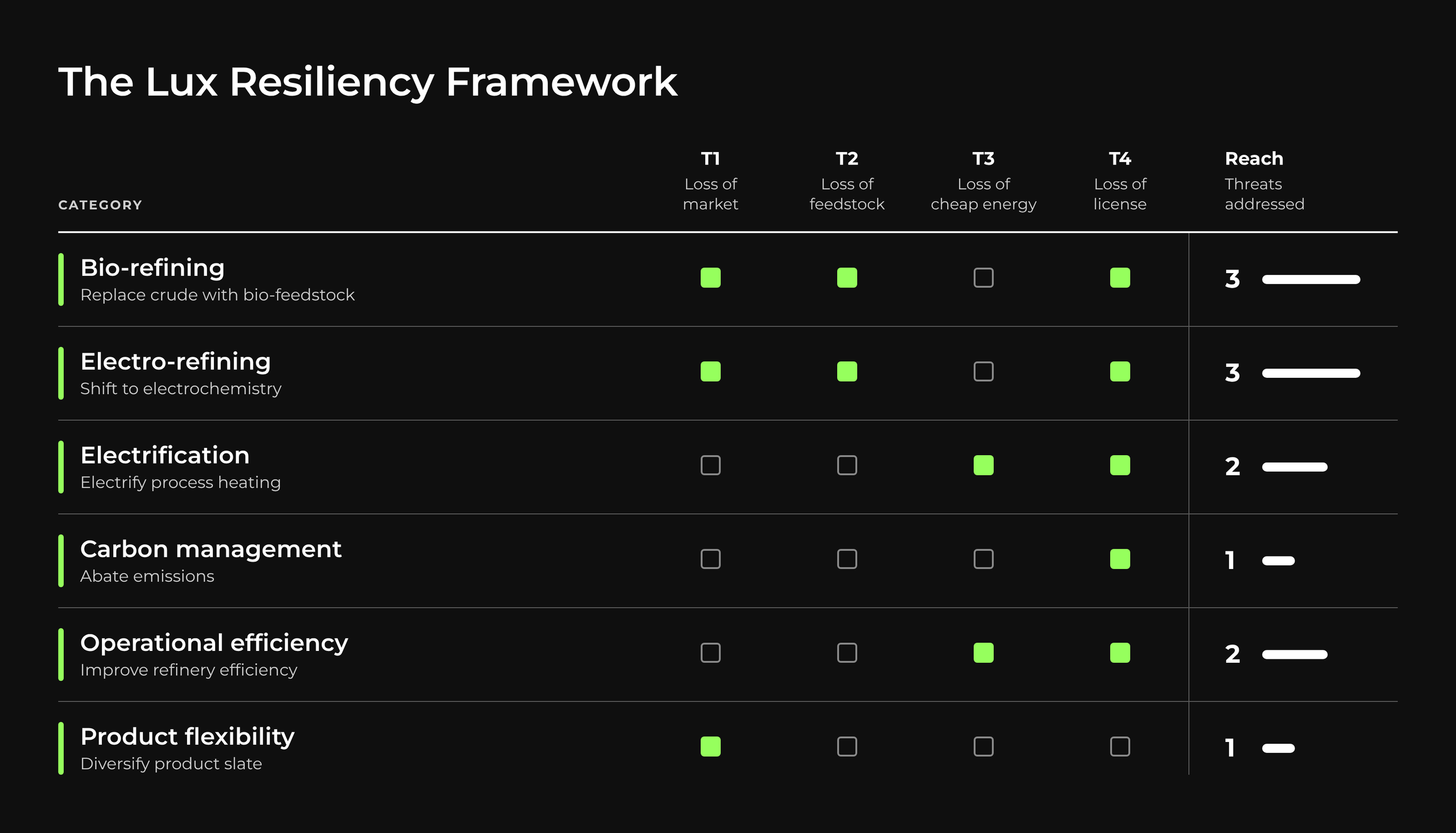
Bio-refining replaces crude oil with a bio-based feedstock. Co-processing and plastic pyrolysis are already commercial: BP’s co-processing project at its Cherry Point refinery grew from 3,500 b/day in 2018 to 7,000 b/day in 2024, and ExxonMobil plans to extend its Baytown plastic pyrolysis capacity to 200 kT/year by end of 2026. The barrier is feedstock. BP’s co-processing is still equivalent to only 3% of the facility’s total throughput, 85% of the waste oil the EU uses for SAF is imported, and the EU recycles only 30% of its plastic waste. Technologies that unlock novel feedstocks, such as synthetic biology, are the way forward.
Electro-refining replaces thermochemical processes with electrochemical ones that use water, CO2 and renewable electricity. Shell launched REFHYNE, a 10 MW PEM electrolyzer, at its Shell Energy and Chemicals Park in Germany in 2021, with capacity scaling up to 100 MW in 2027. The barrier is electricity cost: at EU prices of 60 to over 100 EUR/MWh, hydrogen costs at least three times more than gray hydrogen. Next-generation approaches like decoupled electrolysis can reduce electricity costs by about 10% while also lowering capex.
Electrification swaps natural gas with electricity for high-temperature process heat. SABIC, BASF and Linde launched a 6 MW e-cracking demo unit at BASF’s Verbund site, and Linde is now offering the technology for licensing. But in the EU, wait times for securing a grid connection range from two to ten years. Small modular reactors could supply power on-site, but they fit best as cogeneration for industrial clusters, not a single facility, and won’t be online until after 2035.
Carbon management addresses the loss of license only. Sinopec deployed three carbon capture projects between 2021 and 2023, but solvent-based capture can use up to about 4 GJ per ton of CO2 captured. Reactive carbon capture, which converts CO2 while it is still dissolved in its capture medium, offers 18% energy savings for point-source capture and 30% for direct air capture.
Operational efficiency reduces energy consumption, which cuts both energy costs and emissions. Commercial tools like Tracerco’s Tru-Scan sensors and Sulzer’s VGPlus distillation trays are widely deployed, but still have limits. Newer options include GScan’s muonFLUX, which uses cosmic-ray particles to generate 3D images of refinery reactors, and Ardent’s silver-based membranes, which Braskem tested for 10,000 hours and which Ardent claims deliver 2%–8% higher polyolefin yields.
Product flexibility expands the portfolio beyond conventional oil products. S-Oil is deploying Aramco’s crude-to-chemicals technology, but ethylene production capacity has been growing faster than demand. Critical minerals are another route: ExxonMobil and BASF will build a methane pyrolysis plant in Baytown, and Occidental partnered with BHE Renewables on direct lithium extraction from geothermal brine. The driver is supply chain security, since China dominates graphite supply and lithium refining.
Why single-crisis business cases fail
After the EU Green Deal, European industry announced a wave of decarbonization projects: biofuel plants, hydrogen-based steel, green ammonia and e-methanol. Two years later, the Russian invasion of Ukraine sent natural gas prices soaring. Bio-refining and carbon capture are great for decarbonization, but they are still energy-intensive, and several of those flagship projects were cancelled in 2025.
It’s really about assessing your exposure to the crisis. You can’t predict it, but you can prepare for it.
– Runeel Daliah, Principal Analyst, Lux Research
The same logic applies to technology development: target more than one threat. Value propositions are already shifting. Methane pyrolysis, once promoted for low-carbon hydrogen, is now positioned as an alternative graphite supply route, and green ammonia is being pursued in several regions for food security.
Q&A
Why doesn’t the framework include cost?
Q: Deploying a new sensor is much cheaper than building a new biorefinery, even if they address the same threats. Why wasn’t cost included in this assessment?
A (Cansu Doganay): Cost is a big barrier for most of these technologies, but it is very company- and site-specific. It varies with the type of company, the size of the operation, the customer base and, most importantly, geographic location. Biorefining is a great option if you have access to feedstock, but for many regions the feedstock bottleneck eliminates the option, even if it’s the cheapest. We recommend generating your own resiliency framework according to your business needs, then assessing both the cost of the technology and the cost of adoption.
Watch the full webinar
Watch The Future of Refining: Survive, Thrive, or Retreat? on demand to see the full Lux Resiliency Framework and the innovators in each category.