Key takeaways
- The 2026 midterms put federal climate tech funding back on the table, Lux Research says, with Democrats holding both chambers of Congress and 54+ Senate seats as of the webinar.
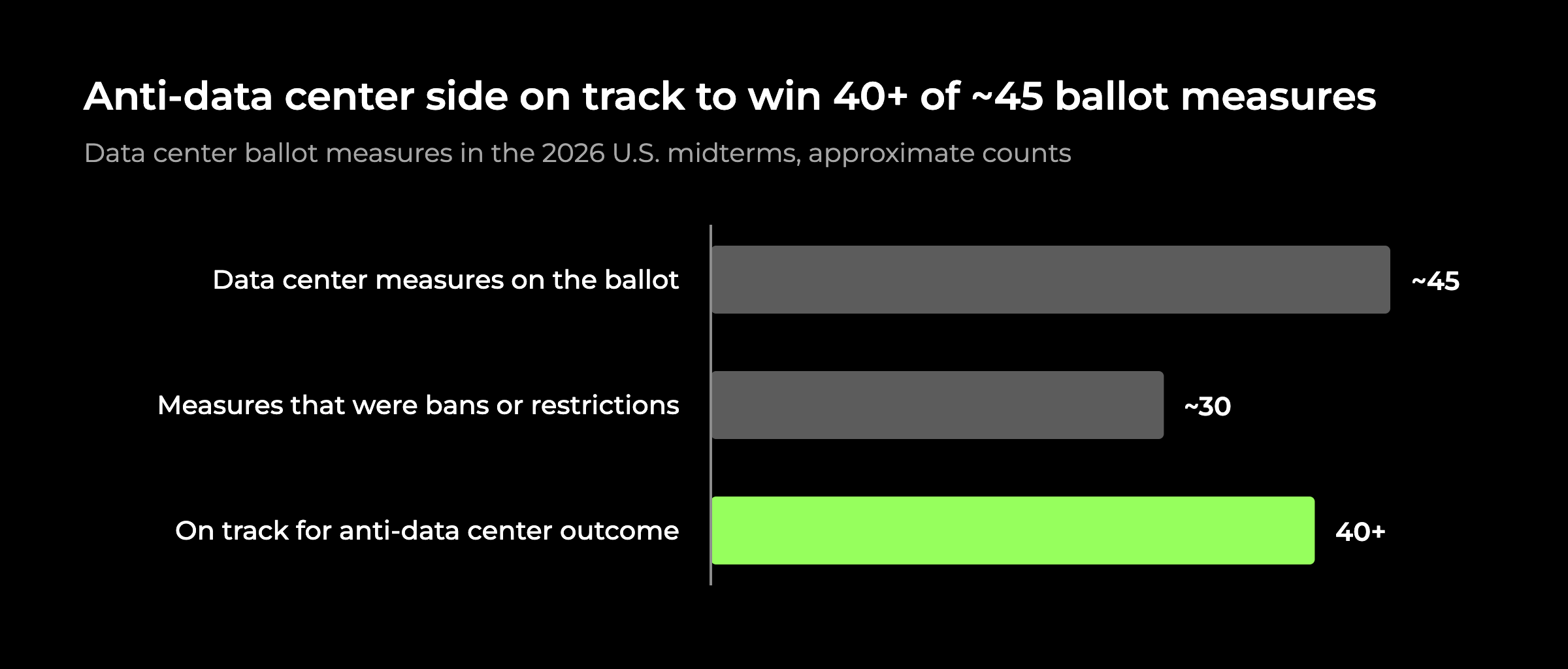
- Data centers lost big on the ballot: of roughly 45 data center measures, about 30 were bans or restrictions, and anti-data center positions were on track to win 40+ of them.
- Data center projects still in planning face 12 to 18 months of delays in many jurisdictions, according to Lux Research, with Texas the most exposed growth market.
- Affordability is now the winning pitch for climate tech: technologies that lower consumer energy bills, such as residential storage and grid flexibility, are best positioned after the 2026 midterms.
- Lux Research expects a shift toward smaller data centers of 25 MW to a few hundred MW, a scale that suits distributed climate tech like batteries, fuel cells, and microgrids.
In the webinar What the Democratic Wave in the U.S. Midterms Means for Innovation, Energy, Climate Tech, and AI, Lux Research Senior Directors Anthony Schiavo and Chris Robinson assessed how the 2026 midterms reshape climate tech, energy, and AI. Their verdict: the election matters far more for innovation than they expected even two months earlier.
Will the 2026 midterms restore federal climate tech funding?
Federal climate tech funding is likely to recover partially, according to Lux Research. Democrats now control both chambers of Congress, with 54+ Senate seats and 28 governorships as of the webinar. That gives Congress leverage to restore R&D funding that the administration withheld in 2025, though agencies like the DOE will take time to rebuild.
Schiavo listed three likely wins: a permitting reform deal, restored clean tech funding, and protecting FERC and NRC independence. Tougher fights include national data center and AI rules, reining in tariffs, and ending the war with Iran, where the president still holds most of the cards.
Robinson was more cautious on funding. Its prospects, he said, depend on how many Republicans in competitive districts break with party lines ahead of 2028.
Why did data centers lose on the ballot?
Voters rejected data centers almost everywhere they appeared on the ballot. Lux Research counted roughly 45 data center ballot measures, about 30 of them bans or restrictions. Anti-data center positions were on track to win 40+ of them, and Schiavo described public opposition as roughly 75–25.
Texas is the clearest example. Governor-elect Gina Hinojosa has promised a data center moratorium and lower retail electricity costs. John Rosenthal became the first Democrat on the Texas Railroad Commission since 1990. Georgia Democrats won a majority on the commission that regulates Georgia Power.
Robinson’s advice to developers: offer communities a direct financial benefit, not jobs pitches. He cited a Netherlands data center that won approval during a moratorium by feeding its waste heat into the local district heating network.
Why is affordability the new pitch for climate tech?
Affordability is the message voters rewarded, so climate tech that lowers bills is best positioned, according to Lux Research. The technologies stay the same; the framing changes. Robinson pointed to Base Power, a residential storage company that raised $1 billion while pitching domestic manufacturing, lower bills, and reliability rather than decarbonization.
Schiavo argued the backlash could help both climate tech and AI. Lux has long been skeptical of forecasts of 350 GW of data centers, expecting closer to 50 GW. Restrictions should clear out weaker projects and push hyperscalers toward data centers of 25 MW to a few hundred MW. Distributed technologies such as lithium-ion batteries, fuel cells, microgrids, and quieter cooling fit that scale better.
Lux Research’s recommended actions for clients:
- Lead with affordability: position climate tech as a way to lower consumer energy bills.
- Stress-test data center exposure: expect delays and higher costs, especially in Texas.
- Revisit non-data center plays: methane detection, bio-based materials, and carbon capture could regain federal support.
- Plan for volatility: avoid betting on any one policy regime.
Q&A
How should companies approach carbon capture after the 2026 midterms?
Carbon capture will be harder to sell than affordability-focused climate tech, according to Robinson. Unless captured CO2 becomes a valuable product, which no one has done at scale, it adds cost to a project. Its economics depend on a carbon tax or offtake agreements for credits. He advises having a plan ready in case new subsidies arrive.
Will the new Congress pass federal data center or AI rules?
Possibly, but Robinson expects state and local action to matter more. Local opposition, not federal law, is what is blocking data centers today. President Trump has consistently positioned himself as pro-AI, so national data center and AI rules sit among the tougher fights for the new Congress, while state measures are already passing.
Will the data center backlash hurt or help climate tech?
Expect a rough near-term transition but a better long-term position, according to Lux Research. Many climate tech startups pivoted to data centers because that is where the money was. Restrictions make grid-independent designs more attractive: microgrids, batteries, load shifting, and novel cooling help data centers win approval with minimal grid impact.
Go deeper on energy innovation priorities
Policy volatility, rising demand, and tighter project economics are reshaping how oil and gas companies and utilities set innovation priorities. Lux Research’s e-book, led by Chris Robinson, breaks down the ten priorities emerging across the energy sector, drawn from 80+ annual reports and 30+ industry interviews.