How AI infrastructure became a consumer issue
Opposition to AI infrastructure is becoming a question of economic fairness, not simply NIMBYism. While consumers increasingly benefit from AI-powered services, they are questioning why local communities should absorb the electricity costs, resource demands, and environmental consequences of infrastructure whose benefits often extend far beyond those communities.
The 2026 U.S. midterms made this tension politically significant. According to The Hill, 76% of voters in an NBC News exit poll opposed new data centers in their communities, while 56% considered the issue crucial or a major factor in their congressional vote. Across the country, an overwhelming majority of ballot measures restricting data center development passed, signaling widespread opposition to the industry’s rapid expansion.
Data centers have become a visible symbol of broader concerns about AI, from rising living costs and environmental pressures to job displacement and Big Tech influence. Developers must now consider public acceptance alongside technical capacity.
LUX TAKE
The rejection of AI data centers in the 2026 U.S. midterms exposes a disconnect between AI’s promised benefits and consumers’ willingness to absorb its infrastructure costs. Concerns about electricity affordability, local resources, and job displacement are turning data centers into a focal point for broader AI distrust. Clients should prioritize resource efficiency, grid flexibility, and measurable community benefits as public acceptance becomes a constraint on AI expansion.
Electricity affordability is turning AI growth into a household concern
The most immediate concern is that data center expansion will increase electricity costs. Large facilities require substantial power connections and potentially new transmission and generation capacity, raising questions about whether households will bear part of these investments.
This connects to two themes identified in Lux’s 2026 Mid-Year Consumer Trends: affordability and growing backlash against AI in consumer goods. Opposition to data centers suggests this backlash extends beyond rejecting AI-enabled products and embracing tangible alternatives, such as analog and nostalgic products, to the infrastructure powering AI itself.
These concerns are translating into political demands. In Texas, Governor-elect Gina Hinojosa campaigned on restricting data center construction. In Ohio, tax breaks for developers became an issue in the Senate race, according to The Hill.
For clients, this creates demand for grid-flexible operations, energy storage, and power management systems that reduce peak demand and limit costs passed onto households. Demonstrating these benefits could become as important to project approval as securing electricity supply.
Water, land, and local resources are making AI’s footprint harder to ignore
Electricity is only part of the problem. Data centers can compete for water, land, and infrastructure, particularly where local resources are already under pressure. Cooling requirements raise concerns about water consumption, while large campuses bring construction, noise, and landscape changes.
In Emporia, Kansas, voters approved a ban on high-impact data centers following a proposal for a 1,000-acre, gigawatt-scale development, according to The Guardian. The concern reflects an imbalance between local costs and distributed benefits: facilities support AI services used globally while concentrating resource demands within individual communities.
AI distrust is shifting from digital risks to real-world economic impacts
Consumer concerns about AI are increasingly shifting toward affordability, expanding beyond traditional issues of privacy, misinformation, and reliability. Lux’s consumer data reveals that negative perceptions of AI are increasingly shaped by concerns about its impact on household finances, particularly the potential costs passed on to consumers from expanding AI infrastructure and growing uncertainty around job security.
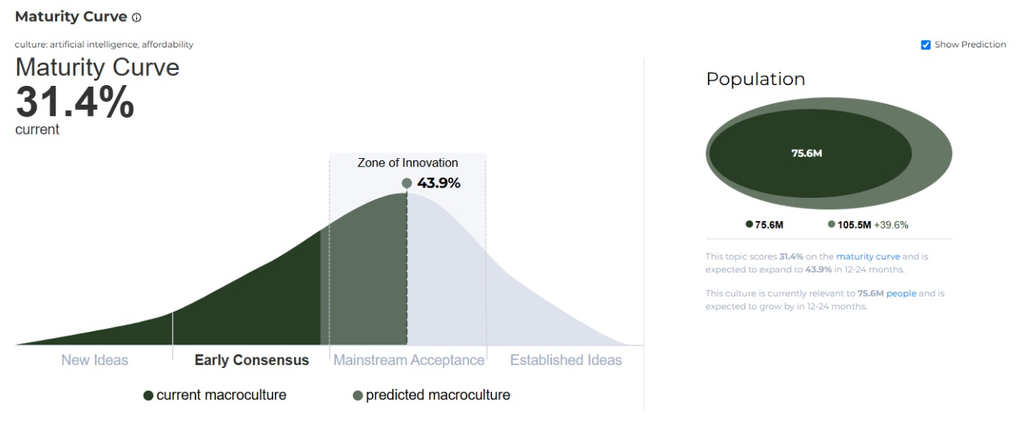
These shifting concerns are also becoming politically relevant, as AI infrastructure and affordability emerge as interconnected issues surrounding the 2026 midterm elections. As highlighted by The Hill, opposition to data centers in states like Texas and Ohio illustrates growing concerns about energy costs and the impact of AI infrastructure on local communities.
This evolution also reflects a broader shift in expectations around corporate accountability, echoing the themes of trust and authenticity explored in Lux’s 2026 Mid-Year Consumer Trends. As AI’s economic and physical footprint becomes more visible, consumer trust will increasingly depend on whether companies can demonstrate tangible benefits for households and communities, rather than relying on promises of technological innovation.
Local value is becoming as important as technological progress
The backlash exposes a gap between AI’s benefits and the costs of supporting it. Consumers encounter AI in shopping, work, and entertainment, yet resist the facilities needed to expand these services.
This is not necessarily inconsistent. AI services deliver direct convenience, while nearby data centers can create tangible costs. National technological leadership is an abstract benefit compared with household electricity bills or concerns about local resources.
Developers can address this imbalance through concrete community contributions, including funding grid improvements, protecting household energy costs, and creating credible local economic opportunities. However, substantial capital investment does not necessarily translate into large numbers of permanent jobs. Clients should avoid relying on investment size alone as evidence of community value.
The opportunity is to position data centers as infrastructure delivering measurable local benefits, not just computing capacity for technology companies.
Local opposition is changing AI infrastructure investment priorities
Community acceptance is becoming a material constraint on data center expansion. Restrictions on construction, zoning, and resource use can delay projects, increase costs, and undermine otherwise attractive locations.
The implications extend beyond AI infrastructure. As Lux examines in What the Democratic Wave in the U.S. Midterms Means for Innovation, Energy, and AI, restrictions on data center development could delay projects by 12 to 18 months in key areas, with consequences for energy investment and clean technology deployment. At the same time, political pressure to lower household energy costs could favor innovations that deliver affordability benefits independently of AI expansion.
For clients, three priorities emerge. Site selection must account for electricity prices, water stress, and community opposition alongside conventional economic factors. R&D should prioritize water-efficient cooling, energy storage, and demand flexibility to reduce pressure on local resources. Developers should also establish measurable commitments to protecting household energy costs and delivering local benefits before seeking approval.
Technologies that improve both resource efficiency and community acceptance could gain a competitive advantage, even without the largest immediate operating cost savings.
Outlook
The 2026 midterms show that consumer backlash against AI is extending from digital products to the infrastructure supporting them. Data centers are becoming a test of whether technological progress can coexist with household affordability and community well-being.
For clients, commercial viability will depend on minimizing resource demands, protecting households from infrastructure costs, and demonstrating verifiable local benefits. Failure to address these concerns risks permitting delays and stranded investments.
The strongest opportunities lie in grid-flexible operations, efficient cooling, energy storage, and transparent resource monitoring. AI infrastructure will compete not just on computing capacity and cost efficiency, but on its ability to earn community acceptance.