Innovation is getting harder, and money alone doesn’t guarantee that a startup will scale. In our webinar Innovating Innovation: How to Spot Startups That Will Scale, Lux Senior Director and Principal Analyst Anthony Schiavo used two Lux data tools to tackle two questions: How can we identify high-potential, underserved technology areas? And how can we predict which startups are most likely to scale?
Key takeaways
- Be systematic about technologies, not just startups. It’s possible to be systematic in identifying not just startups but also technologies and themes to invest in.
- Momentum is the best predictor. Early-stage momentum is the best predictor of long-term startup success.
- There are still good bets. There are both good technologies and good investments out there, even in the current innovation environment.
Why innovation is getting harder
In Lux’s most recent survey, clients overwhelmingly said the risk environment was hurting their ability to innovate. Only 7% expected the innovation risk environment to improve over the next three years; 93% expected it to stay the same or get worse.
Raising funds is hard, too. Climate tech funding is down from its 2021–2022 peak, 2025 was back to 2019 levels, and 2026 looks to be a low ebb. Even funding is no guarantee of scale: many startups from the climate tech boom raised a billion dollars or hit a unicorn valuation, then were acquired for pennies on the dollar or went bankrupt.
The VC model of a few big wins is also hard to do in cleantech. Many climate-critical technologies have limited addressable market sizes, especially compared with AI, and climate tech is structurally high capex with low relative returns. As Anthony put it, we need to innovate the way we do climate tech innovation: do a better job distributing capital, and do a better job identifying which companies can scale.
Finding underserved technology areas with the Lux Tech Signal
The Lux Tech Signal tracks how innovation ecosystems develop. It is forward-looking, data-driven and predictive: it combines patents, academic publications, venture funding, early-stage government funding and Lux proprietary analysis into a single deduplicated, mapped and tagged database. It maps three key elements of innovation activity:
- Activity: a combined, normalized level of innovation events for a technology.
- Vitality: the size and diversity of the innovation ecosystem, including the number of players, collaboration, geographic diversity and new entrants.
- Reinforcement: the impact that new innovation will have on future development; in Anthony’s words, how fast the innovation flywheel is spinning.
Lux mapped 91 technology areas with the Tech Signal. Headliner technologies such as Li-ion, quantum and EVs are very large and vital ecosystems. Emerging technologies such as methane pyrolysis and paper packaging are relatively small and low-activity. The most interesting group is vital technologies, such as electrical heat and thermochemical biomass conversion, which have a lot of vitality relative to activity: many players and new entrants, but not yet the patents, publications or funding to match.
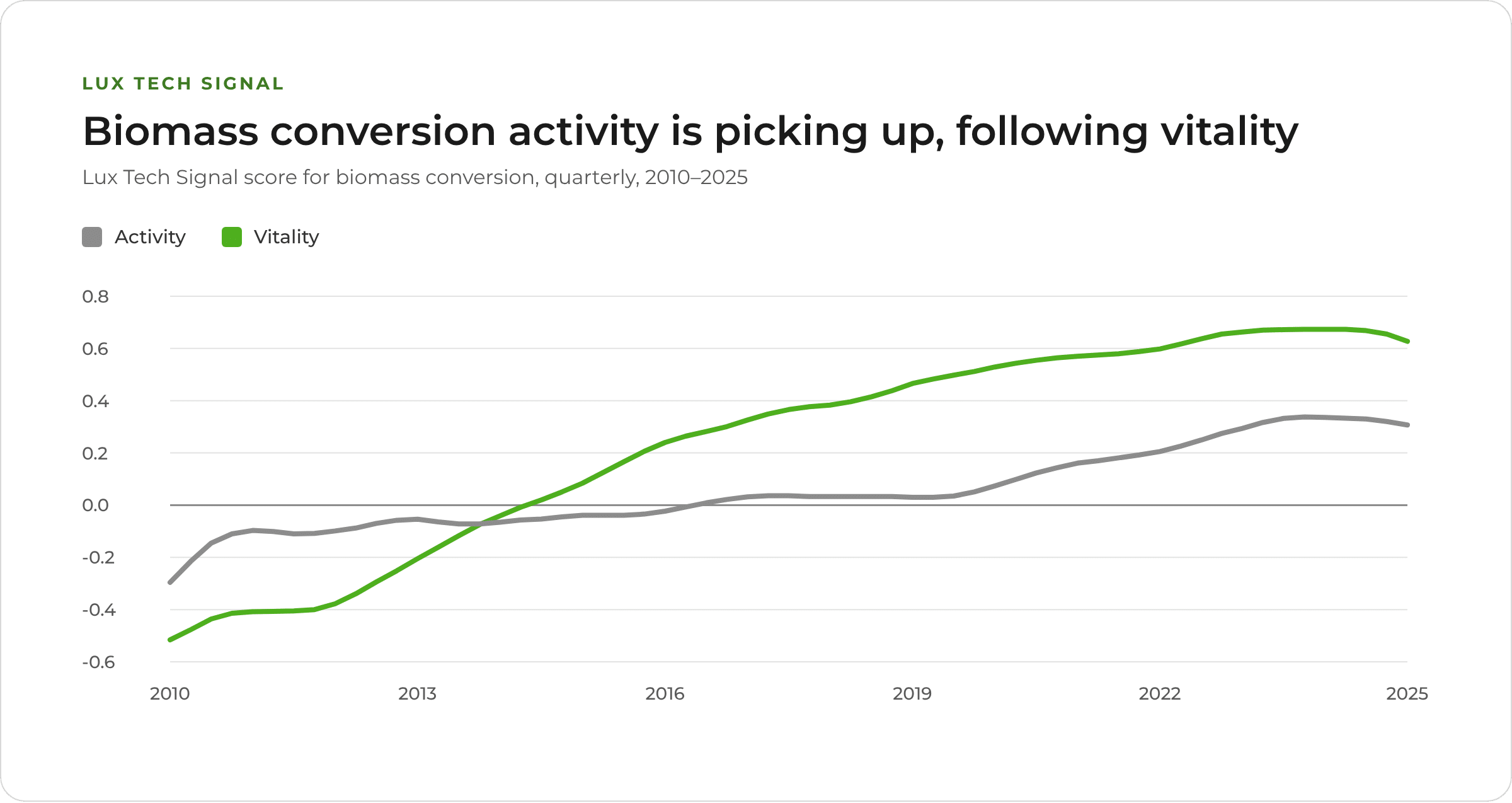
Biomass conversion turns waste resources like lignin into useful products. A post-2020 interest in carbon removal drove activity, but vitality began rising long before that, and VC funding lags other technologies. Grants and papers drive the signal: there is research waiting to be commercialized here.
Clustering technologies by reinforcement reveals the innovation valley of death, which the model inferred from the data on its own. But some technologies in that valley are still highly reinforcing. Advanced plastic recycling went through a major boom-bust cycle in the past few years. Despite that, the core research remains very strong and new companies are emerging. This is a time to build on a highly reinforcing ecosystem.
The Tech Signal can show where startup formation is likely to occur and where investing can drive future activity. What it can’t tell us is whether a technology, or a company, is likely to succeed.
What predicts which startups will scale
To answer the second question, Anthony turned to Lux’s innovator assessments: an interview with a C-level executive, an assessment by the analyst, a fact check and publication. The methodology has been refined over 15 years and about 17,000 briefs. That’s roughly 11,000 individual startups, about 2,800 of them profiled at scale stage.
Each assessment includes the Lux Scorecard, which rates technology value, management, partnerships and momentum (how much a company has achieved in roughly the last six months). Comparing lab-stage and scale-stage companies shows that technology value barely changes over a startup’s life. Management and especially partnerships are what set scaled companies apart.
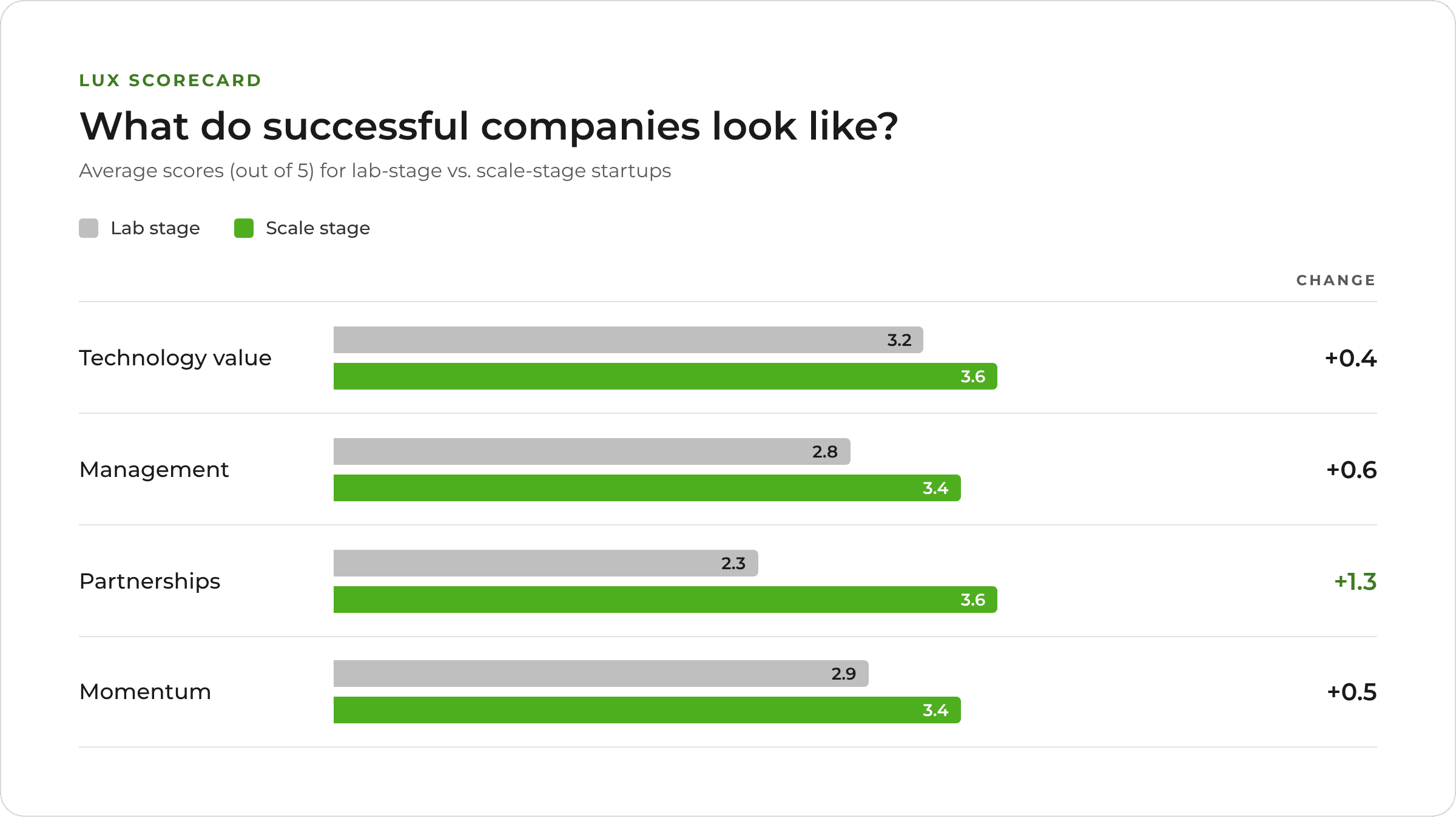
But what predicts scale is different. Lux has interviewed about 7,200 companies before scale, about 2,450 of them more than once, and about 600 went on to achieve scale stage after being profiled. Compared with the whole pool of early-stage startups, those future winners scored higher on momentum (+0.3), partnerships (+0.2), management (+0.1) and technology (+0.1).
Momentum and partnerships are the most predictive of long-term success. Going from a three to a four out of five on momentum makes a company about 20% more likely to succeed, or about 3% more likely in absolute terms. Management, by contrast, is not very predictive at the early stage: statistically, a team of serial entrepreneurs is not that much more likely to succeed than two PhDs founding their first company straight out of the lab.
Lux can use this to identify promising innovators, even in tough spaces. Lab-stage Nova Biochem uses catalyst-free hydrothermal depolymerization to convert kraft black liquor into aromatic monomers and oligomers. It scores only a 2 on management, but a 4 on both momentum and partnerships. Development-stage Recyc’Elit, with PET-selective methanolysis in mild conditions, scores a 3 on management and momentum, and a 4 on partnerships. As Anthony put it, the conventional wisdom about technologies and startups doesn’t stand up to the data.
Why good startups go bad
Even startups with a better chance to scale are still likely to fail. Anthony pointed to three pitfalls.
Platform technologies without focus. Graphene has had an incredible amount of research and activity over the last two decades, with activity reaching two standard deviations above average on the Tech Signal. Companies scaled up production and cut costs dramatically, yet commercial activity was not very successful, because many sold the material and left customers to figure out what to do with it. Startups need a very clear use case and value proposition.
Corporate innovators lack clarity and speed. Startups need to know who is who and not be surprised by stakeholders. Corporates often can’t answer “What are the steps to getting a deal done?”, and most legal agreements are bespoke. The VC world has standardized much of this for speed and consistency, and corporates can learn from it.
Overcapitalization as well as undercapitalization. Startups can be underfunded, but they can also be overfunded, as many were in the last cleantech bubble.
We knew that there was a misalignment with our business model, but when you are offered half a billion dollars it’s really hard to turn it down.
– SPAC’d start-up CTO, in conversation
It’s on corporate partners, board members and investors to help companies stay disciplined about when to take the money and when to leave it on the table.
Q&A
Isn’t management quality an important early signal?
Q: Isn’t the quality of management essential to building momentum and partnerships? Why isn’t it an important early signal?
A (Anthony Schiavo): Management quality is ultimately very important. The question is what you can measure. Nobody can sit down with every startup, so innovators have to pre-filter, and that’s where they tend to over-index on experience, accolades and serial-entrepreneur credentials. At that stage, lean more on momentum. Once you’re making a final investment decision, you’ll be working with these people, and you should feel good about them.
Where would you invest $10 million today?
Q: If you had $10 million to invest today, where would you invest?
A (Anthony Schiavo): Personally, protein-based materials outside food and health, for things like coatings, functional materials, packaging and even structural materials. It’s very early stage and speculative. For the strongest signal, data center cooling and thermal management: even if the data center bubble bursts, a lot of data centers are already being built and will need better cooling and energy management solutions.
Watch the full webinar
Watch Innovating Innovation: How to Spot Startups That Will Scale on demand to see the full Tech Signal map and innovator data.