
The Lux Take
Water use in data centers is shifting from a disclosure metric to a binding constraint on permission to operate. For materials and systems providers, several new revenue opportunities are emerging in retrofit control and sensing systems to raise cycle of concentration (CoC) and reduce blowdown, reclaimed-water integration, and coolant and materials systems for warm-water liquid cooling architectures. The strongest long-term opportunity lies in reducing or eliminating facility-level water use through system-level design shifts such as hybrid dry-adiabatic architectures or liquid cooling.
Rising Rack Densities and the Growing Water Demand in Data Centers
As rack power densities increase from 10–20 kW to more than 150 kW (AI training clusters), cooling systems remove significantly more heat per unit footprint. Most data centers today are in regions where the average temperature of operations is higher than the American Society of Heating, Refrigerating and Air-Conditioning Engineers (ASHRAE) recommends (18 °C–27 °C). Higher atmospheric temperature leads to greater water and energy use. As a result, total water consumption in data centers is expected to reach up to 2 trillion liters annually by 2030, depending on the growth scenario. While this amount is 0.05% of total water demand, the geographic concentration of the data centers and potential water stress are causes of concern. These water-related risks are across three dimensions:
- Availability. Many new data centers are being built in water-stressed regions due to proximity to power, land availability, and/or tax incentives.
- Quality. Advanced cooling systems require tighter control of particulates, ions, and biological contaminants.
- Regulation and societal perception. Water use increasingly attracts scrutiny from regulators and local communities, affecting permitting timelines and expansion approvals.
This brief summarizes water use across data centers, outlines quality requirements, and highlights water use mitigation strategies and associated innovation opportunities.
Water Use in Data Center Cooling Systems: TCS vs. FCS
In a data center, water primarily circulates in the technology cooling system (TCS) and facility cooling system (FCS) as shown in Figure 1. Most liquid cooling systems in the technology cooling loop are closed and effectively have no water loss. While liquid cooling is gaining market share, the significant stock of legacy infrastructure still uses air cooling, which uses traditional heat rejection units like evaporative cooling towers. The primary water use happens in the FCS, and the intensity depends on the configuration of heat rejection. A key parameter to normalize the water use is water usage effectiveness (WUE), expressed in liters per kilowatt-hour (L/kWh), a metric that varies widely across different types of data centers and cooling systems.
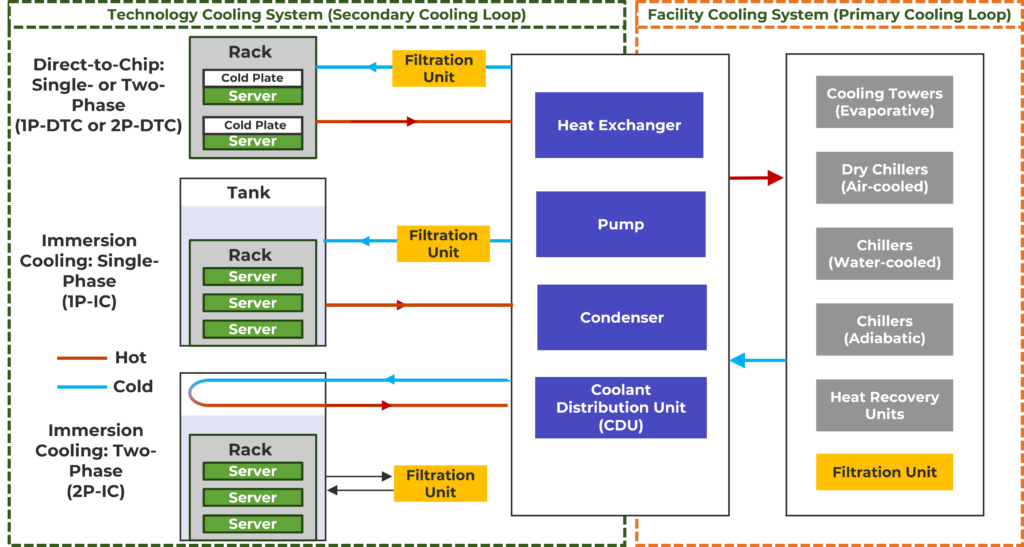
Figure 1: Cooling system configurations for liquid cooling systems in data centers (Note: Only 1P-DTC uses water in TCS; 2P-DTC and IC configurations use dielectric fluids.).
Water consumption in data centers is dominated by the FCS (heat rejection), while TCS are typically closed loop and water neutral. The following sections explicitly distinguish between these two domains. Evaporative chillers have the highest water use profile.
Water Quality Requirements for Data Center Cooling Infrastructure
The water quality requirements for data centers vary widely for the TCS and FCS. A liquid TCS, especially 1P-DTC loops, are primarily closed-loop systems with water or water-glycol mixtures. The size of the microchannels in the cold plates drive the particulate size requirements. Currently, a typical filtration system for the DTC is in the range of 5 µm along with additives for preventing biofouling and corrosion. With smaller features on the cold plates, the filtration requirements will further drop to submicron ranges (<15 µm). To achieve these requirements, the filtration units primarily sit upstream of cold plates in the DTC setup and have become an integral part of the liquid cooling system. IC systems have similarly stringent cleanliness requirements but employ fluid-compatible filtration media designed for dielectric fluids.
On the other hand, the water quality requirements for the FCS are relatively relaxed. In practice, side-stream filtration treats 5%–20% of circulating flow with typical particle removal in the 10–50-µm range, depending on water quality and target CoC. In the FCS, operators must keep water within defined parameters to prevent scaling, corrosion, fouling, and biological growth that can reduce cooling efficiency and damage equipment.
ASHRAE does not prescribe specific filtration micron ratings for the TCS and FCS. As a result, OEMs, hyperscaler standards, and reference designs define filtration and fluid cleanliness requirements. DTC system providers like Vertiv, Motivair, CoolIT secure off-the-shelf filtration units to retrofit coolant distribution unit racks or partner to design custom filtration and fluid-quality management systems to maintain the quality of water in the TCS. Several large industrial filtration players such as Entegris, Mann+Hummel, and Parker offer polymer-based micro- and ultrafiltration membranes for the TCS and FCS. Startups find it hard to penetrate this business segment as data centers typically work with companies that can guarantee reliability and scale-up.
Water Management Innovation Opportunities
1. Increasing Cycle of Concentration (CoC) to Improve WUE
Increase CoC: Because the majority of evaporative water loss occurs at the cooling tower, most water treatment and filtration companies target this application to improve facilities’ WUE. Water reuse strategies in data centers focus on increasing CoC in evaporative cooling systems and transitioning to closed-loop liquid cooling, which uses minimal water. CoC measures how many times water is reused before discharge by comparing total dissolved solids (TDSs) in recirculating water to those in incoming makeup water: A higher ratio means more efficient water use. Traditional data centers operate at low CoC levels (3×–7×) to minimize risks of scaling, corrosion, and biofouling, favoring excess blowdown over system complexity. However, this results in high water use and poor WUE, which conflicts with hyperscale sustainability goals, especially in locations facing higher water stress. New data centers are pushing toward significantly higher CoC levels, commonly targeting 8×–15× (at least), to reduce blowdown volumes and freshwater intake. Increasing CoC, however, fundamentally concentrates all nonvolatile constituents in the circulating water, creating three primary technical constraints: accumulation of suspended solids, scaling from dissolved minerals, and amplified biological growth.
Advanced filtration systems are the primary enablers that allow data centers to operate safely at higher CoC by reducing fouling and scaling. In one example, a data center operator partnered with Veolia Water Technologies to upgrade its cooling tower treatment and monitoring, enabling stable operation at significantly higher CoC. The improved control of pH and chemical dosing nearly doubled cooling tower cycles, resulting in an estimated 50% reduction in makeup water demand, equivalent to approximately 12 million gallons of water and USD 150,000/y in operating cost savings — active cycle optimization directly translates into water reuse benefits. Singaporean startup Hydroleap builds electrooxidation and electrocoagulation systems for data centers to provide similar benefits. Unlike traditional polymer and inorganic chemicals, Hydroleap’s systems generate reactive oxidation species that eliminate biofilm and remove hardness with minimal chemical waste. The company has delivered up to 70% blowdown water saving, 5%–15% energy efficiency improvements (chillers and pumps), and about 50% chemical savings, while improving CoC levels.
2. Alternative Water Sources and Reclaimed Water Integration
Use alternative water sources: In regions of high water stress or where access to water permits is limited, hyperscalers are tapping into reclaimed municipal wastewater as a strategic alternative to freshwater withdrawals. A good example is the Quincy Water Reuse Facility built in the state of Washington, where high-TDS cooling tower blowdown from regional data centers could not be discharged directly to the municipal utility due to calcium, magnesium, and silica loads. Instead, Microsoft partnered with the city to finance and build a dedicated reuse utility that treats data center cooling water through lime softening, ultrafiltration, and reverse osmosis, reclaiming the treated water back to its data center or for other nonpotable applications. Similar models are already operating at scale, but recycling wastewater will often need advanced water treatment trains. Integrated system providers like Saltworks Technologies, Gradiant, and Aquatech International (through its subsidiary Qua Group) are building high-purity water reuse projects targeting minimal or zero-liquid discharge. Singapore’s NEWater program is a benchmark for indirect and direct potable reuse, supplying high-purity reclaimed water to industrial users, including data centers, through advanced membrane and oxidation processes.
Other approaches to significantly reduce cooling water use include Infinite Cooling’s software-hardware combo, which optimizes cooling tower performance and recaptures exhaust plumes for reuse. More aggressive strategies, like large-scale seawater cooling projects in China and Finland, require advanced filtration to manage dissolved solids, suspended particles, and microbial risks. Companies in filtration and monitoring should track these shifts as high-value deployment opportunities.
3. Eliminating Water Use Through Dry and Hybrid Cooling Architectures
Eliminate water use: Data centers eliminate water use by minimizing evaporative heat rejection through dry cooling, hybrid dry-adiabatic systems, and liquid cooling with dry heat rejection. These methods can drive on-site WUE to near zero but introduce tradeoffs in energy use, cost, and performance that depend heavily on climate and system design.
Fully dry cooling systems, such as air-cooled chillers, air-cooled condensers, and pumped-refrigerant economization, reject heat sensibly to ambient air and eliminate cooling tower evaporation entirely. These systems can achieve a WUE of 0 L/kWh but operate at higher condensing temperatures, increasing compressor lift and fan energy. Microsoft has disclosed that its new zero-water data center designs avoid more than 125 million liters of water per facility per year but acknowledge a power usage effectiveness increase relative to evaporative designs, mitigated through higher coolant temperatures enabled by liquid cooling. Similarly, Digital Realty has reported savings of over 300 million gallons of water annually across its portfolio through adoption of pumped-refrigerant economization systems, effectively trading water consumption for higher electrical load during peak ambient temperature conditions.
Hybrid dry-adiabatic systems represent a near-elimination strategy, using dry heat exchangers as the default mode and activating evaporative precooling only during extreme temperatures. Engineering studies and deployments indicate that these systems can reduce water consumption by 80%–95% compared with conventional cooling towers while avoiding the worst-case energy penalties of fully dry systems. For example, Shumate Engineering reports that its hybrid dry/liquid cooling architecture — designed to support both air and DTC liquid cooling — can achieve 93% water reduction and 50% energy savings relative to baseline designs, by operating wet only during a limited number of peak hours.
Architectural elimination of water use increasingly relies on DTC liquid cooling paired with dry coolers, which enables higher water temperatures (often 30 °C–45 °C) and significantly expands economizer hours. Nvidia recently announced that next-generation systems, such as the upcoming Vera Rubin platform, can operate using hot water (~45 °C) for heat transfer, removing the requirement for water chillers. Moreover, this shift opens opportunities for the incumbents to design components that can sustain higher temperature.
Outlook: Water as a Strategic Constraint in AI-Driven Data Center Growth
AI’s thirst will turn water from a background utility issue into a strategic matter for data centers. Although absolute consumption remains small at the global level, geographic concentration of data centers in water-stressed regions creates regulatory, cost, and reputational exposure for companies. In response, utilities and operators must demonstrate reduced freshwater withdrawal through higher CoC, alternative water sources, and credible water management plans that will include advanced filtration and reuse of process water. In the near term, filtration and fluid-management suppliers can drive growth via retrofit optimization with cooling system OEMs while positioning for differentiation by qualifying into next-generation liquid cooling and water-elimination designs.
For more insights on technologies shaping industry opportunities, see 30 Tech Trends for 2026.