
Key takeaways
- AI in synthetic biology (synbio) delivers the most value in automation-driven applications, not breakthrough discovery.
- Novel molecule discovery leads in AI value, combining strong knowledge gains with measurable commercial impact.
- AI in strain engineering and bioprocessing remains incremental, improving efficiency but not transforming outcomes.
- Lab automation and robotics offer the highest near-term ROI, driven by throughput, cost reduction, and scalability.
- The gap between AI hype and real commercial value persists across most synbio applications.
- Over the next 2–3 years, AI impact will be driven more by operational efficiency than by scientific breakthroughs.
The Lux Take
Today’s most valuable AI applications in synbio look less like creative discovery and more like “administrator” platforms: They excel at executing highly structured, repetitive workflows. Yet, without a matching rise in knowledge value, these gains merely speed up existing processes rather than unlock new capabilities. As seen in the AI Application Value Model: Synthetic Biology, even the lone rock star application is barely driving both knowledge and automation value; as such, the clear differentiation of AI vs. incumbent approaches is still not that stark.
Because strain and enzyme engineering require deep expertise and complex experimental design, automation and robotics — even when paired with AI — cannot yet replace human input. Over the next two to three years, AI will therefore deliver most of its value through automation rather than knowledge generation. In contrast, platforms for novel molecule discovery will advance on both fronts, increasing both automation and knowledge output as generative models and data sets mature. Meanwhile, AI startups focused on bioprocess optimization will likely proliferate rapidly but soon plateau. With only a limited set of parameters to model and control, these systems will reach their automation limits quickly and generate minimal new insight, creating a crowded market with few meaningful differentiators.
AI in synbio: Where it delivers real value vs. hype
Synbio has repeatedly chased “silver bullet” technologies, only to see platforms underdeliver when hype outpaces measurable returns. As AI increasingly shapes investment and strategy in the field, the key question is where it creates tangible value.
To assess this, we applied Lux’s AI Application Value Model to evaluate both automation value (including labor savings, faster cycle times, and throughput gains) and knowledge value (performance improvements and strategic differentiation). We analyzed four core synbio use-cases: novel molecule discovery, strain and enzyme engineering, bioprocess optimization, and lab automation and robotics.
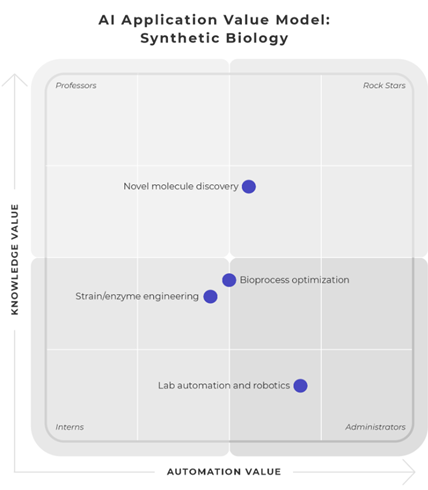
By grounding each assessment in concrete metrics — such as reductions in labor hours for repetitive or standardized tasks, increases in task frequency coverage or speed, and AI-enabled performance gains that surpass human expertise or unlock specialist-level tasks — we aim to distinguish genuine commercial impact from empty promise. This analysis provides a clear view of where AI is poised to create real business value in synbio.
Where AI creates the most value in synbio
Novel molecule discovery – Rock Star
AI-driven novel molecule discovery is classified as a Rock Star in Lux’s AI Application Value Model, reflecting moderate automation value and high knowledge value. This means AI contributes more by enhancing discovery quality than by replacing manual labor. The process of discovering new functional molecules — like enzymes or bioactive compounds — requires deep scientific understanding, high specialization, and strong links between sequence, structure, and function. While AI does not eliminate the need for downstream experimentation, it is uniquely capable of identifying and generating molecules with novel structural and performance properties, thereby delivering significant strategic and commercial advantages.
Examples demonstrate high knowledge value and moderate automation value: AI is equipped to understand and generate novel structures based on well-established structure-function rules and prediction frameworks. For example, Cambrium reports that its AI-driven molecule generation, screening, and optimization platform reduces time to launch by one order of magnitude by generating structures with a 90% secretion success rate, compared with 5% using traditional methods. This platform generated the company’s first product, a human-skin-identical collagen, which has now garnered a commercial distribution partnership with Brenntag, despite Cambrium’s seed stage. In another example, Arzeda used its AI-driven protein design platform to develop novel enzymes for Unilever’s cleaning products, achieving development five times faster than traditional methods — completing the process and integrating the enzymes commercially in just 18 months. These enzymes not only enhanced cleaning performance at low temperatures but also enabled a reduction of up to 50% in formulation ingredients (and thus raw materials costs), demonstrating significant commercial value.
Strain/enzyme engineering (with iterative optimization) – Intern
AI-guided strain and enzyme engineering is categorized as an Intern in Lux’s AI Application Value Model, with moderate automation value and low-to-moderate knowledge value. This reflects AI’s limited ability to replace experimental workflows and its modest contribution to strategic differentiation. In most cases, AI supports incremental efficiency gains in strain development rather than enabling novel functionality or market-defining breakthroughs. Models often help reduce the size of design libraries or prioritize variant testing, but wet-lab iterations and human oversight remain central. While AI reduces labor and time per design-build-test-learn (DBTL) cycle, it does not fully automate the process or meaningfully transform optimization strategy in most current implementations.
Examples demonstrate moderate knowledge and automation value: While AI reduces screening burden and improves cycle efficiency, the overall impact on performance and strategic outcomes remains dependent on additional factors, and experimental design and validation requires human supervision/input. For example, Twig Bio uses AI to design high-yield microbial strains for sustainable ingredient production, analyzing tens of thousands of strain designs monthly and reducing 6 to 12 months of experimental time to a single day. The company claims this enables faster licensing and commercialization of biobased ingredients, though performance outcomes remain tied to conventional downstream strain validations and manufacturing constraints. Moreover, Solugen couples machine-learning (ML)-directed enzyme design to optimize preexisting, naturally robust enzymes to achieve up to 30-g/L/h productivity gains and greater stability in free-enzyme systems. The company claims this supports unit-cost reductions comparable to those of petrochemical routes, demonstrating direct commercial value, though commercial performance ultimately depends on independent validations, scalability, and market integration.
Bioprocess optimization – Intern
AI in bioprocess optimization is categorized as an Intern in Lux’s AI Application Value Model, with moderate automation value and low-to-moderate knowledge value. While AI has been positioned as a solution to reduce process variability and contamination risk or improve real-time decision-making in fermentation, its commercial impact remains modest. Most platforms function more like upgraded analytics or expert systems rather than delivering predictive control or system-level learning. AI may reduce the frequency or intensity of manual interventions, but it typically supports, rather than transforms, the core bioprocessing task. Its strategic contribution is limited by sensor data fidelity, model generalizability, and the highly context-specific nature of fermentation optimization.
Examples demonstrate limited knowledge and automation value: AI is most useful when integrated with high-resolution sensors and control systems, but to date, its commercial value is often incremental and analytics adjacent rather than transformative. For instance, Culture Biosciences developed the Stratyx 250, a cloud-integrated, mobile bioreactor designed to accelerate bioprocess development. This system enables real-time remote control and monitoring, leading to a 16% reduction in total cost per run compared with traditional benchtop bioreactors. Additionally, it offers 25% faster development timelines and a 30% improvement in scale-up success rates. Similarly, Pow.Bio employs an AI-controlled, continuous fermentation platform that has demonstrated significant improvements in biomanufacturing efficiency. Its system minimizes contamination and genetic drift events by detecting, interpreting, and responding to changes in reactor conditions using AI. This approach reduces capex and unit costs by 50% by cutting down on failed batch events, demonstrating commercial value, but success ultimately depends on additional technical and market factors.
Lab automation and robotics – Administrator
Lab automation and robotics is categorized as an Administrator in Lux’s AI Application Value Model, reflecting high automation value but low knowledge value. This positioning highlights how AI adds commercial value primarily by accelerating throughput, reducing labor intensity, and enabling higher reproducibility — rather than generating novel insight. While these systems can integrate closed-loop learning or dynamic decision-making, most operate as rule-driven automation pipelines that offload repetitive or time-sensitive tasks. As such, AI in lab automation adds operational leverage but often does not influence the strategic direction or outcome of the R&D effort itself.
Examples demonstrate high automation value and limited knowledge value: AI enables streamlined DBTL cycles and higher parallelization but adds little beyond operational efficiency or experimental coverage. For instance, Emerald Cloud Lab (ECL) operates a fully automated, remotely accessible life-science facility where ML-driven orchestration lets a single scientist process more than 50,000 samples per year, versus a few thousand in a conventional lab. ECL’s customers report cutting experimental cycle times from weeks to hours, which translates into faster go/no-go decisions and lower per-project overhead.
Connect with our expert at SynBioBeta
Will you be at this year’s SynBioBeta? We’d love to continue the conversation in person — reach out to [email protected] if you’d like to connect.