TMRE 2025
This presentation reveals the anthropological strategy behind McDonald’s imaginative and culturally resonant WcDonald’s campaign.
FEATURING
Jacob Ford, Director of Go-to-Market Consumer Insights at McDonald's
&
Cheryl Auger, Senior Director, Consumer Insights at Lux Research
FULL INTERVIEW
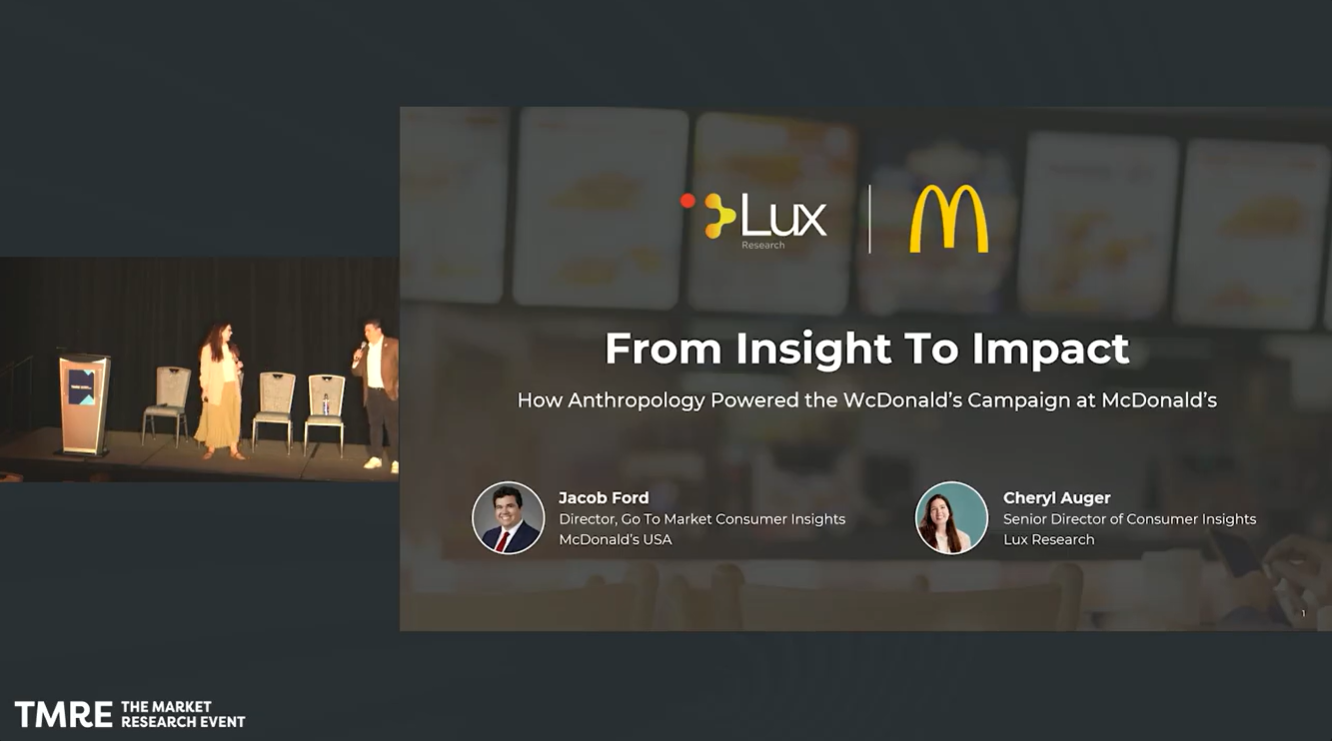
In this insightful session, Cheryl Auger (Senior Director of Research at Lux Research) and Jacob Ford (Director of Go-to-Market Consumer Insights at McDonald’s) revealed the anthropological strategy behind McDonald’s imaginative and culturally resonant WcDonald’s campaign — a creative initiative inspired by anime’s long-standing obsession with the golden arches.
As brands strive for deeper, more authentic consumer connections, traditional segmentation and surface-level trendspotting often fall short. The WcDonald’s campaign exemplifies how uncovering the why behind cultural behaviors, rather than simply tracking the what, can unlock breakthrough creative and commercial opportunities.
Leveraging Lux Research’s ethnographic tools, the team unearthed rich meaning systems embedded in anime fandom, nostalgia, and cultural hybridity. These insights empowered McDonald’s to engage in a passionate subculture with authenticity while avoiding appropriation and amplifying resonance.
Attendees walked away with a new understanding of anthropology not just as the study of people, but also as a powerful lens for decoding the evolving meanings that shape culture, behavior, and brand relevance.
Read Full Transcript
Jacob Ford:
Hi, everyone. Thank you, Michael, for bringing some energy to those introductions. I don’t know if the intros themselves are that exciting, but you made them sound fun.
I love conferences like TMRE, especially sessions like this. I always walk away with new ideas, new ways of thinking, and inspiration I can take back to my own business.
I’m Jacob Ford, and I’m here with Cheryl, a good friend and partner. I’ll kick us off with a quick introduction, Cheryl will walk through the research, and I’ll come back in at the end to talk about how we brought it all to life.
Let’s rewind to the end of 2023. Our U.S. marketing teams, creative agencies, and insights team started noticing something interesting. McDonald’s wasn’t explicitly branded, but its colors, the quick-service restaurant environment, and even the food itself were showing up in anime. Often it appeared unofficially or in a bootleg way.
We thought, there’s something here. There’s an opportunity to create a moment and participate in this culture. But we paused. We asked ourselves: How do we do this without stepping on a landmine? How do we make it authentic?
That’s when we turned to Lux and said, “Help us think this through. Help us understand this culture and our consumers at a deeper level.”
Cheryl:
That’s exactly what we did.
Today, I’ll start by briefly grounding us in who we are at Lux, how we approach anthropology, and why it matters. Then we’ll talk about the research findings, specifically how Gen Z thinks about anime and manga, and why those insights were so critical. From there, Jacob will walk through how those insights shaped the campaign.
At Lux, I work with an incredible team of cultural anthropologists. We combine traditional social science methods with AI-enabled technology. In fact, we were the first company to use AI for ethnographic analysis, starting back in 2018.
We didn’t do this to be flashy or cutting-edge. We did it to solve real problems. Clients told us they wanted research at scale, with larger sample sizes, but without losing the nuance and depth of traditional anthropology. They also told us they needed insights faster.
So we built tools that allow us to ask big questions, especially one we’re obsessed with: What do things mean to people, and why do they matter?
We collect millions of data points every month from online conversations where people can be anonymous and engage in real dialogue. We don’t just track mentions; we analyze context, because meaning lives beneath the surface.
That’s why we use the iceberg metaphor. We want to go beyond self-reporting and uncover the deeper motivations, anxieties, rituals, and values that drive behavior.
Let me give you a simple example. Think about watching TV. Some people use it as background noise while doing chores. On the surface, that seems passive. But when you dig deeper, you find that TV acts as a companion. It helps people feel productive, reduces anxiety, and creates a sense of rhythm and control. That’s the kind of insight we’re after.
With that approach in mind, we turned to the campaign.
Research Findings: Gen Z and Anime
We focused on Gen Z as the target consumer, and what we found was incredibly compelling.
Anime represented authenticity. It allowed Gen Z to connect across cultures and move away from stereotypical Western narratives. It stood for creativity, cultural crossover, and rebellion against dominant norms. It fostered community and subculture.
We then dug deeper into subgroups within Gen Z to understand nuance.
Asian Gen Z consumers saw anime as a way to explore cultural roots while embracing creativity and nonconformity.
Black Gen Z consumers emphasized the importance of representation and talked about “blerd” culture, blending anime fandom with Black identity.
Hispanic Gen Z consumers valued anime as a bridge across cultures and wanted better representation.
White Gen Z consumers also cared deeply about authenticity and gravitated toward anime for its exploration of universal themes like morality, gender, and social justice.
This gave us a rich understanding of expectations, motivations, and even critiques of existing anime content.
Jacob:
This is where we started asking, how do we bring this to life within the McDonald’s system?
It’s not enough to have a great creative idea. We have to sell it internally, tie it to media buying, and make it work operationally. The ability to connect deep subcultural insight to something scalable was critical.
If I had simply briefed an agency to “make an anime McDonald’s campaign,” it would not have been nearly as strong. Instead, we did three key things differently.
First, we partnered authentically. We didn’t just observe anime culture; we worked directly with studios known for creating great anime and manga. We co-created from the beginning to ensure authenticity.
Second, we paired the creative with something universally appealing: a 10-piece McNuggets meal and a new sauce. The sauce gave people an easy entry point. Even if someone wasn’t deeply into anime, the food drew them in.
We also put Sprite front and center. Research showed that Sprite resonated strongly within this cultural context, so the visual pairing of anime-style Sprite and McNuggets became iconic.
Third, we made the campaign fully immersive. We transformed a McDonald’s location in Los Angeles, partnered with Snapchat on custom filters, and created four anime-style story episodes. These weren’t just 15-second ads. They were full 90-second narratives, supported by original artwork and manga extensions.
Consumers could enter the world in multiple ways.
Results
The campaign overperformed across the board.
It significantly over-indexed with younger consumers, particularly 18–34, at a time when the QSR category overall was declining. We gained share against competitors and brought in new customers, including non–McDonald’s users.
The campaign resonated across multicultural audiences, not just one group. Media performance exceeded expectations, and earned media impact rivaled viral moments like the Grimace Shake.
Perhaps most importantly, the campaign took on a life of its own. People engaged with it organically because it felt authentic.
Closing Thoughts
Jacob:
The takeaway for me is this: We all want faster and cheaper insights, but sometimes the most important thing is to pause, go deep, and do it right. Partnering with Lux allowed us to move quickly and thoughtfully.
We need to push beyond surface-level demographics and truly understand motivations, fears, and aspirations. That’s how brands become part of culture, not just observers of it.