
Key takeaways
- The proposed EU ETS reform would give industry an additional 5–10 years to adapt, creating more time to reassess decarbonization technologies and capital investment strategies.
- Changes to emissions allowances, carbon offsets, and funding mechanisms aim to ease near-term pressure while maintaining the EU’s long-term decarbonization trajectory.
- New funding through the Industrial Decarbonization Bank and expanded ETS revenue allocation could improve the bankability of large-scale industrial decarbonization projects.
- Aviation, marine transport, waste incineration, and landfills will face important sector-specific changes under the proposed reforms.
- Companies should use the extended timeline to reassess technology portfolios, prepare for greater electrification, evaluate carbon dioxide removal opportunities, and position projects for public funding.
LUX TAKE
A reform of the EU Emissions Trading System (ETS) was inevitable to align the EU’s targets with the economic reality of the energy transition but will not solve Europe’s broader challenge in industrial competitiveness on its own. Clients in the EU should use the additional 5–10-y runway from the reform to reassess emerging technologies that have cost reduction potential in the new timeline, brace for increased electrification, and leverage new funding instruments to develop bankable projects. Companies that delay or exit projects because of the reform risk encountering the same structural constraints once compliance requirements tighten again in the mid-2030s.
The European Commission proposed a reform of its ETS on July 17, 2026. The proposed changes ease near-term decarbonization pressure on industry, while aligning EU policy and carbon markets with its 2040 climate target. Subject to approval in Q1 2027, the EU will implement the reforms in phases from 2027–2028 onward. In this research brief, we analyze the proposed changes to the ETS, what it means for clients in the region, and implications on the EU’s global positioning.
Why EU ETS reform is needed to balance decarbonization and industrial competitiveness
In March 2026, the EU adopted a binding target to reduce its net greenhouse gas emissions by 90% by 2040 relative to 1990 levels. Achieving this target requires transforming European industry, not shrinking the domestic manufacturing base or reducing production. Successive geopolitical shocks over the last five years, including the Russia-Ukraine war and the Strait of Hormuz conflict, have left Europe with persistently high energy and fuel prices while intensifying competition with Asia for natural gas supplies. This disruption to Europe’s energy system has increased production costs for energy-intensive industries, contributing to a gradual but sustained decline in industrial output. European steelmaking has fallen by 9% this decade, equivalent to 19 Mtonne of lost output. The European chemicals industry has been particularly vulnerable, contracting significantly between 2022 and 2025, with major producers including BASF, Dow, SABIC, and Ineos accounting for 37 Mtonne of lost capacity. Approximately half of these closures involved steam crackers, reducing feedstock availability for downstream petrochemical and specialty chemical producers.
The ETS is not the root cause for Europe’s high production costs and reduced competitiveness, but it amplifies the current pressure because EU industries have global competitors that do not face comparable emissions penalties. The EU ETS is a cap-and-trade system that creates a price for CO2 emissions by allowing a fixed number of emissions allowances to be traded in the market. Although the European Commission does not set the carbon price directly, it controls the supply of allowances. By reducing the number of allowances issued each year, it progressively tightens the emissions cap and drives overall emissions reductions. While this approach has successfully reduced emissions, it does not address the practical barriers to industrial decarbonization. A higher carbon price can improve the economics of installing an electric boiler at a refinery or a carbon capture unit at a cement plant, but it cannot deliver the enabling infrastructure needed to make those investments viable. It does not build the grid connection or pipeline required to operate these assets reliably, secure financing, and turn them into bankable projects.
The EU is approaching a point where it can no longer afford to leave industry’s legitimate concerns unaddressed without risking further deindustrialization. At the same time, it must find a balance between completely backtracking and staying inflexible. Dismantling or suspending the EU ETS, as some Member States have proposed, would not address Europe’s competitiveness challenge. Instead, it would undermine the EU’s first-mover advantage in several low-carbon technologies and leave it vulnerable as other regions continue deploying, scaling, and reducing the cost of these technologies. The proposed ETS reform seeks to strike that balance. It preserves the EU’s long-term decarbonization signal while easing near-term pressure on industry by giving companies more time to adapt and establishing the financial architecture needed to transform the ETS from a carbon pricing mechanism into an investment-enabling framework.
What the proposed EU ETS reforms mean for industry
ETS architecture
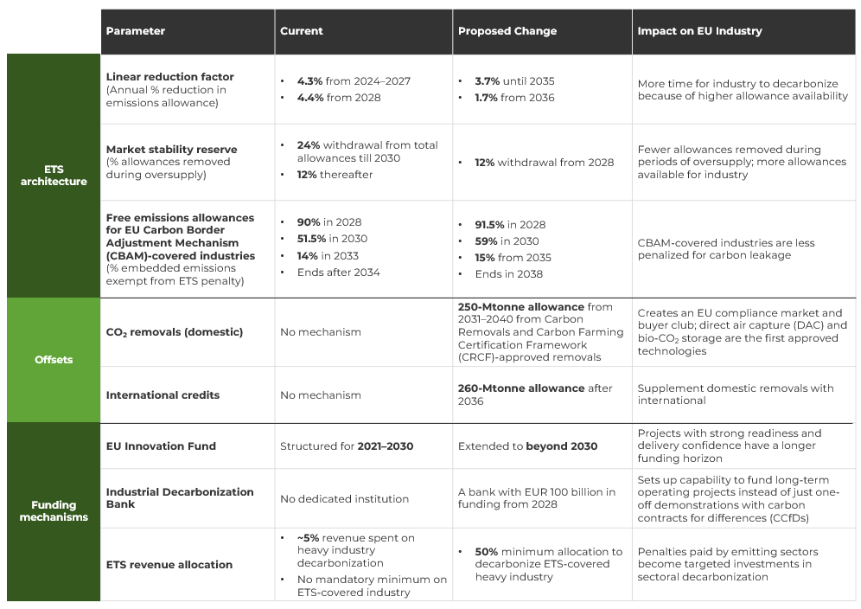
The EU designed the existing ETS to deliver its 2030 target. Under the current linear reduction factor of 4.4%, the European Commission reduces the supply of emissions allowances each year, leaving almost no allowances available by 2039. The proposed reform extends the allowance trajectory to 2050 by reducing the annual linear reduction factor to 1.7%–3.7% during the 2030s. The European Commission also manages allowance supply through the Market Stability Reserve (MSR), which withdraws a fixed share of allowances during periods of oversupply to prevent a collapse in the carbon price. The reform cuts the MSR intake rate from 24% to 12% during the 2030s, making more allowances available to industry. It also delays full implementation of the CBAM by four years and expands the share of embedded emissions eligible for free allowances. Together, these reforms slow the phase-out of allowances, give industry more time to invest, and better align the ETS with industrial investment cycles.
Carbon removals and international credits
The reform introduces 250 Mtonne of domestic CO2 removal (CDR) for compliance between 2031 and 2040 and an additional 260 Mtonne of international carbon credits after 2036. At an approximate price of EUR 100/tonne CO2eq, these measures create a EUR 50 billion compliance market in the EU and generate market pull for durable CDR technologies. For domestic CDR, the European Commission will purchase EU-certified removal credits and auction the corresponding allowances. The CRCF framework defines the eligible CDR technologies. So far, the CRCF has approved DAC, biogenic CO2 storage, and biochar, although the 2026 reform does not mention biochar. International carbon credits become more important in the late 2030s, as the allowance cap tightens and the EU replaces free allowances with the CBAM.
The Industrial Decarbonization Bank
The proposal establishes the EU Industrial Decarbonization Bank as a dedicated institution to fund scale-up using more standardized risk assessment frameworks. During the first phase (2028–2031), the bank will reserve 400 million allowances to fast-track investment in high-impact projects before expanding to EUR 100 billion in funding. It will use CCfDs and other direct investment tools to support industrial decarbonization. While these new funding instruments increase the capital available for decarbonization projects, the reform focuses on enabling continuous, long-term operations rather than demonstration projects that operate for only months or a few years. The reform also increases the share of ETS revenue earmarked for transforming ETS-covered industries. Reports suggest that only 5%–10% of ETS revenue currently supports heavy-emitting sectors; the proposal increases that share to 50%.
The proposal also has industry-specific modifications as outlined below.
Impacts on aviation
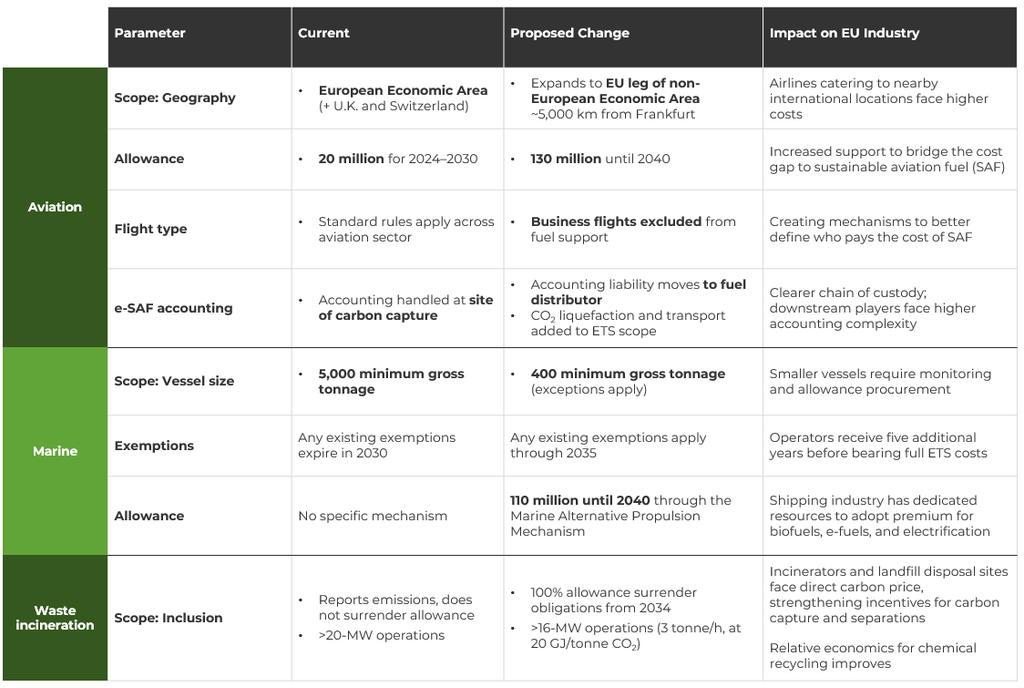
The reform increases the number of aviation allowances from 20 million to 130 million and extends their availability from 2030 to 2040. However, this additional support comes with a modest expansion of the ETS’ scope. The reform extends coverage from flights within the EU to the European leg of non-EU-bound flights with a final destination less than 5,000 km from Frankfurt. As a result, flights to the Middle East (e.g., Frankfurt to Dubai, an approximate flying distance of 4,800 km) fall within the scope of the ETS. The reform also clarifies the chain of custody for carbon accounting for e-fuels. Fuel distributors, rather than carbon capture facilities, must surrender the corresponding allowances. As a result, the ETS now covers emissions associated with CO2 logistics and transport, requiring fuel distributors to implement robust carbon accounting systems.
Marine electrification and alternative fuels
The reform introduces targeted objectives and financing instruments for the marine sector. It lowers the threshold for ETS coverage from vessels of 5,000 gross tonnage to 400 gross tonnage, bringing smaller vessels into emissions monitoring and accounting requirements. It also allocates 110 million allowances to support marine decarbonization through 2040, including methanol, ammonia, biofuels, batteries, shore power, and other electrification technologies. The reform does not favor one fuel over another, and the marine sector will likely continue to decarbonize along different pathways depending on vessel size, voyage distance, and other operational considerations.
Waste incineration, recycling, and carbon capture
The reform brings waste incineration and certain landfill operations within the scope of the ETS, with allowance surrender obligations beginning in 2034. The sector currently reports emissions but does not surrender allowances. The reform also classifies regulated facilities by waste throughput (3 tonne/d) rather than operating capacity (megawatt), simplifying emissions accounting. Including waste incineration in the ETS improves the business case for improved sorting, materials recovery, and advanced recycling as alternatives to incineration. It will also increase interest in carbon capture and storage (CCS) at waste-to-energy plants because storing biogenic CO2 can generate carbon credits. However, project operators will need to accurately quantify the biogenic share of their waste streams. Because the sector also supplies steam to industry and district heating systems, operators can offset the cost of CCS for low-carbon heat and power with revenue from carbon credits.
What EU companies should do in response to ETS reform
The ETS reform gives industry additional time to adapt but does not fundamentally change the economics of decarbonization or make the EU more or less competitive. Emissions will continue to carry a carbon price, but the slower phase-out of emissions allowances will lead to a more gradual increase in carbon prices than under the current trajectory.
The reform must also be complemented by policies that address structural barriers in Europe’s energy system that carbon pricing alone cannot overcome. Alongside the ETS reform, the EU launched the Electrification Action Plan to address constraints such as high electricity prices and limited grid capacity.
As the ETS proposal moves toward implementation, clients should:
1. Reassess decarbonization technology portfolios for 2040–2050
With the ETS now aligned to a 2040–2050 timeline rather than 2030–2040, companies should use the additional 5–10 years to resequence capital investments and reassess technologies previously considered too early stage for deployment this decade. They should also evaluate emerging technologies in the context of energy security, supply chain resilience, and industrial competitiveness rather than compliance alone. As the EU increases its focus on electrification, companies should continue prioritizing technologies that enable heat integration and grid flexibility.
2. Prepare for carbon dioxide removal integration into the EU ETS
Regulatory affirmation of carbon credits with boost investment in DAC and biogenic CO2. Because biogenic CO2 can generate durable carbon credits at lower cost than DAC, it will likely see faster deployment. However, the current market price for durable carbon credits (USD 300–USD 1,000/tonne CO2) remains well above the ETS carbon price (EUR 70–EUR 100/tonne CO2eq). Unless the EU develops a credible mechanism to close that gap, integrating CDR technologies from the voluntary carbon market into the ETS will remain challenging, particularly under conditions of limited credit supply.
3. Position industrial decarbonization projects for EU funding
The expanded Innovation Fund and the Industrial Decarbonization Bank will increasingly determine which projects scale during the 2030s. Access to this funding will depend on more than technological innovation. Companies will also need to demonstrate continuous operations, verified project delivery, and other indicators of execution credibility.
Frequently asked questions about EU ETS reform
What is changing under the proposed EU ETS reform?
The proposed reform would slow the phase-out of emissions allowances, modify the Market Stability Reserve, introduce carbon removal and international carbon credits, expand industrial decarbonization funding, and make sector-specific changes affecting industries including aviation, marine transport, waste incineration, and landfills.
How could EU ETS reform affect industrial decarbonization investments?
The reform could give companies an additional 5–10 years to sequence capital investments and reconsider technologies that may previously have been considered too early for deployment. Companies will still face carbon costs, but the revised timeline creates a longer runway for developing scalable and bankable decarbonization projects.
What should companies do to prepare for EU ETS reform?
Companies should reassess technology portfolios against a 2040–2050 horizon, prepare for increased electrification, evaluate carbon removal opportunities, and strengthen project plans to compete for funding from mechanisms such as the Industrial Decarbonization Bank and Innovation Fund.
Prepare for the next era of industrials innovation
As policy, energy systems, and technology priorities evolve, industrial companies need to rethink where and how they invest. Explore The Next Era of Industrials Innovation to understand the technologies, strategic shifts, and emerging opportunities shaping the future of industrial competitiveness.
Explore The Next Era of Industrials Innovation →