
Key takeaways
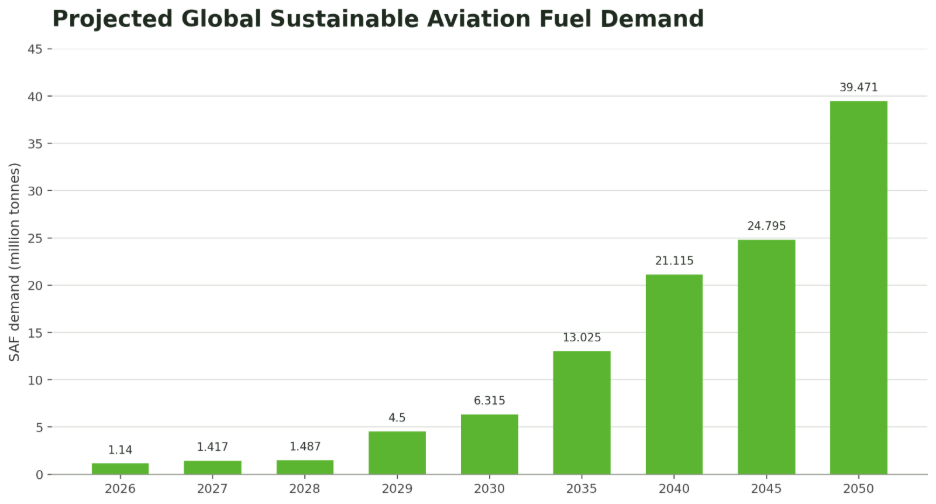
- Global sustainable aviation fuel (SAF) demand could approach 40 million tonnes by 2050, up from about 1.2 million tonnes in 2026, if announced mandates are implemented.
- HEFA is the most commercially mature and scalable SAF pathway, but limited waste-oil supply means the industry must expand into alternative bio-oils and energy crops.
- Ethanol-to-jet is the next pathway to prioritize where regulations permit suitable feedstocks, especially in markets with established ethanol supply chains.
- Bio-SAF offers a more practical near- and medium-term route than e-SAF because green hydrogen keeps CO₂-to-jet and e-methanol-to-jet costs high.
- The industry should concentrate on scaling and optimizing existing conversion platforms rather than pursuing entirely new production routes.
SAF demand is rising faster than production
Sustainable aviation fuel has moved from a voluntary decarbonization option to a policy-driven requirement. The EU and U.K. introduced active blending mandates in 2025, while countries across Asia are considering targets or mandates before 2030. These policies are creating a demand curve that today’s production base is not prepared to meet.
Lux Research projects that worldwide SAF demand could rise from 1.14 million tonnes in 2026 to 6.3 million tonnes in 2030 and nearly 39.5 million tonnes by 2050, assuming planned mandates take effect. Yet global production reached only about 1.9 million tonnes in 2025. Closing the gap will require both additional capacity and a broader mix of feedstocks and conversion technologies.
What makes an SAF pathway commercially viable?
No single production pathway currently meets every requirement for an ideal SAF technology. Lux Research evaluates pathways against four factors:
- Abundant feedstock: The input must be available at the scale required by a commodity fuel market.
- Sustainable feedstock: The pathway must deliver genuinely low-carbon fuel and comply with regional eligibility rules.
- Scalable technology: Conversion systems must progress beyond pilots and demonstrations toward large, reliable facilities.
- Experienced developers: Multibillion-euro projects require credible licensors, project developers, financing, and operational expertise.
These criteria reveal a recurring tradeoff. Mature pathways often face feedstock constraints, while pathways with more abundant inputs remain technologically immature or uneconomical.
Five SAF production pathways to watch
1. Bio-oil to SAF: Commercially ready, feedstock constrained
Hydroprocessed esters and fatty acids (HEFA) is the only pathway producing SAF at meaningful commercial scale today. It converts vegetable oils, used cooking oil, animal fats, and other bio-oils through processes similar to conventional refining. The technology is ASTM-approved, scalable, and supported by experienced providers such as Honeywell, Axens, Exxon, and Neste.
Its weakness is feedstock availability. EU and U.K. rules exclude food-crop oils, increasing dependence on used cooking oil and animal fats. These supplies are limited, geographically dispersed, and increasingly contested. The industry therefore needs new HEFA-compatible sources, including nonfood energy crops such as camelina and fermentation-derived bio-oils. Cemvita and the Bayer–BP NewGold partnership illustrate two approaches to expanding the pool of eligible bio-oils.
2. Biomass to SAF: Abundant inputs, unresolved scale-up risk
Forestry residues, agricultural waste, and other forms of cellulosic biomass are abundant and potentially low carbon. Two routes can convert them into SAF: gasification followed by Fischer–Tropsch synthesis, and biomass liquefaction or pyrolysis followed by upgrading.
Neither route is commercially established for SAF. Gasification faces tar formation, syngas contamination, catalyst deactivation, and costly maintenance. Pyrolysis oil contains substantial oxygen and water, increasing hydrogen demand during upgrading, and the route still lacks an approved ASTM pathway. Developers such as Haffner Energy are working to reduce tar through staged thermochemical processing, but large-scale fuel production is unlikely before the next decade.
3. Ethanol to SAF: A strong option where regulations allow
Ethanol-to-jet (ETJ) converts ethanol into ethylene, oligomerizes it into longer-chain hydrocarbons, and hydrogenates the product into jet fuel. The route was ASTM-approved in 2016 and benefits from experienced licensors including Honeywell, Axens, and Praj Industries.
Its outlook depends heavily on regulation. First-generation ethanol from corn, sugarcane, or beets is widely available, but it is not eligible under EU and U.K. SAF rules. Second-generation ethanol from cellulosic biomass is eligible but remains limited and expensive. In markets that permit first-generation ethanol, ETJ could become one of the lowest-cost and most scalable alternatives to HEFA. Brazilian sugarcane ethanol is particularly attractive because of its lower carbon intensity relative to U.S. corn ethanol.
4. Methanol to SAF: Promising for mandated e-SAF
Methanol-to-jet (MTJ) received ASTM approval in 2026. It can use biomethanol derived from biomass or biogas, or e-methanol produced from captured CO₂ and green hydrogen. Major technology companies, including Topsoe, Exxon, and Honeywell, are active, which should help the route mature faster than many startup-led alternatives.
However, biomethanol supply is fragmented and e-methanol remains scarce and costly. Startups such as Metafuels are developing higher-selectivity catalyst systems, but must prove differentiation and commercial-scale economics against established licensors. Where e-SAF is required, Lux Research favors MTJ over CO₂-to-SAF via Fischer–Tropsch because its projected production cost is lower.
5. CO₂ to SAF: Abundant theoretical feedstock, difficult economics
CO₂-to-SAF pathways combine captured or biogenic CO₂ with green hydrogen. Conventional designs first produce syngas through reverse water-gas shift and then convert it through Fischer–Tropsch synthesis. Emerging companies are attempting to simplify this chain: OXCCU combines the two reactions in one catalyst system, while Twelve uses CO₂ electrolysis to produce syngas directly from CO₂, water, and renewable electricity.
The central challenge is scale and cost. Modular Fischer–Tropsch systems, catalysts, and electrolyzers must demonstrate durability and efficiency in commercial operation. More importantly, green hydrogen remains expensive. Even with an optimistic hydrogen cost of €5 per kilogram, Lux Research estimates that e-SAF can cost roughly €4,000 per tonne, or five to six times more than typical fossil jet fuel.
SAF economics favor bio-based pathways
Cost will ultimately determine which technologies secure financing and reach scale. In Lux Research’s best-case model, all SAF pathways remain more expensive than fossil jet fuel, even when modeled at a fully optimized capacity of one million tonnes per year. Bio-oil-to-jet and first-generation ethanol-to-jet sit closest to fossil fuel economics, while biomass and second-generation ethanol carry higher feedstock or conversion costs.
The cost gap widens substantially for e-SAF. Electricity and green-hydrogen costs dominate the economics of both CO₂-to-jet and e-methanol-to-jet. This makes mandates, incentives, offtake agreements, and other financing mechanisms essential. It also explains why many announced e-SAF projects have not reached final investment decisions.
Three priorities for scaling sustainable aviation fuel
1. Expand HEFA beyond waste oils
HEFA offers the fastest route to additional near-term volume, but developers need long-term access to feedstock. Companies should secure waste-oil supplies early while also evaluating energy crops, fermentation-derived oils, and other alternatives that can run through existing HEFA assets.
2. Scale ethanol-to-jet where feedstock rules permit
ETJ combines credible technology providers with existing ethanol infrastructure. It is especially relevant in the U.S. and Asian markets that may permit first-generation ethanol. In the EU and U.K., progress will depend on scaling second-generation ethanol or revisiting feedstock eligibility.
3. Choose MTJ over Fischer–Tropsch when e-SAF is required
E-SAF should be prioritized only where mandates require it. In those cases, MTJ offers a more attractive cost outlook than direct CO₂-to-SAF via Fischer–Tropsch. Project developers should focus on securing affordable low-carbon methanol and green hydrogen while validating commercial performance.
Can the industry meet future SAF mandates?
The answer differs by milestone and region. Lux Research expects the industry to have a reasonable chance of meeting 2030 demand, primarily through HEFA capacity and available waste oils. Beyond 2030, the outlook becomes more difficult. The EU’s 2035 target is unlikely to be met through HEFA alone because eligible waste-oil supply is insufficient, second-generation ethanol remains immature, and e-SAF remains expensive.
Regional strategy will therefore matter. In the U.S., HEFA and ETJ can leverage waste oils and established corn-ethanol infrastructure. In the EU, HEFA remains the first priority, followed by MTJ using imported lower-cost methanol. In Asia, the strongest portfolio may combine HEFA, ETJ in ethanol-rich markets, and biomass-to-jet where agricultural, forestry, or municipal waste is abundant.
Frequently asked questions about sustainable aviation fuel
Which SAF pathway is most commercially mature?
HEFA, or bio-oil-to-SAF, is the most mature and scalable pathway. It accounts for essentially all commercial SAF production today, but its growth is constrained by limited eligible waste oils.
What is the best alternative to HEFA?
Ethanol-to-jet is the leading alternative in regions that allow first-generation ethanol and have established ethanol supply chains. In markets that restrict those feedstocks, its growth depends on the maturation of second-generation ethanol.
Where should SAF developers focus investment?
Near-term investment should maximize HEFA using diversified feedstocks, scale ETJ in supportive markets, improve existing biomass conversion platforms, and reserve e-SAF investment for mandates or applications that specifically require it.
The path forward for SAF
Sustainable aviation fuel can supply a growing share of aviation demand, but no single pathway will close the gap. The most credible strategy is a portfolio approach: expand mature HEFA capacity with new bio-oils, scale ETJ where eligible ethanol is abundant, improve biomass conversion technologies, and selectively deploy MTJ where e-SAF obligations apply. Success will depend less on discovering a wholly new pathway than on resolving feedstock supply, proving commercial scale, and reducing cost across the technologies already in view.
Turn SAF uncertainty into an actionable innovation strategy
As SAF demand accelerates, not every production pathway will be equally viable. Download Can Sustainable Aviation Fuel Meet Future Demand? to see where the strongest opportunities and biggest challenges lie.