Lux Suggested Expert Broadcasts
As a valued Lux strategic partner with an Advisory- or Executive Partner-level membership, you have access to an exclusive benefit: Lux Expert Broadcasts. These live broadcasts with Lux experts are designed to engage your team or, more broadly, other teams across your organization—similar to the analyst inquiries you love, but built for group learning and collaboration.
Because of your status as a strategic partner, you receive this additional privilege, which is not extended to all Lux clients. Lux Expert Broadcasts are invaluable live events that foster ideation, feedback, and collaboration with your peers and Lux experts.
These broadcasts are designed to educate and inspire curiosity and creativity on topics relevant to your business. Please work with your Client Experience Manager to build your team’s broadcast series based on our suggested menu, which covers a wide range of industries and trends.
Are Critical Minerals Fueling or Failing the Future of Green Hydrogen?
As countries advance toward decarbonization, low-carbon hydrogen has emerged as a pillar of the global energy transition. But there’s a hidden challenge looming beneath the surface — access to critical minerals. As governments deglobalize and onshore manufacturing and raw materials supply chains, innovation in the hydrogen economy could hit serious roadblocks.
In this webinar, we explore how Lux’s Raw Materials Criticality Framework empowers stakeholders across the hydrogen value chain to anticipate material bottlenecks, prioritize resilient technologies, and evaluate new strategies.
What you’ll discover:
- How critical minerals and materials supply impacts green hydrogen deployment
- Innovation strategies to build supply chain resilience for electrolyzer manufacturing
- Potential winners and losers in the future of green hydrogen
AI in 2026: Predictions on the Future of Models, Investments, and Impact
What does 2026 hold for AI? Will next year usher in superintelligence, or bring the bursting of the AI bubble?
This webinar unpacks the big questions surrounding AI and makes predictions about what the next year holds for model development, investment in AI and data centers, and business adoption.
Aligning R&D with What Consumers Will Care About Tomorrow
The future doesn’t arrive with fanfare. It whispers. The innovators that win are those who catch these early signals of cultural change before they become trends.
In this webinar, you’ll learn how to spot those signals hidden in conversations, subtle shifts in values, and emerging questions. We show how anthropology adds context, revealing the deeper motivations that fuel lasting change, and why timing is everything when transforming sparks into breakthrough innovations.
For R&D and insights leaders, this approach uncovers unmet needs, guides smarter product development, and reduces risk by aligning innovation with real cultural momentum. We also highlight the role of foresight in building resilient pipelines, so you’re not reacting to the future, but shaping it.
Join us to see how Lux’s Consumer Insights empowers you to anticipate shifts, seize opportunities ahead of competitors, and unlock growth — not by moving faster, but by seeing further.
Carbon Credits: Currency of the Next Decade?
The demand for durable and verifiable CO₂ removal (CDR) is growing, and the global voluntary carbon market sold approximately 13 Mtonne of credits sourced from technologies beyond nature-based solutions. These include direct air capture, bioenergy with carbon capture and storage, biochar, enhanced rock weathering, biogenic CO₂ storage, and others. As the demand for carbon credits continues to grow, companies face increasing exposure to poor durability and verification.
In this webinar, we:
- Use Lux’s Carbon Negative Framework to assess cost and risk trends in CDR technologies over the last three years
- Explore key factors that determine project successes and shortfalls
- Provide an outlook for CDR and recommendations on how companies should engage with the CDR market, and identify which technologies will provide reliable credits
Emission or Asset? Identifying Winning CO2 Utilization Pathways
Among the innovation priorities Lux has identified across energy and chemicals companies, two clear trends stand out: decarbonization and defossilization. While enthusiasm for taking big bets on new low-carbon products has waned, a push to find real business opportunities and make money from the energy transition remains a clear focus for innovation teams.
This webinar explores how companies can leverage CO2 as a raw material to produce fuels, chemicals, and materials — unlocking a pathway to carbon circularity while reducing dependency on fossil-based carbon. We discuss which CO2-derived products are gaining traction, what technologies are commercially viable, and how to identify the most strategic entry points based on product-market fit rather than pathway novelty. You can expect to learn:
How to choose the right CO2-derived product to enter the market, based on strategic alignment and maturity, not just the conversion pathway.
Which technologies are commercializing fastest (from concrete to e-methanol to formic acid) and what makes their scale-up stories successful — or stalled.
Where innovation is heading next, including the return of synthetic biology, platform electrolysis technologies, and intermediates like acetates and C3+ chemicals.
How to Leverage Innovation Clusters: Turning Ideas into Impact
Decades into the era of “”open innovation,”” companies have tested a wide range of structures and strategies to maximize returns and outcomes in selecting, forming, and growing effective partnerships — with mixed results. In today’s era of lean innovation, when budgets are cut but expectations aren’t, innovation clusters can be a powerful tool to advance innovation initiatives.
This webinar draws on the experience of incubators, accelerators, and other innovation clusters to highlight best practices for selecting startup partners that will drive growth, avoid pitfalls, and navigate a shifting and complex opportunity and innovation landscape.
How to Prioritize Packaging Innovations for Long-Term Viability and Growth
Packaging innovation is underway. Global regulations, demand for safer formulations, and shifting market dynamics create opportunities for stakeholders across the packaging value chain to develop solutions to current problematic items used by the industry. Despite significant innovation activity and investment, commercialization has been slower than expected. Technical innovation is not enough to achieve market implementation; fit-for-purpose alternatives are needed, and successful adoption requires holistic evaluation across the entire value chain, from materials and processing to market needs and end-of-life infrastructures.
In this webinar, Lux unfolds the criteria for differentiating high-potential opportunities from those that are misaligned or low impact. It presents a framework for prioritizing emerging solutions and highlight strategic approaches companies can adopt to develop packaging solutions that are profitable, resilient, and future oriented.
Identifying Future Platform Materials to Drive Industrial Innovation
The development of new materials has long defined innovation in the chemicals and materials industries. Yet, with countless formulation pathways, it has become increasingly difficult to direct R&D toward materials that are both technically promising and commercially viable. Breakthroughs in materials science often stall at the edge of adoption — not due to lack of performance, but because of market timing and application fit. The challenge is twofold: identifying platform materials with transformative potential early and actively scouting for the market conditions and applications that will enable their success.
This webinar introduces Lux’s top 10 future platform materials — those poised to address critical industry challenges and unlock new value across sectors.
Innovation for Materials Security in Volatile Times
Materials security has become a critical concern as supply chains grow increasingly fragile. With geopolitical tensions, export restrictions, and rising demand tightening access to key inputs, companies face growing risks to business continuity and operational resilience. In this environment, it is no longer sufficient to know what materials are required — companies must also understand how to secure them reliably or replace them entirely. This challenge calls for a forward-looking strategy that integrates innovation across both materials development and manufacturing practices.
This webinar draws on Lux’s Raw Materials Criticality Framework to outline four innovation strategies that help mitigate supply risk and strengthen resource security.
Navigating PFAS Restrictions, Alternatives, and Remediation Technologies
Companies must act now to assess PFAS use, map regulatory risk across their portfolios, and prioritize substitution in high-risk applications and regions. The transition is highly disruptive but creates a window for proactive compliance and innovation. This webinar will highlight alternative materials for common PFAS applications and remediation solutions necessary to address previous PFAS use.
Clients who attend this webinar will gain insights on:
- The global policy landscape for restrictions on PFAS use
- Material innovations to replace PFAS in applications like water-repellent coatings, heat transfer fluids, and lubricants
- Emerging remediation technologies to detect, separate, and destroy PFAS at contaminated sites and manage liability in manufacturing operations
Opportunities to Decarbonize Offshore Platforms: Reality vs. Rhetoric
Oil and gas companies face increasing pressure to decarbonize power systems on offshore platforms. As the costs of emerging technologies fall, offshore microgrids could soon deliver lower costs and better performance than the simple-cycle natural gas turbines commonly used today. However, decarbonization is only one factor shaping platform electrification decisions. Space and weight limitations, reliability requirements, distance from shore, fuel logistics, product characteristics, and asset lifespan all influence which solutions are feasible—and which remain impractical despite growing interest.
In this webinar, we present Lux’s latest analysis on the performance and economics of alternatives to conventional offshore gas turbines. We explore retrofit strategies that incorporate fuel blending or shore power and examine novel technologies such as wave energy currently under consideration.
Re-Evaluating Regenerative Agriculture: Where Innovation Can Deliver Resilience and Value
Clients across industries that touch agriculture, including energy, chemicals, manufacturing, agrifood, and CPG, have turned to regenerative agriculture to reduce emissions, improve on-farm livelihood, and build resilience in supply chains. However, regenerative agriculture by and large remains a concept, not an industry-validated system like USDA Organic. After a wave of lofty corporate commitments to reduce scope 3 emissions with regenerative practices and businesses developed to create new sources of revenue generation for agriculture, we need to take stock of successes and failures arising from innovation. This is particularly important as agriculture will continue to face unpredictable environmental impacts and companies across the agrifood value chain balance rising costs and limited consumer willingness to pay for poorly evaluated and diverse regenerative certifications. It is important that we reevaluate regenerative agriculture or its associated practices and the role of innovation in expanding their use.
In this webinar, Lux presents the state of regenerative agriculture initiatives across industries, highlights where practical implementation challenges lie, and identifies innovation models that are helping to scale the practices that create value — and where you should expect difficulties in creating value. This presentation is for all those looking for actionable models to scale regenerative outcomes while generating value.
The Future of Carbon: Building Resilience in a Defossilized World
Over the next two decades, industries will undergo significant transformation as the world electrifies, decarbonizes, and reorients supply chains toward local and waste inputs. In this new era, renewable carbon feedstocks like biomass, captured CO₂, and recycled plastics stand to become critical carbon sources. Yet the shift away from fossil-based carbon has been slow to date. Many companies hesitate, wary that scaling renewable routes too soon could leave them uncompetitive, especially without clear policy support or markets developed for more novel products. On the other hand, waiting too long risks missing near-term opportunities and ceding ground to competitors that move decisively. The central question is no longer if companies should invest in defossilized carbon pathways, but when and how.
This webinar provides a strategic framework for navigating these choices, helping companies balance risk and opportunity while positioning themselves for leadership in a defossilized future.
The Great EV Debate: Will Battery Swapping Replace Fast Charging?
EV adoption is no longer a question of if but of how fast. Yet, despite rapid progress, consumer pain points remain remarkably consistent: limited range, slow charging times, and high costs. Fast-charging technologies are racing ahead to address the first two challenges, with speeds approaching 350 kW per vehicle, but this progress introduces new challenges for grid operators already facing significant load growth.
In this webinar, Lux looks deeply into whether fast charging is the right technology to scale or if battery swapping can address all three consumer pain points. We examine the tipping points that could preview mass adoption of battery swapping. Our discussion covers strategies for managing the power demands of fast chargers, highlights key automaker projects and pilots to watch, and shares insights from our economic analysis on when — and where — battery swapping could reach a tipping point.
The Hidden Connections that Win Consumers in a Divided World
Consumer tastes are shifting faster than ever, and brands are caught in the tension between broad appeal and local nuance. A one-size-fits-all strategy doesn’t cut it, while overrelying on demographics can be just as misguided. Hershey’s misstep in China proves the point: The company assumed American-style chocolate would resonate, ignoring local tastes and gifting traditions. Meanwhile, Cadbury’s Unity Bar in India, meant to symbolize harmony, fell flat by oversimplifying deep cultural and caste divisions. The lesson? Success lies in understanding what truly resonates — not just on the surface but also deep within each market’s cultural fabric.
In this webinar, Research Director Alina Strugut and Senior Research Director Joshua Haslun show how belief-based segmentation uncovers surprising common ground across two seemingly opposing generations in three different geographies. By analyzing chocolate perceptions in the U.S., Germany, and China, we reveal how boomers and Gen Z — despite their differences — are drawn to products that align with shared emotional triggers yet differ by locality (e.g., self-care in the U.S., knowledge in Germany, social connection in China). We also explore how these distinctive beliefs can be positioned to align product positioning and innovation opportunities like functional ingredients or sustainable packaging.
The takeaway? Brands that blend global strategy with local relevance unlock new opportunities by aligning innovation with what truly matters to consumers. Understanding how beliefs shift across markets ensures R&D doesn’t just react to trends. It also fuels lasting impact worldwide.
The Lux Innovation Helix: Where Human Pull Meets Technological Push
Most innovation today starts with technology. Companies race to develop breakthroughs, but too often, those ideas never connect with what people actually want or need. The result? Solutions looking for a problem. Missed opportunities and products that don’t take off.
The Lux Innovation Helix changes that. It’s a unique approach that blends the consumer strand with the technology strand to help organizations design products, categories, and strategies that people are truly ready to embrace. The Helix works by decoding consumer needs first, and technological readiness second, to uncover what people truly want and match it with what science can realistically deliver. Where the two align, it reveals the strongest opportunities for growth: the moments where human pull meets technological push.
For executives, the Helix cuts through the noise and brings clarity on where to invest and when adoption will accelerate.
For R&D leaders, it reveals which technologies deserve priority and where to pivot before relevance fades.
For insights teams, it turns understanding into influence, transforming your research into strategic direction that shapes what actually gets built.
Join Lux Research to discover how to apply the Lux Innovation Helix to transform innovation from a game of chance into a science of certainty. Learn how to align your capabilities with real consumer needs and desires to power the next wave of market-defining growth.
The New Affordability Mindset
Recent reported shifts suggest consumers remain willing to spend, but are increasingly price sensitive and value conscious. There was record Black Friday online spending and higher than expected sales in categories like electronics and apparel, with both discount and luxury retailers benefiting. Yet, shoppers are purchasing fewer items overall as prices rise, and they’re becoming more selective about what they buy. This raises a key question: How are consumers redefining “affordability” as they balance financial constraints with the desire to maintain their quality of life and access meaningful, premium moments?
This webinar explores cultural negotiation about what counts as “”affordable”” today and what people see as truly worth buying when every dollar matters. Our methodology looks beyond economic statistics to reveal the underlying beliefs and motivations that shape how consumers experience economic strain and make spending decisions.
What we find is that when money feels tight and the future is uncertain, people don’t just cut their spending. Instead, they become more intentional, prioritizing products that help them preserve routines, wellbeing, and a sense of normalcy. This trend drives demand for premium-affordable products that deliver elevated quality while still aligning with tighter budget expectations.
In this webinar, we unpack these shifting behaviors and expectations — and explore what it takes to win and retain customers in today’s turbulent times.
The Next Era of Agrifood & Health Innovation
Agrifood and its associated health industries are undergoing a pivotal transformation. Innovation priorities are shifting fast as regional politics, climate disruption, evolving consumer demands, and resource constraints push companies to make smarter, more strategic decisions — especially as many technologies reach the end of their first innovation cycles.
The era of following hype is over. The question is no longer whether to innovate but how to place the right bets. Success depends on recognizing not just emerging technologies but new pathways for existing ones to unlock growth. Precision fermentation, smart packaging, biosensing, and precision agriculture each offer potential, but real impact requires a fundamental shift in how organizations prioritize innovation.
Lux’s analysis shows that enhanced health and reduced harm now lead as the strongest growth drivers, as the once-vague goal of sustainability evolves into clear targets: resilience, bioeconomy-driven growth, and effective packaging. At the same time, companies must do more with less, making purposeful innovation more critical than ever.
In this webinar, we share our latest research on agrifood and health innovation, examining how regional risks, regulatory shifts, and emerging technologies are reshaping strategy. You’ll gain insights into the themes that will define innovation success in 2026 and beyond and learn where your organization must lead, not follow.
The Next Era of Chemicals Innovation
Geopolitical tensions, slower global growth, and price pressures from overcapacity are pushing the chemicals industry into a period of profound uncertainty. This moment represents a potential inflection point: Organizations advancing with a clear innovation agenda are positioned to emerge as leaders, while others risk falling behind as they adopt a defensive stance.
In this webinar, Lux analyzes the annual reports of the world’s 80 largest chemicals companies to identify how innovation priorities are shifting. Drawing on proprietary data and interviews, we provide a clear view into the strategies and technologies shaping the global chemicals innovation landscape.
This webinar:
- Highlights industry-wide shifts. Review innovation initiatives across leading chemicals companies to show how organizations are responding to industry headwinds.
- Reveals technology trajectories. Identifies rising, declining, and emerging technologies and examine the strategic questions shaping corporate innovation efforts.
- Provides strategic guidance. Introduces frameworks that enable innovation leaders to position their organizations to capture opportunities in the next era of chemicals innovation.
The Next Era of Industrials Innovation
Regulatory uncertainties, contentious trade policies, and high interest rates are placing financial stress on the industrials sector, dampening project pipelines worldwide. Yet, despite the turbulence, leading organizations continue to advance their innovation agendas, capitalizing on reshoring initiatives in raw materials and manufacturing and positioning themselves for long-term differentiation.
In this webinar, Lux analyzes the annual reports of the world’s 70 largest industrials companies to uncover how innovation priorities are evolving in this challenging environment. Drawing on proprietary data and interviews, we provide a clear view into the strategies and technologies shaping the global industrials innovation landscape.
This webinar:
- Highlights industry-wide shifts. Review innovation initiatives across leading industrials companies, showing how organizations are leveraging sector tailwinds while mitigating emerging risks.
- Reveals technology trajectories. Identify rising, declining, and emerging technologies and examine the strategic questions shaping corporate innovation efforts.
- Provides strategic guidance. Introduce frameworks that enable innovation leaders to position their organizations to capture opportunities in the next era of industrials innovation.
The Next Era of Medical Devices and Diagnostics Innovation
Medical devices and diagnostics are entering a pivotal new era as health systems confront workforce shortages, rising chronic disease burdens, and cost pressures. Innovation priorities are shifting from hospital-centric, reactive care toward distributed, preventive, and personalized models. What was once a collection of specialized tools and fragmented systems is rapidly transforming into a connected, intelligence-driven ecosystem — one that integrates data, precision, and patient experience to redefine healthcare delivery.
The question is no longer whether to adopt new technologies, but how to scale them responsibly and align them with measurable impact. Success hinges on identifying not only emerging technologies, which are currently driving industry growth and will continue to drive growth, but also the new pathways through which AI-enabled imaging, noninvasive diagnostics, point-of-care connectivity, and automation can create tangible clinical and operational value.
Lux’s analysis shows that precision health technologies, accessibility, and regulatory agility now lead as the strongest growth drivers, while traditional silos between medical devices, life sciences, and healthcare delivery continue to dissolve. The next wave of progress will depend on integrating sensing, analytics, automation, and therapeutic delivery into unified platforms that elevate both performance and patient outcomes.
In this webinar, Lux presents its latest research on innovation in medical devices and diagnostics, highlighting how emerging technologies centered on personalization and decentralization are transforming industry strategies. You’ll gain insights into the themes that will define innovation success in 2026 and beyond and learn where your organization must lead, not follow.
The Next Era of Oil and Gas Innovation
Innovation priorities are fluid, and in the last year, there’s been a noticeable shift in the priorities of oil and gas companies. In the early 2020s, sustainability emerged as the driving force behind corporate innovation initiatives in response to a surge of public interest, shareholder pressure, and emissions regulations. Compared to its zenith just a few years ago, enthusiasm for sustainability has waned considerably, and many innovation teams are wondering “What’s next?”
In this webinar, we share our recent analysis of innovation priorities within the oil and gas industry, focusing on how regional context, regulatory pressure, and grid modernization challenges are reshaping agendas and offer our perspective on what innovation themes will define 2026 and beyond.
The Next Era of Utilities Innovation
The energy system is changing rapidly, and utilities are at the heart of this change. More intermittent variable renewables are being added to the grid, and regions with high renewables adoption are already experiencing reliability and stability challenges. At the same time, electricity demand is beginning to outpace economic growth, as existing energy consumers like transportation and buildings electrify and new loads like data centers emerge. Utilities clearly need to innovate, but what among the many opportunities should be pursued?
In this webinar, we share our recent analysis of innovation priorities within the utilities sector, focusing on how regional context, regulatory pressure, and grid modernization challenges are reshaping agendas and offer our perspective on what innovation themes will define 2026 and beyond.
Unlocking Functional Performance through Materials Innovation
Breakthrough materials often promise transformational capabilities, but they are often developed without a clear view of the consumers they are intended to serve. Meanwhile, consumer expectations around functionality continue to evolve, placing new demands on product performance. To close this gap, companies must align materials innovation with emerging consumer needs — anticipating where current materials fall short and identifying which technologies can deliver meaningful differentiation. This demands a clear grasp of both technical feasibility and consumer readiness — what they will adopt and when.
This webinar combines Lux’s consumers insights and technology expertise to spotlight high-potential materials innovations that respond directly to evolving consumer needs.
What Drives Consumer Trust: Fostering Authentic Consumer Connections
Consumer skepticism is at an all-time high. As trust in institutions, media, and brands declines, consumers no longer accept corporate claims at face value. Instead, they scrutinize messaging, question motives, and demand proof of authenticity before engaging with a brand. In this landscape, aligning with consumers’ beliefs is a necessity.
Recent missteps highlight the risks of misunderstanding consumer expectations. Google’s Gemini showcase eroded trust by failing to reinforce confidence in the company’s commitment to surfacing the best information. And Bumble’s users saw its ad campaign attacking celibacy as a betrayal of the platform’s promise to empower women. Both brands miscalculated because they relied on traditional demographic segmentation rather than recognizing the belief systems that create meaningful consumer connections.
This webinar explores how brands win or lose consumer trust — whether through their handling of price increases, their corporate responsibility efforts, or their engagement with niche communities like gamers. Through real-world case studies, Analyst Elena Gorachinova and Product Manager Derek Gingrich demonstrate how addressing consumer beliefs directly, rather than simply signaling demographic alignment, builds credibility and prevents missteps that come across as insincere. By understanding the deeper motivations behind consumer trust, brands can avoid the pitfalls of virtue signaling and foster genuine connections.
We also discuss the challenges and opportunities of engaging belief-driven consumers — helping brands navigate how to build trust without overstepping, alienating audiences, or falling into the trap of performative branding.
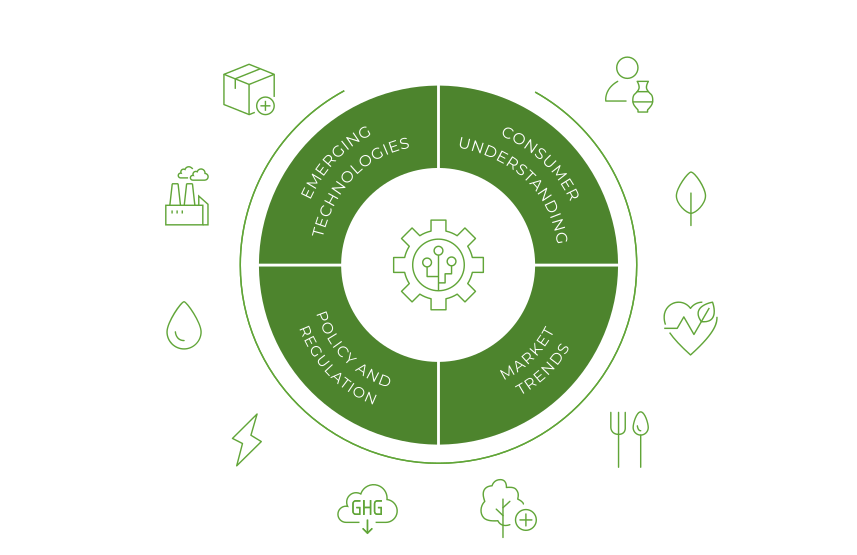
our unique know-how
What makes Lux special is our ability to link insights across industries, scientific domains, and cultures to give you a complete interdisciplinary and cross-industry perspective.